
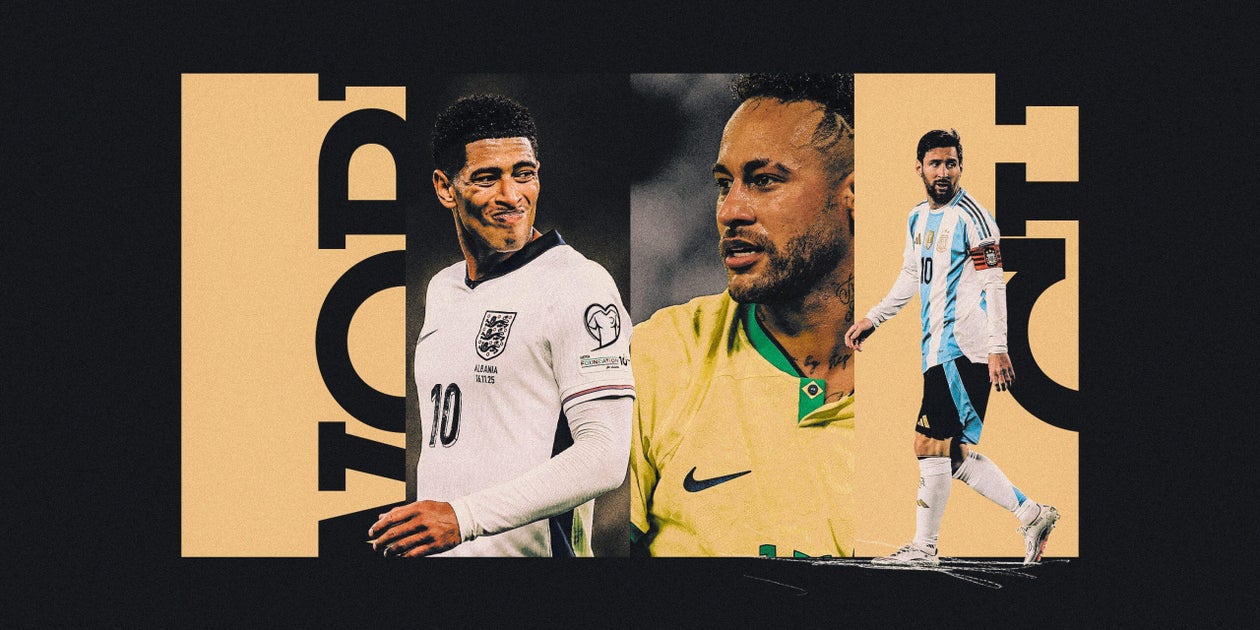
Welcome to the final mid-season international window of 2025-26, the last chance for managers to work with players before naming their World Cup squads.
Over the next 10 days, we will find out the identity of the final six of the record 48 qualifiers, with 22 nations still in contention via two play-off routes, one in Europe and the other playing out a rest-of-the-world mini-tournament in Mexico.
So there are plenty of key decisions to make, while lots of players need to make a good impression now or risk missing out on the tournament altogether.
We asked 20 of our writers to answer the key questions that will be addressed this month. You can use the tabs to scroll to the areas that interest you the most: European play-offs, inter-confederation play-offs, players, around the world (featuring key issues facing assorted managers), USMNT, England, Canada and how ready the co-hosts are off the pitch.
Let’s start with perhaps the biggest question of all…
The Athletic has launched a World Cup WhatsApp Channel. Click here to join.
European play-offs
Will Italy miss out on a third World Cup in a row?
The full draw for the European play-offs (Getty Images)
They shouldn’t. Italy play Northern Ireland, then the winners of Wales vs Bosnia and Herzegovina. This is not like 2022, for instance, when Portugal awaited Italy in their section’s play-off final and pessimism already prevailed as they prepared for what proved a surprise home loss to North Macedonia in the semi-finals.
Italy’s greatest opponent is their own fear. If they fail to make it again, the same broader questions about the state of the game in the country will be asked, as was the case after group-stage exits from the World Cups of 2010 and 2014 and their first absence from the tournament in decades eight years ago. Ultimately, Thursday’s play-off in Bergamo is about leaving psychological baggage behind and playing to potential.
James Horncastle
Can war-torn Ukraine make it to the World Cup?
Ukraine will not fear either their semi-final opponents Sweden or potential final rivals Poland and Albania.
Serhiy Rebrov’s squad features a mixture of young talent and experienced heads — with both Brentford midfielder Yegor Yarmolyuk and veteran Genoa playmaker Ruslan Malinovskyi playing key roles in qualifying.
Aiming for their first World Cup since 2006, Rebrov’s team also have a country behind them. Ukraine Football Association staff in Kyiv provide daily help to victims of Russia’s continuing attacks, a situation which means their ‘home’ semi-final on Thursday is being played in Valencia, Spain.
FIFA president Gianni Infantino suggesting recently that Russia could soon return to international competition may also provide Ukraine with extra motivation this month.
Dermot Corrigan
Will Denmark qualify and add another political dimension?
Stoppage-time goals in the dying seconds of the qualification group from Scotland’s Kieran Tierney and Kenny McLean — the latter from the halfway line — have left Denmark with an uphill task.
Overcome North Macedonia — third behind Belgium and Wales in their qualifying group — at home and it’s either the Czech Republic or the Republic of Ireland away on Tuesday.
The prize if they were to contest that fixture? A World Cup being co-hosted by a nation that has threatened to take Greenland — a self-governing territory within Denmark — by force, before President Donald Trump dialled down the rhetoric.
Trump wants the “big piece of ice”, as he puts it, for U.S. security, saying he’ll get it “one way or the other” eventually. U.S. aggression has brought Denmark closer to another NATO ally, Canada.
Fortunately for the Danes — who will face another of the co-hosts, Mexico, as well as South Korea and South Africa if they make it — American hospitality would only be needed for one group game, in Atlanta, with the other two on Mexican soil. There’s a long way to go before that, though.
Adam Leventhal
Can Wales reach back-to-back World Cups for the first time?
It’s a big ask. First things first, they need to navigate a way past Bosnia and Herzegovina, who have the evergreen Edin Dzeko, fresh off turning 40 last week, still leading the line. If Wales can win that, they’ll face Italy or Northern Ireland five days later for a place at the finals.
The good news is both games would be on home soil in Cardiff and also, crucially, Harry Wilson is fit. Wilson is having an outstanding season for Fulham — contributing 10 goals and six assists in the Premier League — and has emerged as Wales’ post-Gareth Bale talisman over the past few years. The bad news is that Ben Davies, their captain, is missing through injury, as are striker Kieffer Moore and fellow defender Chris Mepham.
Advertisement
When Wales qualified for the previous World Cup, it was the first time they had played in it since 1958. Unfortunately, they did not do themselves justice, losing twice and only scoring one goal — a penalty. The motivation to reach another World Cup will be huge.
Brace yourselves for a special atmosphere, or two, at the Cardiff City Stadium.
Stuart James
Can the Republic of Ireland continue their qualifying momentum?
Troy Parrott’s hat-trick against Hungary in Budapest will live long in the memory for a nation seeking their fourth World Cup finals but first since 2002, when Roy Keane stomped home from their pre-tournament camp and the team still managed to reach the knockout stages (a story so dramatic it has recently been turned into a movie).
Parrott’s goals secured second place in their group ahead of the Hungarians, teeing up a tough play-off semi-final in the Czech Republic. Win that, and it will be a home final against Denmark or North Macedonia, for which Dublin’s Aviva Stadium will be rammed and, just like it did 24 years ago in Japan and South Korea, “You’ll never beat the Irish” will ring out.
Theirs is a squad light in quality — there is nobody to compare with the volatile Keane, but then, who could? Compensation comes in other areas. Could be fun.
George Caulkin
Were Sweden right to give Graham Potter a four-year contract?
It was anticipated that Potter would only be in charge for these play-offs and — it was hoped — the World Cup itself.
The subsequent decision to already commit to a four-year deal reflects several things.
First, that Potter is enjoying being back in Sweden, where he made his name managing club side Ostersund.
Second, that Sweden are relatively short of homegrown options, and after the disastrous tenure of Danish predecessor Jon Dahl Tomasson (they didn’t win a single World Cup qualifier and are in the play-offs courtesy of results in the third tier of the 2024-25 Nations League), consider the Englishman an adopted Swede.
Third, that Sweden have such terrible injury problems, with key men Alexander Isak and Dejan Kulusevski having been sidelined for several months, and the likes of Lucas Bergvall, Yasin Ayari, Emil Holm and Emil Krafth all out of action recently, that this coming week’s results probably aren’t the best barometer of progress.
Michael Cox
Inter-confederation play-offs
The full draw for the inter-continental play-off (Getty Images)
Will New Caledonia become the smallest nation to qualify for a World Cup?
Honestly? It’s vanishingly unlikely. New Caledonia, for anyone catching up, is a tiny group of islands in the Pacific, between Australia and Fiji. Technically, it is part of France. Its population is just north of 250,000. Even in the category of sporting long shots, we’re in magical realism territory here. Jamaica are imposing semi-final opponents. Even if they manage to win that, DR Congo will still stand in their way next Tuesday. New Caledonia’s journey to this stage through Oceania qualifying has been remarkable in every possible sense, but it would take a compound miracle for them to reach the World Cup.
Jack Lang
Can Suriname reach the World Cup for the first time?
They can, but it will take two huge performances. Narrowly missing out to Panama for automatic Concacaf qualification has led Suriname to the intercontinental play-offs in Mexico, where they face Bolivia on Thursday. Win that, and it will be a final against Iraq four days later for a place at the World Cup.
Both Bolivia (76th) and Iraq (58th) are comfortably higher than Suriname (122nd) in the FIFA rankings, and they will have to recover from the disappointment of falling short in November’s final round of the Concacaf qualifiers, which led to Stanley Menzo resigning as head coach. Henk ten Cate, the former Ajax manager, is now carrying the hopes of a small South American nation that knows it is now or never if their team are to join France, Norway and Senegal in Group I of the tournament.
Phil Buckingham
Advertisement
Are DR Congo and Iraq the most likely qualifiers then?
That is the expectation, given what the two have achieved so far in qualification.
DR Congo were particularly impressive when squeezing past Cameroon 1-0 and then Nigeria in a similar play-off format to cap the African qualifiers in November, with a penalty-shootout win in the latter game showing the mettle of a squad that includes regulars from the Premier League, La Liga in Spain and France’s Ligue 1. Their opponents in the final, you expect, will be an unconvincing Jamaica, if they manage to get past minnows New Caledonia.
Iraq will be the obvious pick on the other path. They are its seeded team and, having overcome travel difficulties in reaching Mexico from the Middle East, will know they might never get a better chance of reaching a first World Cup since 1986. It will only be Bolivia or Suriname that stand in their way and, like DR Congo, they ought to have the fresher legs going into next Tuesday’s final.
Phil Buckingham
Players
Is this the end of Neymar’s World Cup hopes?
Neymar last played for Brazil in October 2023 (Pedro Vilela/Getty Images)
Not necessarily. The 34-year-old forward is not in Brazil’s squad for friendlies in the United States over the next week against France and Croatia, but the door remains ajar. The consensus view is that he still has what it takes to contribute in big matches, even if it’s just with one or two moments of individual brilliance. Brazil coach Carlo Ancelotti has repeatedly said he will be considered for selection if he is 100 per cent fit. That, of course, is easier said than done; Neymar’s recent injury record is sketchier than your average art class. So… still possible? Yes, but the clock is ticking.
Jack Lang
Can Portugal win without Cristiano Ronaldo?
The question of whether Ronaldo will lead Portugal’s attack at this World Cup appears to be unequivocal, with his main rival for a starting berth up front, Goncalo Ramos, still not starting (or scoring) regularly enough for Paris Saint-Germain.
Advertisement
But with the 41-year-old missing this month’s internationals due to injury, we will get a chance to see how his nation can cope without him.
When Ronaldo has been absent in recent years, Portugal have recorded some huge victories (9-1 against Armenia, 9-0 versus Luxembourg, and that 6-1 demolition of Switzerland in the last 16 of the 2022 World Cup), but away matches this week against 2026 co-hosts the United States and Mexico will surely be sterner tests.
Tim Spiers
Is Kylian Mbappe going to be fully fit?
Mbappe returned to the Real Madrid side for their second leg victory over Manchester City in the last 16 of the Champions League last week, replacing Brahim Diaz in the second half. After missing five matches through injury, the France captain was straight into the action, almost scoring a minute after his introduction.
As The Athletic previously reported, Mbappe has been dealing with discomfort in his left knee since December — and had already sat out several games this season before his most recent lay-off. That appearance against City was his first for Madrid since the 2-1 defeat by Osasuna on February 21. Earlier this month, the club confirmed Mbappe had been diagnosed with a left knee sprain, although he didn’t undergo any surgery.
With the World Cup less than three months away, France hope that spell on the sidelines will have helped ease his troublesome knee.
On Thursday, Mbappe, who has been in excellent form for his country, was included in manager Didier Deschamps’ squad for their upcoming friendlies in the United States against Brazil and Colombia.
Speaking to reporters at his press conference that day, Deschamps said: “In terms of injuries, the protocol was respected. I’ve been in regular contact with Kylian.
“There was no obligation, even if I could understand or hear that he was there just for marketing purposes. Of course, Kylian is Kylian, and he has a significant impact — that’s part of his life as a footballer — but from his side, it was clear he wanted to be there with us as a player, and therefore be available for these two matches.”
Tom Burrows
Advertisement
Is Lionel Messi still key to Argentina’s hopes?
Messi remains the captain and emotional leader of the defending world champions. And at 38 (he turns 39 between their second and final group games), the 2026 World Cup is expected to be his sixth and last.
However, Lionel Scaloni’s side have learned to play without the eight-time Ballon d’Or winner. Argentina have won important matches without Messi in major tournaments and World Cup qualifying. In doing so, Scaloni has incorporated younger players and different tactics to adjust when their talisman isn’t available. That approach will be tested this summer.
The now Inter Miami forward would have had a chance to demonstrate his enduring influence against Spain this week, but that ‘Finalissima’ game between the reigning South American and European champions in Qatar was cancelled because of events in the Middle East. Instead, Argentina now aim to play hastily arranged friendlies against Mauritania and Zambia in Buenos Aires.
Felipe Cardenas
Has Martin Zubimendi replaced Rodri as Spain’s deep midfielder?
The Rodri of a few years ago was a fixture for Spain, controlling most games from the base of the midfield. But he has rarely featured since Euro 2024 due to injury, with Zubimendi impressively filling the role through their Nations League and World Cup qualifying campaigns.
Zubimendi has also had an excellent first Premier League season, driving Arsenal into a commanding position in the table.
Rodri is now fit again, but his displays for City suggest he has not yet returned to his best. So at present, it looks like Zubimendi will be first choice this summer. Their upcoming friendlies against Serbia and Egypt may reveal more about who coach Luis de la Fuente wants in the role come the World Cup.
Dermot Corrigan
Will this World Cup take place without some of the world’s best strikers?
Only Lionel Messi has scored more goals in Europe’s top-five leagues over the past 15 years than Robert Lewandowski (Rafal Oleksiewicz/Getty Images)
The World Cup is where the best players on the planet gather… or at least the majority of them will. Some of the most thrilling attackers around won’t be involved.
Advertisement
Nigeria’s Victor Osimhen, Bryan Mbeumo of Cameroon and Georgia’s Khvicha Kvaratskhelia have definitely missed out, their countries having failed to qualify, but Robert Lewandowski (Poland), Alexander Isak, Viktor Gyokeres (both Sweden) and Arda Guler (Turkey) will also be absent if their teams don’t make it through the European play-offs.
Injury could rule some out too, notably Spain’s Nico Williams, who has not played since February 11 because of a groin problem.
Nick Miller
Is Gilberto Mora ready to take the World Cup by storm?
He shouldn’t be; baby-faced and born in 2008, with barely 300 minutes of senior international experience to his name. But Mora has already made an unerring habit of stepping up and running rings around the older kids — now, men — popping up with some incredible moments over a fledgling career.
A zippy winger with quick feet and a free-spirited approach to dribbling, Mora played as a central midfielder on his debut for the Mexico national team, laying on an assist for Raul Jimenez — a team-mate more than twice his age — in his second game after showing for the ball between the lines and sliding the striker through. He was the youngest outfield player at the Under-20 World Cup last October, yet took most of Mexico’s set pieces, directly contributed to five of their nine goals, and created 17 chances, more than anyone else at the tournament.
Nobody should expect Mora to carry the creative responsibility of his country, aged 17, at a (partially) home World Cup. But the excitement is justified, and friendlies this month against Portugal and Belgium will be a fascinating test of where he is at.
Thom Harris
Around the world
Has Ancelotti had enough time to make an impact with Brazil?
The fundamental issue for Brazil is that only the World Cup will provide an answer to this question. After faffing about for the best part of three years after Tite walked away following a quarter-final exit from Qatar 2022, Brazil’s federation left the Italian with a fairly short runway when he was appointed last summer.
Advertisement
There have been signs, across his eight matches so far, that a few things are beginning to click: 34-year-old Casemiro has rolled back the years since being brought back into the midfield, while Vinicius Junior looks liberated in a new roving-striker role. Other issues remain, however, as does the feeling that everything could still collapse into the usual tournament psychodrama.
Ancelotti was hired to prevent that from happening. If he can do so, and keep everyone relatively calm, the tactical side of the job may take care of itself.
Jack Lang
Can Germany calm their doubts?
The mood has really turned against manager Julian Nagelsmann. Results in 2025 failed to build on the substantial progress made at the previous year’s home European Championship, and Germany’s momentum has been on the wane; a lacklustre World Cup qualifying campaign was a success in literal terms only.
One of the problems has been selection. While the country is hungry to see teenagers Lennart Karl and Said El Mala unleashed in the team and for a few more risks to be taken, Nagelsmann has been conservative in his selections, keeping faith with tried and tested — but not necessarily popular — players, such as Leroy Sane and Leon Goretzka.
Nagelsmann is not under any pressure, but there are fans who would like him to be. That’s not the kind of unity anyone needs ahead of a tournament for which, on a talent basis, Germany have every right to be considered among the favourites. It makes this week’s friendlies against Switzerland and Ghana extremely important.
The squad (Karl is in, El Mala isn’t) and teams that Nagelsmann picks for them will have to be good enough to calm the infighting, because the bickering is helping nobody.
Sebastian Stafford-Bloor
Should Portugal be one of the favourites?
Most people tend to look at Spain, Argentina, France, England and possibly Brazil and Germany before Portugal’s name gets put forward as realistic winners of this World Cup. However, given the XI they can put out, the strength in depth they possess and the match-winners in their ranks such as Bruno Fernandes, perhaps the country who beat reigning European champions Spain in last season’s Nations League final should be taken more seriously.
Advertisement
They face difficult opponents in co-hosts Mexico and the United States away from home in this window’s friendlies and we’ll get a strong indicator of the shape Portugal are in under Roberto Martinez, who was experimenting with his tactics during the Euros two years ago and will want to be sure of his preferred XI, formation and approach before this tournament.
Tim Spiers
Could all four of the nations within the United Kingdom be at a World Cup for the first time since 1958?
No. While they have all either qualified (England and Scotland) or are in the European play-offs (Wales and Northern Ireland), it is not possible for them all to be at the tournament because Wales and Northern Ireland have been drawn in the same play-off path, and only one of the four competing teams will advance from it.
Three of the UK’s countries could qualify, however — something that last happened in 1986 (England, Scotland and Northern Ireland).
Will Jeanes
How many teams will be World Cup debutants?
Of the 42 nations to have qualified so far, four are debutants (Jordan, Uzbekistan, Cape Verde and Curacao). And of the 22 sides in the two sets of play-offs, five have never played at the World Cup before (Albania, Kosovo, North Macedonia, New Caledonia and Suriname). All of these teams are in different play-off paths, meaning there could be up to nine first-time countries among the 48 taking part at the tournament.
Will Jeanes
Are first-timers such as Curacao and Uzbekistan capable of holding their own against the world’s best?
The best team that Curacao, the smallest nation ever to qualify for the World Cup (the Caribbean island is home to 185,000 people), faced in qualifying — according to the FIFA world rankings — were Jamaica, at 70th on the list. While the rankings may sometimes not be an exact science, facing Australia (27th) this week will be an almighty test for the 81st-placed minnows. They also play China (93rd) in a double-header in Australia that will be their first matches since manager Dick Advocaat announced his resignation for personal reasons.
Advertisement
Fellow World Cup new boys Uzbekistan (52nd) are playing Gabon (86th) and Venezuela (50th) as they ramp up their preparations. Neither of those two have made it to the World Cup.
Tim Spiers
Are Norway the early favourites to be this year’s ‘dark horses’?
Norway have been dark horses in waiting since Erling Haaland and Martin Odegaard emerged as world-class talents, so it’s a bit of a surprise they have not qualified for a major tournament since Euro 2000. They finally met — and then exceeded — expectations in qualifying for this World Cup, finishing as one of just two teams in Europe (alongside England) with a perfect record. On their way, they scored 37 times, 10 more than the next-highest European goalscorers (the Netherlands), and beat Italy twice by a combined score of 7-1.
Any team with such talent in the final third is capable of going deep in a tournament, but they will first have to navigate a tricky group including France, who are trying to reach their third straight World Cup finals, and new African champions Senegal.
Elias Burke
Is Fabio Cannavaro ready for his first World Cup as a manager?
Three men — Mario Zagallo (Brazil), Franz Beckenbauer (Germany) and Didier Deschamps (France) have won the World Cup for their countries as both a player and a manager. If Cannavaro, who captained Italy to their 2006 success, joined that list this summer, it would be a football miracle, but Uzbekistan’s new boss will merely be aiming for the Asian nation to be competitive as they make their World Cup debut.
Cannavaro’s previous international managerial job was a two-game spell with China, so his credentials aren’t lengthy, but Uzbekistan are hoping his gravitas and experience will make a difference. They host Gabon and Venezuela in friendlies in the capital Tashkent during this window and Cannavaro will need to work fast to make an impact, having only been appointed in October.
Tim Spiers
Advertisement
Will picking friendly games based on group-stage opponents pay off?
This has long been a tradition in the build-up to a World Cup, with teams often arranging matches against what they consider to be countries who play a similar style to those they will face at the tournament. It is usually more of a feature of the friendlies immediately before (so in early June this year) the competition gets underway, however. For example, England are playing Costa Rica in a warm-up game on June 10 as preparation for their final group match against Panama, another Concacaf side, a couple of weeks later. There is little evidence one way or the other about the merits, or otherwise, of this logic.
Will Jeanes
Will Iran compete at the tournament, or might their place go to another country?
The safest answer right now is: we don’t know. Amid ongoing U.S. and Israeli military attacks, we can’t say with any certainty what Iran will be as a country next month, much less whether it will send a team to compete in the World Cup in June.
The official answer is: as of now, Iran is playing. Its football federation president, Mehdi Taj, said “we will boycott the United States, but we will not boycott the World Cup”. He has pushed the idea that Iran’s group games — currently scheduled for Los Angeles and Seattle — could be moved to Mexico, but FIFA doesn’t appear to be entertaining that possibility, and hasn’t revealed any contingency plans or potential replacement teams.
“FIFA is looking forward to all teams participating at the FIFA World Cup to compete in a spirit of fair play and mutual respect,” the global governing body’s president, Gianni Infantino, said in a recent statement. “We have a schedule. We will soon have the 48 competing teams confirmed, and we want the FIFA World Cup to go ahead as scheduled.”
Henry Bushnell
USMNT
Which team will complete the United States’ group?
The U.S. will face the winners of Path C in the European play-offs: Turkey, Romania, Slovakia or Kosovo.
Advertisement
The favorite to emerge is Turkey, a team the USMNT lost to, 2-1 at home, in a friendly last summer.
Turkey will be expected to win Thursday against a visiting Romania side that finished third in its qualifying group, but advanced as a Nations League group winner. The Slovakia-Kosovo game in Bratislava has enormous cultural undertones considering the history between those nations, but Slovakia is fancied to go through to the Tuesday final.
Whichever team makes it to the end of Path C will face the U.S. in the two countries’ final match in Group D, which will take place on June 25 at SoFi Stadium in Los Angeles.
Paul Tenorio
Who has a point to prove during this window?
Several players are looking to make a strong argument for the summer.
Malik Tillman and Gio Reyna are sparring with Weston McKennie for a job in the U.S. line-up. Both will need big performances against Belgium and Portugal in this window. Sergino Dest’s recent hamstring injury means Tim Weah can prove he’s the starter in the right wing-back position. Center back has multiple jobs on the line — will Mark McKenzie, Auston Trusty or Joe Scally secure a spot? And in midfield, keep an eye on Johnny Cardoso, Aidan Morris, Sebastian Berhalter and Cristian Roldan. There is likely room on the final roster for just three of the four.
Paul Tenorio
How similar will this roster be to the final World Cup selection?
This is pretty darn close to Mauricio Pochettino’s World Cup squad. You’d have to think he will basically be calling this squad, though we have to sub in the currently injured players: Tyler Adams, Haji Wright and Dest.
So who gets dropped to accommodate those three? Well, one of the four goalkeepers will be out. That gets you down to 26 names. The three players fighting for those last spots are probably Morris, Cardoso, Trusty, McKenzie and Patrick Agyemang.
Advertisement
(Though that doesn’t even factor in Diego Luna and Alex Zendejas, both of whom will try to use club form to stay in the picture after recent returns from injury.)
Paul Tenorio
Is Pochettino getting the best out of his players?
Mauricio Pochettino has been the USMNT head coach since 2024 (Rich Storry/Getty Images)
This window will go a long way toward determining that.
It was a great fall for the Americans. Wins over Japan, Australia, Paraguay and Uruguay built confidence. But it’s been a long time since those matches, and teams in the upcoming windows are going to be closer to full strength. Let’s see how this U.S. team looks against Belgium, Portugal, Senegal and Germany in the four friendlies ahead of the World Cup.
Overall, though, it’s clear Pochettino has strengthened the depth of this pool.
Paul Tenorio
What does Pochettino need from these two matches?
Results and good performances.
I think both matter in these games. Losing both would just zap the positive momentum from the fall. Getting a good result in at least one of the two preserves some of that optimism. But the USMNT also needs to play well this week, even if it loses. At this point, it’s about proving that you can hang with some of the bigger countries you’re likely to run into in the World Cup’s knockout stages.
Assuming Pochettino goes into the first match with his strongest lineup, I put more value on that friendly against Belgium. Heavy rotation is likely in the second game with Portugal, which is just three days later. It’s an important test for the depth of the squad, but at this point I want to see what this best XI can do against the big boys.
Paul Tenorio
England
What is the toughest decision Thomas Tuchel still has to make?
What does he do about the out-of-form big names?
England have plenty of attacking talent, but nobody would argue that Bukayo Saka, Cole Palmer or Phil Foden are in good form right now. Eberechi Eze has been in and out at Arsenal since joining last summer. Jude Bellingham is currently injured. Morgan Rogers had a brilliant spell earlier in the season but has slowed down.
Advertisement
So, how does Tuchel find the best combination of individuals to support striker Harry Kane? Does he stick with them all? Or does he go for more in-form players, like West Ham United’s Jarrod Bowen?
Jack Pitt-Brooke
After a 100 per cent qualifying record, are England looking like genuine contenders?
England had a perfect qualification record and got better as the campaign went on. By last autumn, it looked like Tuchel’s ideas had truly taken root. They have an awful lot going for them: the form of Kane and midfielder Declan Rice, a good pool of attacking talent and an enviable mix of youth and experience.
The questions Tuchel will be thinking about are whether his team are over-dependent on Kane and Rice, and whether he can devise a way of playing that can still work in the conditions that await in North America in June and July. A “heat-proof game model” was how his assistant Anthony Barry put it last year.
Jack Pitt-Brooke
Is Bellingham key to England’s plans?
One of the interesting subplots of last year was Tuchel not picking Bellingham for the October internationals, even when the player said he was fit. Tuchel said the Real Madrid midfielder needed “rhythm” but it felt as if there was another element in the mix, a convenient way for the manager to show that no individual is bigger than the group.
Bellingham came back for the November games, but he is in clear competition with Rogers and others for the No 10 spot, rather than being an obvious first name on the team sheet. He will probably start at the World Cup, but nothing is guaranteed. The friendlies this month against Uruguay and Japan may reveal how badly England need him.
Jack Pitt-Brooke
Do England have a backup plan if Kane is out?
Harry Kane is record goalscorer for the England men’s team (Julian Finney/Getty Images)
One of Tuchel’s most interesting ideas from the November camp was to use Foden as a false nine, giving England a different tactical dimension if Kane was not on the pitch. But ultimately, they are likely to want a more conventional striker as well. Ollie Watkins had appeared next in line, having been a squad regular in recent years, but he was not in the 35-man squad for this month’s matches.
Advertisement
There is every chance Tuchel might want someone in the squad who can hold the ball up and dominate in the air. Dominic Solanke has returned from injury for Tottenham Hotspur and is in this squad, as is Dominic Calvert-Lewin, who has been in great form for Leeds United in recent months. Danny Welbeck was discussed last year but the 35-year-old has been overlooked for these games with Uruguay and Japan.
Jack Pitt-Brooke
Which players are most at risk of missing out on the final squad?
Perhaps the highest-profile question mark is over Palmer, simply because he has not played for England since June. He has featured for Chelsea regularly in recent months but still does not look quite as effective as he was last season, or the one before. Given the other options who can play at his position, his selection does not feel as automatic as you might have expected when he was at his best. And if Palmer does make it, then this question might turn to Foden or Eze.
Jack Pitt-Brooke
Canada
Would Canada be capable of getting out of their group without Alphonso Davies?
How many countries will enter the World Cup with their most recognizable player having spent nearly an entire year not playing for them? That’s the predicament Canada are in, with Davies’ most recent appearance coming in March 2025. Since then, he’s battled various injuries, including an anterior cruciate ligament tear sustained that day against the United States 12 months ago.
Davies’ game-breaking pace, dribbling and crossing are part of what gives Canada a chance to get out of their World Cup group. But his injuries — the 25-year-old left-back is currently out with a hamstring issue — are becoming a concern. Canada have shown they can win games without him. This week, when they face Iceland and Tunisia in friendlies, will be about continuing to do so by relying on their depth more than their star player.
Josh Kloke
Advertisement
Can Jonathan David deliver goals when necessary?
Canada need David to hit the back of the net in these March friendlies. In their past three matches against World Cup 2026-bound opponents (Tunisia are in, Iceland aren’t), Canada have not scored. David is their talisman and the program’s leading scorer. But he’s also enduring an up-and-down first season at Juventus, scoring four of his five Serie A goals in less than a month from early January.
Canada need the consistent production from him they got through 2024 and 2025. They do not have a glut of proven international scorers. Coming into form with goals this week could set David up well for this summer.
Josh Kloke
Is Jesse Marsch finally going to name his World Cup starting goalkeeper?
Less than three months out from the first group game on June 12, almost all of Canada’s starting jobs are spoken for, with one glaring exception: neither Dayne St. Clair nor Maxime Crepeau has grabbed hold of the goalkeeper position.
They have split the starts through recent international windows and will likely do so again in this one. They possess different qualities but neither has been in outstanding early form in MLS after moving clubs in the offseason. Marsch likely wanted to have his goalkeeper locked down by now. This will be the last window for that to happen.
Josh Kloke
The co-hosts off the pitch
What is Mexico City’s new-look Azteca like?
You might see it referred to as the Estadio Banorte — the result of a naming-rights deal — but to Mexicans it will always be the Estadio Azteca, the home of their national team and one of the World Cup’s holy sites.
The stadium used this summer will look a bit different to when it hosted the tournament’s 1970 and 1986 finals: there have been extensive renovations over the past decade, with the latest updates still being worked on ahead of the grand reopening on Saturday, March 28, when Mexico play Portugal there in a friendly.
Advertisement
Many of the changes look positive in theory, but the proof of the pudding will be in the eating; the example of the Maracana in Rio de Janeiro, which lost a chunk of its original charm during a refit before Brazil hosted the 2014 World Cup finals, weighs heavy.
Jack Lang
Is Guadalajara ready for hosting duties?
The mere fact that two of the intercontinental play-off games are going ahead in Mexico’s second city over the next week can be regarded as an achievement.
It is only a month since Nemesio Ruben Oseguera Cervantes, known as ‘El Mencho’ and leader of the Jalisco New Generation Cartel, was killed by security forces, leading to widespread civil unrest, cancelled flights and much uncertainty. The picture now looks less chaotic, with local politicians playing down security fears.
An uneventful week co-hosting the play-offs with Monterrey would suit everyone and be reassuring to fans planning to visit Guadalajara during the World Cup proper.
Jack Lang
What can Mexico’s altitude tell us ahead of the tournament?
With Portugal playing in Mexico City (2,240m above sea level) and those play-off matches taking place in Guadalajara (1,560m above sea level), we are going to get a sneak preview of the effects of altitude on this World Cup.
The academic consensus is that both cities are high enough to impact athletic performance: studies have shown a significant reduction in high-intensity running at 1,600m of altitude, as well as slower recovery between sprints. It will be interesting to see whether those effects will alter the way matches are played.
Jack Lang