
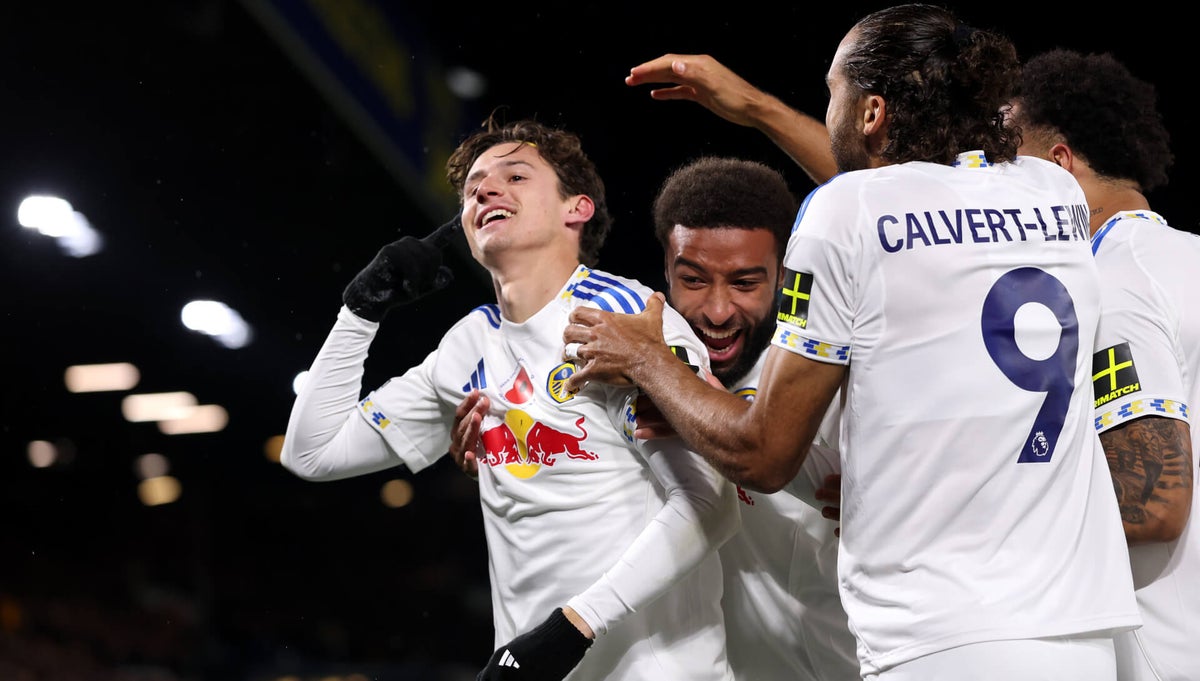
In the bowels of Old Trafford, a cathedral of football for home supporters but a hostile fortress to visiting players, Brenden Aaronson stood in silence facing a mirror in the locker room.
If only for a fleeting moment, he’d quiet the outside noise. Quiet his mind. Visualize the 90 minutes ahead of him and his Leeds United teammates. Lock in and, as his trainer would incorporate in his routine pregame text, prepare for battle.
“Get ready to go to war,” Aaronson told The Athletic, “that’s all you can do.”
Leeds hadn’t won at Old Trafford in 45 years. Manchester United were flying under interim head coach Michael Carrick. Leeds sat precariously just three points above the relegation zone heading into the weekend.
No one expected them to pick up three points in Manchester, but outside noise and expectation didn’t matter within the group. What unfolded was a historic 2-1 win. Aaronson picked up an assist, which he admitted with a laugh was “a little bit lucky, but that luck comes around.”
Aaronson returned for another quiet moment in the locker room after the final whistle.
“Looking back in the mirror after the game, when you see how exhausted I am coming off the pitch, it makes you feel 10 times better about yourself,” Aaronson said.
That win is now part of an eight-game unbeaten run in the league, with top-flight survival secured well before the final day of the season. After winning the Championship in 2024-25, Leeds achieved its top goal and even enjoyed a bonus run to the FA Cup semifinals.
One of many key cogs is Aaronson, the 25-year-old U.S. men’s national team attacking midfielder who is expected to be named to a second straight World Cup squad next week. He has appeared in more Premier League games (36 of 37) than anyone on the team. He took his game to another level after returning to Leeds from a loan in the summer of 2024, winning back fans along the way and silencing doubters.
It’s a natural development and growth from a person who is insatiable in his desire to improve, but it has come with a new weapon in his arsenal: trainer Tareq Azim.
Azim, best known for his work with NFL stars like Marshawn Lynch, Justin Tuck, Dion Jordan and others, has been working individually with Aaronson since the fall. It is his first soccer client and one of two athletes he is working with individually this year.
That routine of looking in the mirror before and after the game is new for Aaronson. It is merely one manifestation of many from their work together, which quickly morphed to a strong bond. A symbiotic partnership, Azim sought to work with Aaronson.
“I wanted to use Brenden as a case study of the power of the individual,” Azim said. “This kid is a f***ing dog.”
Brenden Aaronson and Tareq Azim at Elland Road (Courtesy of Tareq Azim)
Azim first visited Leeds at the request of his close friend Jed York, the club co-owner who is also the CEO and principal owner of the San Francisco 49ers. York sought Azim’s analysis of the club’s performance model.
Azim hadn’t done much work around soccer but has long held a love for the game. A descendant of Afghan nobles, Azim’s family was forced to flee Afghanistan in 1979 and settled in America. He even started playing American football as a kicker because of his connection to soccer, before bulking up and fitting more seamlessly as a linebacker, which is where he played collegiately.
In 2004, Azim returned to a war-torn Afghanistan. The destruction had a profound impact on him. It was there, from the rubble of what once was in his homeland, he set up a neighborhood soccer league for kids.
As he returned to the Bay Area, Azim began working to diagnose and cure a “disease of fear” with various professional athletes. That list kept growing to the point he opened his own gym, Empower, and authored his memoir by that same name.
With that trip to Leeds, Azim was back in soccer. The club listed a number of players for Azim to work with early in the season, but he opted to wait and observe first. He watched a match against West Ham in October and was drawn to Aaronson. Not because he scored in a Leeds win, but his mentality and room for growth.
There was a mundane moment where Aaronson hesitated on the ball and lost an opportunity that particularly attracted Azim.
“It was the moment I saw him battle with trust,” Azim said. “That hesitation is trust.”
After the game, Azim and Aaronson had their first conversation. “I thought, ‘Let me run this moment by him,’” Azim said. “If he agrees with me, then we’re going to rock.”
An initial chat meant to be a few minutes quickly turned into an hour and a half. And so Aaronson became the first pro soccer player in what Azim calls his “stable of champions.”
“That’s our thing,” Azim said. “Stable of champions and humble animals. It’s real.”
All of his clients call him “T.” Really, it doesn’t feel precisely correct to call them clients. The relationships transcend a transactional nature.
“It was his belief in me,” Aaronson said. “The upside he saw in me. The way I look at life, we’re similar. Our lifestyles, the way we view family, pushing ourselves to be the best. It was cool to have conversations and see we’re a lot like each other.”
Azim excels in physical training, but he knows Leeds has that aspect covered with Aaronson. The value and most meaningful growth he could help foster came on the mental side. His philosophy is intensely centered around forcing players to face their own mortality.
Prepare for death.
“Why my methodology, coaching approach, training and performance infrastructure is based off the consciousness of death is because it forces radical transparency with your existence,” Azim said. “Consciousness of death makes you realize there is only guarantee and truth in this world: Death.”
Azim and Aaronson have worked together since the West Ham game. He comes to England every month for 5-10 days, and they have consistent meetings, whether virtual or in person. The focus is on mentality, emotionality and spirituality.
“I’ve never had someone challenging me that much,” Aaronson said. “It set me in a headspace where I can do even more, I can take more risk. What’s the worst that can happen? He taught me all these things, like ‘prepare for death’ and all that. That unlocks something new, gets you in a different mindset. I’ve learned so much mentally.”
Advertisement
Azim added: “Mental and spiritual health should be treated no different than an ab day or a leg day or a cardio day. Just condition it. How do you condition it? There’s a series of different practices and activities that help feed those sectors we neglect.”
In their work together, Azim found a resilient character in Aaronson. Someone who matched his drive and determination to improve, one that while physically different than people he’d worked with before, held a very familiar state of mind.
“I was finding my Marshawn Lynch of soccer. It’s Brenden Aaronson,” Azim said. “I found my Beast Mode of soccer.”
Brenden Aaronson celebrates a Leeds United goal against Wolves (Shaun Brooks / CameraSport / Getty Images)
It would have been easy for Aaronson to stay far away from Leeds, both contractually and practically.
There was a relegation clause in his contract that allowed him to leave on loan for free. After 2022-23, with Union Berlin and others pushing early in the summer following Leeds’ relegation, Aaronson left for a year.
Aaronson was heavily criticized in his debut season. The price tag, nationality and lack of goal production made him an easy target. Leeds signed Aaronson from RB Salzburg for a fee around $30 million and, while he was recruited hard by Marcelo Bielsa, he arrived when fellow American Jesse Marsch was the head coach.
To stay away would have been an easier path. Plenty of clubs wanted him. That relegation contract clause remained active after his sojourn in Berlin. But with Leeds in a better place structurally, and manager Daniel Farke wanting Aaronson back for the promotion push, he returned.
“I wanted to come back, I wanted to make my name here,” Aaronson said. “I know how much of a special club this is. It’s a big club in England. Coming back, I knew I’d be under scrutiny and it would be tough, but I wanted to be here. I feel like I’ve been rewarded for going through a lot of tough times here to come through the good times. Winning the [EFL Championship] last year and the last few weeks (staying up) has been some of the best moments of my career.”
Advertisement
The supporters remain ferocious in their love for Leeds, which can fuel players when times are good but quickly go south when things turn.
“It’s a constant, massive component of our strategy,” Azim said. “The fans have such a huge weight and position on him — not in a bad way. We expanded the lens. The only reason these fans may be the way they are with you, just like your dad, just like your grandparents, just like your mother, just like your brother, just like myself, everybody sees something in you that you won’t allow to exist.
“Them yelling and say what they’re saying is primarily just to let you just f***ing let it rip.”
Aaronson had nine goals and two assists in the Championship, appearing in all 46 league games. He was one of only 12 outfield players who did so in the physically grueling division. This year in the Premier League, he has four goals and five assists.
“Everything I set out to accomplish, we have,” Aaronson said. “Winning the Championship and getting 100 points was unbelievable. I worked under Farke, who is an amazing coach, I’ve grown a lot under him and the people around the club. People doubted I was going to play, that I was going to get this many minutes. I proved myself. I knew I could stay in the team, I believed in myself. I’m proud of it all, the ups and the downs.”
Brenden Aaronson is eyeing a place on a second straight U.S. World Cup squad (John Dorton / ISI Photos / USSF / Getty Images)
By design, Azim doesn’t take on many active clients like this at the same time. He has two dedicated clients right now: Aaronson and 49ers offensive lineman Colton McKivitz. As physical specimens, they couldn’t be more different.
McKivitz is listed at 6-foot-6, 300 pounds. He makes his living never touching the football, by blocking some of the most athletic men at a similar size to him.
Aaronson is listed at 5-foot-9, 150 pounds. He makes his living with a ball at his feet, relentlessly running for 90 minutes.
What makes them one in the same is their minds.
Advertisement
“Brenden is absolutely identical to Colton McKivitz and Marshawn Lynch,” Azim said. “Brenden’s persona, personality and ideals [were] very similar to that. He reminds me of the 1 percenters that I’ve had the privilege to work with. Let me be very clear: The 1 percenter is not about wealth, it’s about having the aspirations and dreams of the ‘not normal.’ And is willing to be not normal until they achieve — an individual that loves risk. It’s only 1 percent of the population.”
Aaronson and McKivitz have developed a friendship, with the two and Azim often FaceTiming. McKivitz ribbed Aaronson for wearing gloves during games in the winter.
“Dude, he doesn’t understand the English cold. He’s got nice weather in San Francisco,” Aaronson said with a laugh.
It’s another outlet of development and support for Aaronson, who has had structure to lean on previously during his career. Aaronson routinely points to his parents, grandparents, siblings, fiancé and more as the bedrock of his career.
“Brenden has a father who understands competition, development, potential, strategy,” Azim said. “He has a grandfather who understands this stuff, vision and perspective. Brenden’s baseline is great. The opportunity to evolve isn’t foreign. His father is a gem, a stud. He understands it. Some parents wish they were. This guy was and is.”
Aaronson added: “My dad watches every single game. He’s the first guy I text after games, he’s who I want to hear from to see how I did.”
When Mauricio Pochettino announces the U.S. World Cup squad next week, Aaronson, who appears to have avoided a leg injury after a scare last weekend, is expected to be on it. No spot is guaranteed, but Aaronson has been called into five of the last six USMNT camps.
“The thing my whole life is being an underdog,” Aaronson said. “I never really was in the youth national team, I was never hyped. I didn’t have a growth spurt until I was 17. That’s how I’ve been my whole life, proving people wrong. I love to play the game, I love to grow, I love to get better. There will always be opinions, it doesn’t matter.”
Advertisement
The opinions that matter most are the ones in his corner. And perhaps it’s poetic that this season, in which he has found another level, will conclude against West Ham, the opponent on the autumn day where things truly took a turn and his mentality became unleashed.
“Every decision you make, make sure you consider how it will contribute to your last breath,” Azim said. “If you embrace death, well, what’s there to fear? Welcome to freedom. My boy Brenden is playing with freedom.”