
Fulham were playing Huddersfield Town and, for Dan Burn, things were coming to a head in more ways than one. The ball, specifically, was arcing towards his skull, and he was doing his job, leaping to clear it, but he landed hard. All this time later, it is obvious the injury he suffered was a simple concussion, but it was not obvious then, not to him, not with his mind fizzing and deceptive and colonised by doubt.
“I persuaded myself I had a brain tumour,” Burn says. “I went to Harley Street in London and talked to neurosurgeons and they said, ‘No, you’re fine, there’s nothing wrong with you’, so I convinced myself it was something else. I didn’t understand the feelings I was having. I couldn’t sleep, I had insomnia, so you become anxious about that and it just snowballs.”
He pauses for a second and then says, “I thought I was dying.”
How Burn had reached this point is not linear. He has spoken to The Athletic before about his unorthodox career path, with its “steep, early trajectory”, that took him from non-League Darlington to the highest level and left him with imposter syndrome.
There were other things going on in his life, like his parents divorcing, which “probably affected me more than I realised”. There was the business with his head, while Roz, then his girlfriend, now his wife, was working full-time and he was on his own for hours at a time, which he hated and wrestled with. “I just got into a cycle,” he says. “It was loads and loads of anxiety.”
Even in better moments, his behaviour was not healthy. In the dressing room after games, he would pick up his phone and search for his own name on social media. “When I was first coming through it was class, because people blew smoke up my a**e,” he says. “When it starts going the other way, there would still be good stuff, but then one person would say, ‘Dan Burn is s**t’ and that would affect me so much. I couldn’t stop thinking about it.”
Everything was escalating. Training had been a refuge, a few hours of respite when his brain stopped whirring, but even there he was now laden with dread. It was overwhelming; fear of letting people down — Roz, who had moved to London to make a life with him, his parents, his home town of Blyth — fear of proving other people right, those who never believed he was good enough. “Bad days would quickly become bad weeks and then turn into bad months,” he says.
One match day, Burn reported to Craven Cottage as usual. Ostensibly, he had the gilded life of a professional footballer, who joined Premier League Fulham in 2011 at the age of 20 and “everybody was telling me I’m living the dream, so what did I have to feel bad about?” which does not explain why he was sitting in his car holding the door handle but unable to move, his body racked by sobs.
“I was crying and crying,” he says. “Just crying my eyes out. I rang my mam and said, ‘I don’t want to feel like this any more. When does it stop?’.”
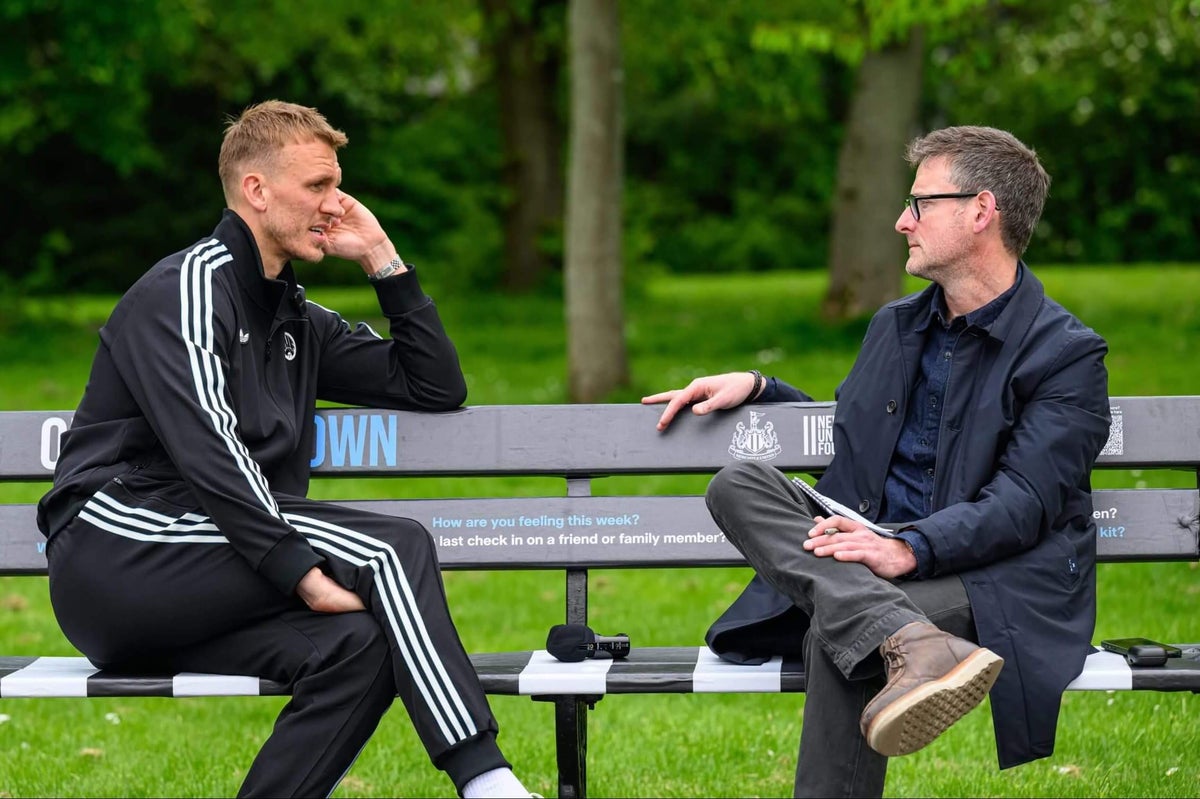
It is May 2026, and Burn is perched on a park bench in a Newcastle United tracksuit.
St James’ Park is visible through the trees. He is instantly recognisable, a giant of a man at 6ft 7in (200cm), a trophy winner with the team he supported as a kid, a grounded, late-blooming England international. Two policewomen break off from their patrol of Leazes Park to ask him for a selfie and he obliges with a laugh, saying, “I hope there’s nothing going on.”
The bench is one of 11 dotted across Tyneside, a joint initiative between the club and Newcastle City Council, decorated in black and white stripes and adorned with conversational prompts about football and life. There are also QR codes which link to the Samaritans and to the club’s charitable Foundation, for which Burn is an ambassador. In a region where suicide is the leading cause of death for men under 50, the big idea is to get people talking about mental health.
This is why Burn is here, another phrase from which you can draw a double meaning.
At Fulham all those years ago, he reached crisis point; in desperation, he reached out to Clive Reeves and Danny Holmes, the club’s sports psychologists. “Asking for help was the hardest thing I’ve ever done,” he says. “I felt like there was a stigma. I thought it was a weakness. It was the best thing I ever did.” Without that, well, who knows?
Burn playing for Fulham in 2015 (Alex Broadway/Getty Images)
Burn was pointed towards a therapist and together they unpicked his feelings and he was given tools to cope. He learned to recognise a bad day — and they still lurk — for what it is, rather than allowing the snowball to form and gather pace. “I surround myself with my wife and kids and keep myself busy and it doesn’t get to that,” he says. “I don’t have therapy now, but I wouldn’t think twice about seeking help if I ever started to feel like that again.”
On the pitch, “Big Dan Burn” from Blyth is a defender, ferocious and loud and as tough as anything; a couple of seasons ago, he came back early from a broken back to help his team. Off it, he is like an everyman, only taller; approachable, relatable, funny. All of this makes him the perfect spokesman for a condition which is wholly democratic and takes no account of who you are or what you do. A killer.
“I can speak about this and know there will be plenty of footballers who might be feeling the way I felt,” he says. “I can talk about it in front of the lads at Newcastle; if they look at me and go, ‘OK, if he went through that then maybe I might need to speak to someone’, then great. I want to help younger lads coming through, knowing the pressure they’re going to feel and try to pass on my experience.”
At Fulham, part of his recovery involved coming off social media.
“Looking back, it annoys me that I let it affect me so much, because why did I care?” he says. “But I did care. I needed that instant gratification, to feel that I was doing well. Now, I’m of the mindset where I know what I’m like, as a person, as a player. It only really matters what the manager thinks.”
There is a better safety net for footballers now. In October 2023, Newcastle recruited Dr Ian Mitchell as their head of psychology, who was “huge”, Burn says, in the build-up to their Carabao Cup final victory over Liverpool the following season.
“He has an open door, he worked with Sandro (Tonali, Newcastle’s Italian midfielder) when he was out (during a 10-month suspension for betting offences),” Burn says. “I enjoy reading Peak articles on The Athletic, different stories about leadership and mentality. If I see one I like, I’ll send it to Mitch and then he’ll give me some feedback on it. I like how we can implement those things.”
In a different way, this season has been mentally challenging for Newcastle. This time a year ago, fresh from winning their first domestic trophy for 70 years, they were tearing towards Champions League qualification. Last summer was cruel; Alexander Isak, their brilliant striker, left for Liverpool after refusing to train or play, their recruitment was scattergun and they have suffered for it. They have been stretched and in transition. A lot of it has felt like survival mode.
Advertisement
That final at Wembley, where Burn’s brilliant headed goal set Newcastle on their way to a 2-1 win, “feels like another lifetime,” he says. “So much has happened since then, but even when it did, I struggled to process it. My whole childhood had been about us needing to win something. I’d lived that moment every day so, when it actually happened, it was such a strange feeling. I was just numb. It was like, ‘OK, so what do we do now?’.”
The answer, of course, is: play football. There has been a lot of that, 56 matches in all competitions (at one stage, Newcastle had played more games than any other team in Europe’s big leagues), defending the Carabao Cup until the semi-finals and reaching the last 16 of the Champions League, but labouring in the Premier League, where they sit 13th with two games to go. Too many wins have slipped through their fingers.
“Speaking personally, I’ve found it mentally draining,” Burn says. “I don’t think you realise the mental load it takes to play in four competitions pretty continuously. You don’t switch off at all.
“All of it has been at such a high level. I don’t know if it’s because I’ve never done that before, but I’ve got so much appreciation now for the elite players who do it year on year. It’s not the physical load, it’s the mental bit of going home and not being able to just be with your family. I feel like I’ve not been present for seven months.
“I’ve still enjoyed it, especially the cup games and the Champions League, visiting different countries, playing against top, top players, it’s just been a different feeling, particularly when there’s England now and a World Cup year. I’ve never previously thought, ‘Oh god, I’m tired’. That’s never really entered my head before, whereas it definitely has at points this season. It’s sort of felt never-ending.”
Burn describes it as a “learning season. The next bit is doing it consistently, like Manchester City or Arsenal, who can hit a certain level in every single game and never dip below it, no matter who they’re playing in whatever competition. That’s what we’re aiming towards”.
For now, they are a considerable distance from that goal. Taking four points from the past two games against Brighton & Hove Albion and Nottingham Forest has quietened some of the noise around head coach Eddie Howe’s position, but there is no denying it has been a testing few months, featuring two awful losses against Sunderland, their local rivals, and an 8-3 aggregate slapping at the hands of Barcelona that knocked them out of Europe. There has been a softness to the team.
“Trust me, we’re as frustrated as fans,” Burn says. “We don’t just brush it off. We’re annoyed.
Advertisement
“There’s been loads of chatter outside the club, but nothing internal. If you’d come in and watched us train in the week of the cup final and compared it with now, you wouldn’t see a lot of difference. The manager has a process he works to, but unfortunately the process doesn’t get you results every time. There are a lot of factors; last summer, the amount of games, injuries. A lot of it is excuses, but it’s also facts.”
It has been a difficult season for Newcastle and Howe (Stu Forster/Getty Images)
The first of those matches against Sunderland ended with Burn in hospital and in agony, courtesy of a punctured lung and broken rib. “It was the worst pain I’ve ever had,” he says. “I didn’t get out of bed for two days, I was on morphine and it was barely touching me.” The second, a 2-1 home defeat, was mortifying. “To concede in the last minute was probably the low point for me at Newcastle,” he says. “Those are the games you can’t lose.”
The mentality aspect is fascinating here, too, how both winning and losing can become ingrained in a team, or how prophecies become self-fulfilling. “When everything is going well, you don’t think about what you’re doing,” Burn says. “It’s like instinct, second nature. It can paper over cracks. When you’re losing, you start second-guessing. You become more hesitant. You think to yourself, ‘We’ve lost a few games from this position…’”
Howe has taken the brunt of criticism. “We feel a huge sense of responsibility towards him,” Burn says. “Nine times out of 10, if we follow the plan the manager has set out for us, then we’ll get a result. When we don’t, it’s because we’ve gone off script. When we get results, players get the credit. When we don’t, he takes the heat. So you feel you owe it to him to put it right — especially the lads who have been here since he arrived.
“We’ve had a lot of hard conversations with each other, player-only meetings. We have tried to take responsibility, particularly the leadership group, trying to set the tone and push what the manager wants. I’ve been around a lot of teams that have struggled, and when things are going wrong, you see signs of people deflecting blame. I haven’t seen a lot of that here, which is why I’ve felt quite calm about it.
“It’s always been the same with the manager; never too high, never too low, just follow the process every week and that’ll get you results. Brighton was huge (a 3-1 win to end a five-game losing streak that started with a 7-2 defeat in Barcelona), for everybody. It wasn’t the greatest performance, but we really wanted to dig it out and get that result for him.”
Burn has just turned 34 but is not done yet. He has one more year on his contract at Newcastle with an option for another.
Advertisement
“It’s Newcastle or nothing for me,” he says. “I don’t want to go anywhere else. I love being home and playing for my team, being around my family. Now we’ve won a cup, I don’t feel like it’s out of reach for us to do it again. When I got here, it was a different stratosphere — never going to happen — but we broke through that ceiling.
“One of our targets this season was to be the first Newcastle team to have back-to-back Champions League campaigns, which isn’t going to happen now, but that’s something I’d love to be part of. Realistically, do I think we’re going to win the league in the amount of years I’ve got left? Probably not. But I’d love to try!
“My whole career, players have signed in my position but I’ll back myself against anyone; anyone in the world. There will be a stage when someone takes my shirt, because that’s the inevitability of time. I’ll hang on to it for as long as I can.”
When Burn joined Newcastle from Brighton in January 2022, he was coming up to 30 and nobody’s idea of the future. He hadn’t even been on the recruitment department’s original list of centre-half targets that month, but Howe liked his versatility, his ability to fill in at left-back and his Geordie backstory. Four years on, he has made 191 appearances and is a cup-winning legend, with the tantalising prospect of a World Cup next month.
Burn joined Newcastle from Brighton in 2022 (Catherine Ivill/Pool/AFP via Getty Images)
“I’m human, so of course the World Cup is in my head, as much as you try to put it out of your mind,” he says. “It’s affected the people around me more, because they want to know about booking travel. I just know that what I do with Newcastle will take care of all that. It’s amazing to think of, and I’m desperate to go.
“I’m happy this has happened at this stage in my career. If I’d been 20 or 21, I’d have had those doubts. It would probably have been too much for me. It was just a fear. But now I have an acceptance. I know what I’m good at, I’m very good at. I know there’s a place for me in the England squad.
“If I don’t get there, I’ll be at peace with it, knowing that I couldn’t have done anything more. I’m not going to get to the end of my career and think, ‘I wish I’d tried harder’. It’ll be, ‘I’ve done absolutely everything a player of my ability has been able to do. I have maxed out’.”
This is who Dan Burn is.
“I’m confident in who I am as a person and I’m not trying to be anything I’m not,” he says. “Like it or hate it, I am who I am.”
Whatever you’re going through, in the UK, you can call the Samaritans any time, from any phone, on 116 123, or in the U.S, the Suicide & Crisis Lifeline on 988.