
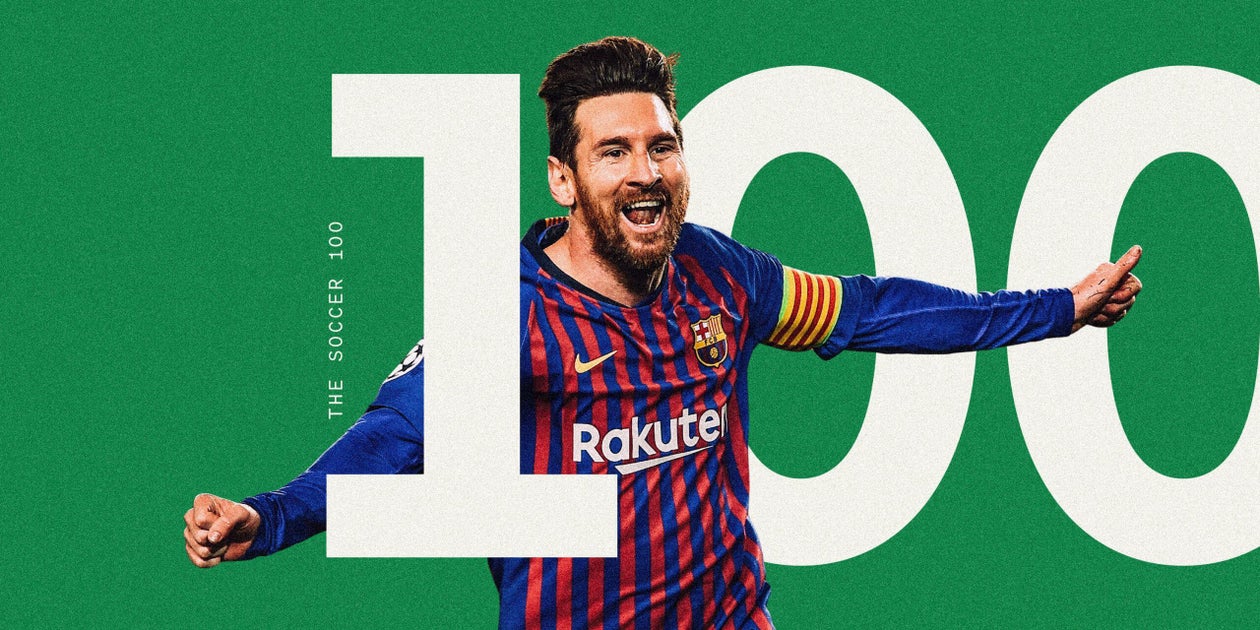
As part of our buildup to the 2026 FIFA men’s World Cup in the United States, Canada and Mexico, we are publishing excerpted chapters from The Soccer 100, The Athletic’s definitive book on the 100 greatest players of all time, courtesy of HarperCollins Publishers.
The 10 players we will feature are the highest ranked World Cup winners of our 100. Today, in our final extract, we look at a player who lifted football’s most coveted trophy late in his career — but it was worth the wait.
The pantheon of sporting greats is dominated by larger-than-life athletes and larger-than-life personalities, towering figures who looked like they were born to dominate and transcend the sporting landscape: Muhammad Ali, Michael Jordan, Michael Phelps, Tom Brady, Usain Bolt.
In that context, it feels all the more remarkable to say that the greatest living footballer — in our collective view, the greatest of all time — is someone who needed growth-hormone treatment to reach a height of 5’7″, an introvert who regards fame and celebrity as the downside of his genius.
Lionel Messi doesn’t look like a megastar. At one stage, he barely looked like a footballer.
Of all the footballers whose arrival in the big time is heralded in such excited terms — the next Pelé, the next Maradona, the next Cruyff — he looked the most unlikely. Emerging from Barcelona’s academy as a 17-year-old, there was a profound teenage awkwardness about him, as if he had been on a stadium tour with a group of schoolmates, taken a wrong turn, and found himself on the touchline ready to come on as a substitute.
Seriously? Him?
Then you saw him with the ball at his feet and he took your breath away. The waif with the lank hair and the blank stare played football like you would not believe.
Lionel Messi kisses the World Cup after winning the trophy with Argentina in 2022 (Julian Finney/Getty Images)
You don’t forget your first time. I had already watched him on television as he established himself in the Barcelona team over the course of the 2005–06 season, but my first time watching him in the flesh came when Messi, still 18, emerged off the bench for Argentina in a group game against Serbia and Montenegro at the 2006 World Cup in Germany.
It is a day that sticks in the mind for a variety of reasons: an outstanding 6–0 Argentina victory, a sublime goal that saw Esteban Cambiasso provide the finishing touch to a sweeping 25-pass move, the theatrics of a delirious Diego Maradona in the stands threatening to steal the show.
But then came Messi’s cameo — and the sense of quasi-religious fervor that swept the crowd in Gelsenkirchen as he appeared on the touchline. He hadn’t played a competitive match for three months due to a hamstring injury, but that only increased the air of anticipation.
It was like we were preparing for the second coming. The sight of Maradona watching from high in the VIP area, clasping his hands together like a proud father and struggling to hold back the tears, only heightened that feeling. Nearby, Messi’s image adorned a huge banner with his legend, Este es mi sueño (This is my dream).
Lionel Messi and Diego Maradona, Argentina greats (Juan Mabromata/AFP via Getty Images)
In the press box, there was just a little cynicism. What number “next Maradona” was this? There had been Ariel Ortega, Pablo Aimar, Juan Román Riquelme, Marcelo Gallardo, Andrés D’Alessandro, and Javier Saviola, to name but six. Great talents all of them, and some had achieved great things, but none had come close to Maradona’s level. And this kid was going to be different, was he? Seriously? Him?
Within two minutes, Messi had scampered down the left wing to set up Hernán Crespo for Argentina’s fourth goal. He scored the sixth himself, threading the ball between the goalkeeper’s legs. But even more than those contributions, it was his adhesive touch and the way he carried the ball. The speed with which he drifted between opponents and into space was something else. Every movement was perfect.
I remember writing in the London Times in early 2010, flying home from Barcelona the morning after watching him score four times in an astounding performance against Arsenal in the Champions League, that what Messi was doing at the age of 22 was of a level not seen since Maradona’s heyday in the 1980s. I followed that with a note of caution, pointing out that even Maradona had not been able to sustain such standards throughout his career and that other true greats, such as Marco van Basten and the Brazilian forward Ronaldo, had been thwarted by injury at what proved to be the peak of their powers.
We should enjoy Messi’s brilliance for as long as it lasts, I wrote, adding that “experience warns us that this could be as good as it gets.”
Hmmm. Experience tells me I shouldn’t have worried.
Lionel Messi celebrates scoring against Arsenal in the Champions League of in 2010 (Josep Lago/AFP via Getty Images)
Where do you start when it comes to detailing what makes Messi so special?
If he was just a goalscorer, the record books at the International Federation of Football History and Statistics tell us he is the second greatest of all time behind Cristiano Ronaldo. But goals have never even been the main feature of Messi’s game, which has instead been defined by his vision, his passing, his dribbling, his creativity.
By the time he made his 1,000th career appearance, which he marked with a goal for Argentina against Australia at the 2022 World Cup, he had scored 789 goals and registered 348 assists. At the time of writing, he has won 12 league titles—10 with Barcelona and two with Paris Saint-Germain (plus a Supporters’ Shield with Inter Miami), as well as four Champions League titles (all with Barcelona), the Copa América twice, the World Cup once, and the Ballon d’Or award eight times, finishing as runner-up on another five occasions. The numbers are outrageous, but again, the trophy collection and the goal tally cannot begin to do justice to his talent.
Every great athlete has a moment that defines his or her excellence in the public consciousness.
In football, Pelé is best recalled for the goals he scored in the 1958 and 1970 World Cup finals; Maradona for the astonishing solo goals he scored against England and Belgium en route to World Cup glory in 1986; Van Basten for that stunning volley against the Soviet Union in the European Championship final in 1988; Zinédine Zidane for his volley for Real Madrid against Bayer Leverkusen in the 2002 Champions League final; Cristiano Ronaldo — though
there are plenty of alternatives — for his overhead kick for Real Madrid against Juventus in a Champions League quarterfinal in 2018.
Advertisement
With Messi, though, where do you even begin? The goal he scored as a teenager for Barcelona against Getafe in April 2007, dribbling from inside his own half and beating six (seven? eight?) challenges, that in terms of pure technique surpassed even Maradona’s “Goal of the Century” against England? The one against Athletic Bilbao in the Copa del Rey final eight years later in which he dribbled in and out of five challenges and thrashed the ball inside the near post? Was that peak Messi? Or was it another solo goal against Eibar, Girona, Real Zaragoza, or Real Madrid? Or against Manchester United in a Champions League final (take your pick from 2009 and 2011)? Or was it any one of the inspirational acts he produced en route to World Cup glory with Argentina — finally — in 2022?
Lionel Messi celebrates scoring at the 2018 World Cup (Kirill Kudryavtsev/AFP via Getty Images)
There is something almost ethereal about Messi’s talent. Watch any of those YouTube compilations that showcase his dribbling and his passing, set to classical music, and it looks like sport as an art form. It is a thing of beauty, poetry in motion.
But what doesn’t always come across on television, what really strikes you when you are watching him in person, is the raw energy behind his genius. Like Ali, he floats like a butterfly but stings like a bee.
I have been privileged to witness some of his most acclaimed moments in person. One match that sticks in the mind was at Wembley in a Champions League group game in 2018 when he rattled the frame of the Tottenham Hotspur goal twice before adjusting his sights slightly and scoring two goals. It was a classic illustration of Messi as a force of nature, possessed of iron will as well as unearthly skill, but in truth, it was career-defining only in the sense that it was consistent with what was seen on innumerable occasions in the years before and since. Would it make his top 10 most memorable performances? Almost certainly not. Top 50? Possibly. For almost anyone else, it would be the performance of a lifetime.
I remember letting out a loud gasp in the press box at Camp Nou in May 2015 when, with a Champions League semifinal against Bayern Munich hanging in the balance, he gave Jérôme Boateng the slip and then dinked the ball over the advancing Manuel Neuer, leaving the great German goalkeeper grasping at thin air. It was stunning in both conception and execution, but by Messi’s standards, it was, again, an ordinary day’s work.
Lionel Messi clips the ball over Manuel Neuer (Shaun Botterill/Getty Images)
The venerable British sportswriter Paul Hayward was in the hospital at the time, between chemotherapy sessions after being diagnosed with cancer. He would later describe watching that match in the lowest of spirits “on a screen in a room short of cheer” and feeling himself “rise from my chair” in wonder when he saw Messi do that to Boateng and Neuer.
“That moment will not leave my memory,” Hayward wrote, “because it made the world full of possibilities again.”
Advertisement
So how did a tiny, painfully shy kid from Rosario, Argentina, overcome the odds to become the greatest footballer of all time?
The reference to his height is important. When he was 10 and already showing prodigious talent, he was sent to see a specialist because the coaches at his local club, Newell’s Old Boys, were, like his parents, worried that at 4’2“ he was so much smaller than his peers. He had barely grown in two years.
Dr. Diego Schwarzstein, a specialist in endocrinology, conducted tests over a period of six months before concluding that because of a growth hormone deficiency, he was unlikely to grow beyond five feet tall. He was prescribed a course of growth hormone drugs, injected into his legs every day. Slowly but surely, he started growing. By the age of 12, he was up to 4’10”, well on the way to his adult height of 5’7″.
The treatment cost about $1,000 a month. Even with a contribution from Newell’s, that left a huge dent in the Messi family’s finances. It was Barcelona’s offer to cover the costs of the treatment — after Messi left their coaches enthralled during a trial — that persuaded the family to leave Argentina so he could begin an apprenticeship with the Catalan club at the age of 13.
Without that treatment, without Barcelona’s willingness to cover the bill, it is highly doubtful whether even a player as talented as Messi could have coped with the physical demands of a top-level career, let alone scale the heights he has.
Lionel Messi in May 2005 (Lluis Gene/AFP via Getty Images)
There was also an extreme reservedness about Messi. On the pitch, he was uniquely expressive. Off the pitch, he was — and to an extent still is — the opposite.
During the 2016 Copa América, Maradona declared that Messi had “no personality,” that he was a nice guy but lacked “the character to be a leader.” Maradona was an extreme personality at one end of the spectrum, Messi at the other. It was only in the later years of his career that Messi began to look comfortable with his role as captain of the Argentina team.
Advertisement
Messi is introverted in a way that seems at odds with his status. Off the pitch, he does not radiate anything like the aura of his great rival Cristiano Ronaldo. He has become a more confident public speaker as his career has gone on, but I am reminded of a line the author John Carlin wrote about interviewing a 21-year-old Messi, an experience he described as “so forgettable that I have no recollection of writing an article after it.”
Watching him play football, on the other hand, is unforgettable.
Fernando Signorini, the former Argentina fitness coach, described Messi as a “genetic miracle.” “Just like Diego (Maradona), his neuromuscular coordination has a cosmic power,” Signorini said. “Almost unthinkable ability to control their body in time and space, defying gravity.”
On the face of it, Messi never seemed to be blessed with extraordinary pace. Sure, he was fast, but not that fast. During the 2014 World Cup, at the age of 27, the highest speed he was clocked at was about 20 miles per hour. That is some way below Cristiano Ronaldo’s top speed, let alone Kylian Mbappé’s (23.5 miles per hour).
But where Messi is unequaled is his speed with the ball under control. Watching him, you would be excused for thinking he is quicker with the ball than without it. He looks terrifying in full flight: twisting, turning, feinting, swerving. Some players do tricks. Messi doesn’t, really. There is an old-school element to his dribbling, but the speed at which he does it, twisting between challenges in the tightest of spaces, appears almost futuristic.
To study Messi in action is to witness an athlete whose perception of space and time — and how to use them — sets him apart. Opponents converge, but he is already two or three steps ahead. Even when you pause the action and zoom out for a wide-angle view, you wonder how on earth he has seen what he has seen.
“Leo always had the talent and personality, but he is also very intelligent,” former Barcelona coach Jordi Roura says. “He quickly understood the way to play collectively and he took on the concepts of Barcelona. He knew the positions to take up on the pitch, how to approach the ball, to perfilarse (shape himself), what to do in each moment.”
Barcelona’s head coach Pep Guardiola instructs Lionel Messi in 2010 (Lluis Gene/AFP via Getty Images)
There is a line another former Barcelona coach, Robert Moreno, used about him in an interview with The Athletic in 2022. “He’s like The Matrix,” Moreno said. “Do you remember that scene where the character is moving his body and all the bullets go slowly? For me, Messi plays like this. All the things are happening slower in his mind than are happening for the rest of the world.”
Advertisement
This analysis has been widely interpreted, in layman’s terms, as “Messi’s brain slows down time.” Could that be true? Ask the man to explain his genius, as many have done in interviews over the years, and he struggles to put it into words. He just does what comes naturally.
David Sumpter is a professor of applied mathematics and the cofounder of Twelve Football, which uses data to help inform clubs not just about scouting, but about decision-making on the field. He worked with Barcelona during Messi’s time there, studying patterns of play and analyzing players’ decisions and their relationship with space and time.
“What we found,” Sumpter says, “is that he and his teammates were finding pockets of space that didn’t yet exist. It wouldn’t exist as a space for another two or three seconds. In that respect, yes, these players could see two seconds into the future, five seconds into the future. But with Messi, it was almost like he could see 10 minutes into the future. I don’t mean that literally because football is such a fluid game, but what he would do is map out early in the match where those spaces were likely to occur — and then he would make sure he found those spaces as the match went on.”
It makes the whole thing sound scientific, as if Messi is walking around the pitch like the mathematician John Nash, as portrayed by Russell Crowe in A Beautiful Mind. “No, I’m not saying he’s thinking in mathematical terms,” Sumpter says. “But having studied the patterns he creates, I would say he is thinking constantly about space and the various angles. We don’t know without scanning his brain, but there must be something mathematical going on in there.
“I would expect in spatial reasoning tests he would score higher than the average person and higher than the average footballer. He strikes me as one of those rare people who has something beautiful and unique in his head which allows him to do what he does.”
“It’s a different thing to the intelligence a ‘normal’ person has,” Moreno added. “It’s the knowledge that you can’t explain. (Footballers) are able to do things, but they are not able to explain why they do them. Messi is the maximum expression of that situation. He finds solutions where mortal people aren’t able to do so.”
Even Barcelona’s brilliant Brazilian, Ronaldinho, was eclipsed by the excellence of Lionel Messi (Lluis Gene/AFP via Getty Images)
For years, it felt like the only thing holding Messi back in the GOAT debate was that, unlike Pelé and Maradona, he had never won the World Cup.
Advertisement
The argument underestimated how much the sporting landscape had changed. Through the 1960s, 1970s, and 1980s, greatness was viewed primarily through the prism of international football and the World Cup in particular. In the twenty-first century, the club game has become so all-consuming, dominated by a handful of “super clubs,” that the final stages of the Champions League have come to be recognized as the highest form of the game, technically superior to the World Cup, albeit not quite as big a global spectacle.
Messi suffered defeats in the World Cup quarterfinal in 2006 and 2010, the final in 2014, and the round of 16 in 2018. Inspiration sometimes eluded him, but Argentina were beaten by better teams; on two occasions by the eventual winners. It was never a question of failing to make a step up in quality. The problem was that in what was often a dysfunctional team, Messi seemed to creak under the burden, with his nation’s hopes resting on his slender shoulders.
Did he really have to win the World Cup to be considered the best of his generation, to join Maradona and Pelé at the top of the pantheon or indeed to be considered the greatest of them all? In a team sport, such an argument felt a little facile.
But in Qatar in 2022, Messi went and won it anyway, at the age of 35. He didn’t quite “carry” the team in the way Maradona did in 1986, but he made huge contributions at every stage of the tournament: a fabulous goal in Argentina’s hour of need against Mexico in the group stage; a precise finish to help beat Australia in the round of 16; a wonderful assist for Nahuel Molina and a high-pressure penalty (followed by another in the shootout) in the quarterfinal against the Netherlands; another high-pressure penalty and a mesmerizing run to set up Julián Alvarez in the semifinal against Croatia; two goals (one a penalty) and then another successful penalty in the shootout as an epic World Cup final against France came to a nerve-shredding denouement.
When victory was confirmed, he fell to his knees, overcome. This was his crowning glory, his Holy Grail. “It’s any player’s childhood dream,” he told reporters afterward. “I am lucky enough to have achieved everything. This is what I was missing. Now it’s here.”
But there is something in what Pep Guardiola said subsequently. “If he had not won the World Cup, my opinion … would not have changed at all,” the Manchester City and former Barcelona coach said. “For me, it’s easy to say he’s the best of all time. Maybe that’s a lack of respect to Pelé and Maradona, but for me, he is.”
Lionel Messi helps propel Argentina to the 2022 World Cup (Dan Mullan/Getty Images)
There is no definitive answer. The debate is never-ending. Even now, there are many who regard Cristiano Ronaldo, by virtue of his goalscoring record, as superior to Messi. The football landscape is so different now to when Maradona played, let alone when Johan Cruyff, Pelé, and Alfredo Di Stéfano played. Messi has excelled in an era in which creative players have largely been spared the brutality faced by the great players of the past.
Advertisement
But he has also played in an era when the game is so much faster and more athletic, when technical levels across the board are so elevated. And Messi has consistently elevated those levels to almost preposterous heights.
There might, in time, be others who score more goals or more eye-catching goals than Messi, who spot a pass better than Messi, who weight a pass better than Messi, who dribble better than Messi, who understand space and time better than Messi. But … all of that in one player? We will be waiting a very long time before we see another player who does all those things to such an extraordinary level, week in and week out, season in and season out, for the best part of two decades.
As Guardiola once said, “Don’t try to explain Messi, don’t try to write about him, don’t try to describe him. Watch him!”
Seriously. Him.
Excerpted from The Soccer 100 by Oliver Kay & James Horncastle with The Athletic Soccer Staff, published by William Morrow. Copyright © 2025 by The Athletic Media Company. Reprinted courtesy of HarperCollins Publishers.