
Get free access to the most comprehensive World Cup coverage in The Athletic app.
A thousand matches. Many of them life-changing, several history-changing. All of them part of the story.
After 96 years and 23 editions, Tunisia vs Japan in Monterrey, Mexico on June 20 (5am on June 21 UK time) will take the total number of games played at World Cups to 1,000.
Naturally, some of these past matches are more famous than others, while each of them will have meant different things to different people.
So, to mark the upcoming milestone, The Athletic has come up with a list of the 10 most important World Cup games. Not the 10 best, but rather the ones that have, for a variety of reasons, had the biggest impact on the sport and loom largest in its history.
For this article, a longlist of games was drawn up and then a panel of our journalists ranked them in order of most importance.
Now of course, many notorious, well-known and iconic matches have failed to make the cut. Italy’s triumph over Czechoslovakia in the 1934 final which strengthened the regime of fascist dictator Benito Mussolini, for example. England’s sole World Cup win in 1966, when they defeated West Germany in the deciding game. And Italy’s fourth victory in 2006 when, despite the Calciopoli scandal ripping apart their domestic game, they beat France in the final in Berlin. That’s just how it goes when it comes to an exercise such as this.
So, here are the top 10… and the reasons why.
10. ‘The day that football died’
1982 second group stage: Italy 3-2 Brazil
Three teams stand out as the best not to have won the World Cup: Hungary in 1954, Netherlands in 1974 and Brazil in 1982. So while they were all very different sides, it is not a coincidence that each of their demises is chronicled in this article.
The Brazil team from that 1982 edition in Spain can’t — unlike the Hungarians 28 years previously and the Dutch eight years beforehand — claim to have definitively been the best side at the tournament or even the best in their nation’s history, but they did play the most glorious and entertaining football in the competition; with their intoxicating, attack-minded style cementing them as the neutrals’ favourites of not just that World Cup, but possibly any World Cup.
Yet while Brazil stunned creatively — particularly when Zico, Socrates, Falcao and Eder were involved — they were not, as The Athletic’s Michael Cox noted in his article last year on Italy’s triumph at the tournament , anywhere near as effective defensively. Indeed, they only kept one clean sheet in five matches.
After qualifying for the second round with three wins, they beat Argentina in their first game of the resulting three-team group and then, in the deciding match, took on an Italy side still trying to find its feet after the Totonero match-fixing scandal of 1980 — which had resulted in several players, including centre-forward Paolo Rossi, being suspended from the sport.
The Italians were as low as seventh-favourites for the tournament with most bookmakers before it got underway and had lumbered through the first group stage with three draws (scoring just twice). They then beat Argentina before the game against Brazil.
What followed, as Brian Glanville wrote in his book The Story of the World Cup, was: “The game which ‘should’ have been the World Cup final. The game in which Brazil’s glorious midfield, put finally to the test, could not make up for the deficiencies behind and in front of it.”
The ‘in front of it’ is a reference to striker Serginho, whose substitution following a laboured performance in the first group stage prompted former Brazil manager Joao Saldanha to remark, harshly: “Now the ball is round again.” He was substituted again against the Italians, with his game in total contrast to that of Rossi’s, who delivered one of the greatest individual displays in the World Cup’s history.
Due largely to his ban — which lasted from the spring of 1980 to the spring of 1982 — Rossi had not scored an international goal in more than three years and at times in the tournament had looked pedestrian, but then, in the space of 69 minutes, the 25-year-old scored a sublimely-executed hat-trick consisting of a header following a perfectly-timed run, a well-placed shot from the edge of the box and a lightning-quick turn and finish that bamboozled Brazil’s goalkeeper Waldir Peres.
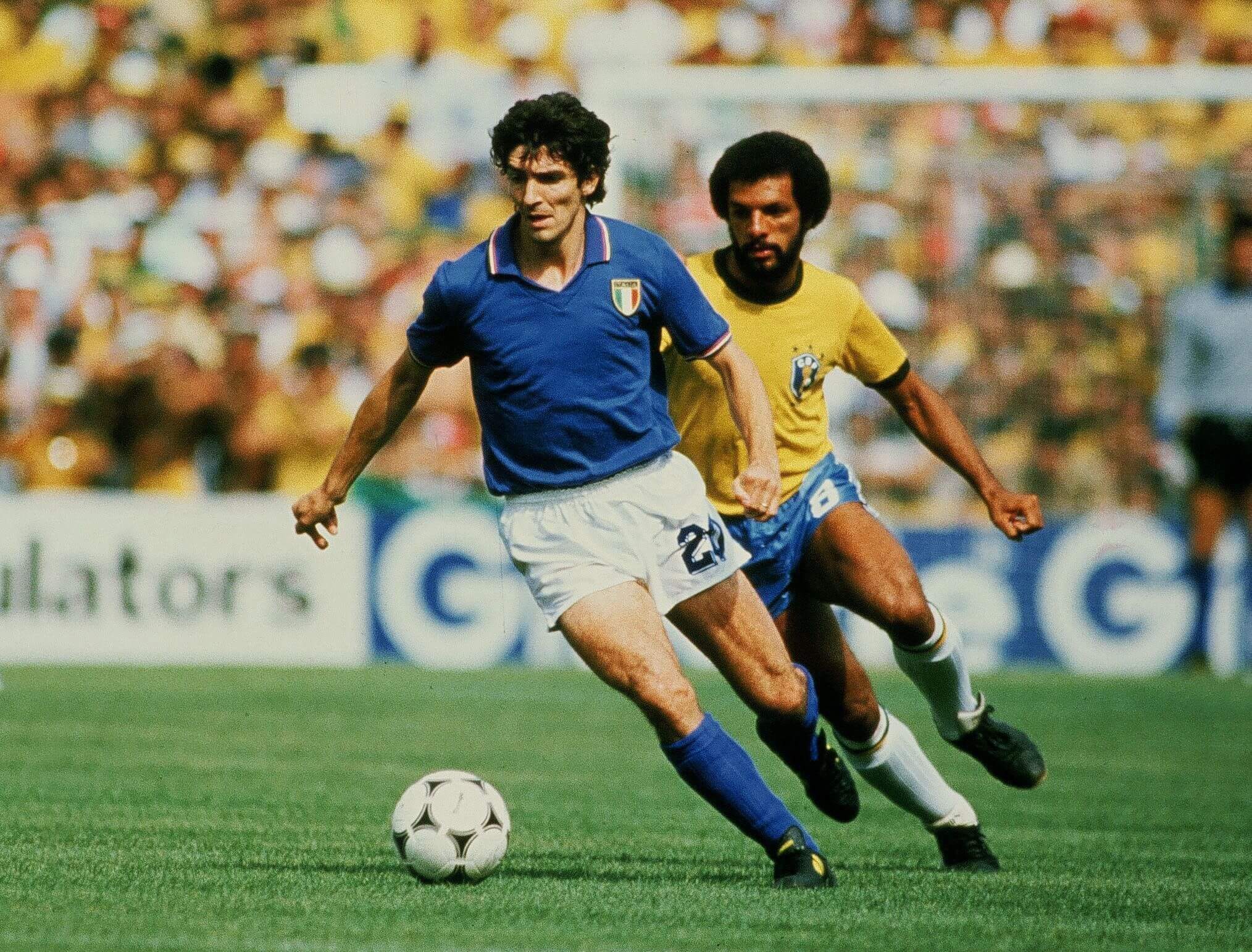
Rossi on the ball for Italy in 1982 against Brazil (Alessandro Sabattini/Getty Images)
The goals came in the fifth, 25th and 74th minutes with Brazil, through Socrates and Falcao, equalising twice but having no answer to Rossi’s third — as Italy’s 40-year-old goalkeeper Dino Zoff made a superb save late on to deny the South Americans the draw they needed.
The game had see-sawed magnificently and the more functional Italians went on to match Brazil’s then-record three World Cup wins by beating Poland in the semi-finals and West Germany in the final, with Rossi scoring three more times to pick up the Golden Boot.
Zico summed up how most Brazilians and many neutrals felt by proclaiming that it “was the day that football died” and Jonathan Wilson, in his book about the history of the World Cup called The Power and the Glory, wrote: “The consequences for Brazilian football were profound. The sense was that the return to the old ways had failed. Brazil’s football may have been beautiful, but they came up short. ‘From that moment on the emphasis changed to focus even more on results,’ Socrates said. ‘Brazilian football would never be the same.’”
And in a strange way, Brazil’s early elimination from that tournament 44 years ago has only added to their enduring appeal — with the team more fondly remembered than the country’s victorious sides in 1994 and 2002. Maybe Zico and Socrates were right.
9. Legendary Hungary team denied their crowning glory
1954 final: West Germany 3-2 Hungary
The Hungarian team of the early 1950s was one of the greatest in the history of football, with their dominance best encapsulated by their two myth-shattering thrashings of England in consecutive years.
Their ultimate fate, though, is to be remembered for the one match they lost rather than their futuristic setup and the sensational feats of, among others, Ferenc Puskas, Sandor Kocsis, Nandor Hidegkuti and Jozsef Bozsik.
That they were beaten in the 1954 World Cup final by a relatively ordinary West Germany side, who they had thrashed two weeks earlier in the group stage, remains one of the sport’s biggest anomalies.
Hungary were rampant and won 8-3 in that group game, though it should be noted that many of West Germany’s players had been rested. (The 1962 edition, where Brazil and Czechoslovakia played in the groups and final, is the only other World Cup where the finalists have met twice).
Overall, Hungary scored 25 goals in their four matches en route to the final, with Kocsis’ 11 for the tournament only bettered by France’s Just Fontaine’s 13 in 1958.
However, West Germany — who had been banned from the 1950 World Cup — grew as the competition progressed and they thrashed a good Austria team 6-1 in the semi-finals to set up the showdown in Bern with a Hungary team unbeaten in more than four years.
Perhaps more importantly than the West Germans’ improvement, though, was the fact Puskas — who at that point was the best footballer of all time and someone who remains in the top 10 — was suffering from an ankle injury that had kept him out of the quarter-final and semi-final; with much of the build-up to the final centred around whether he would play.
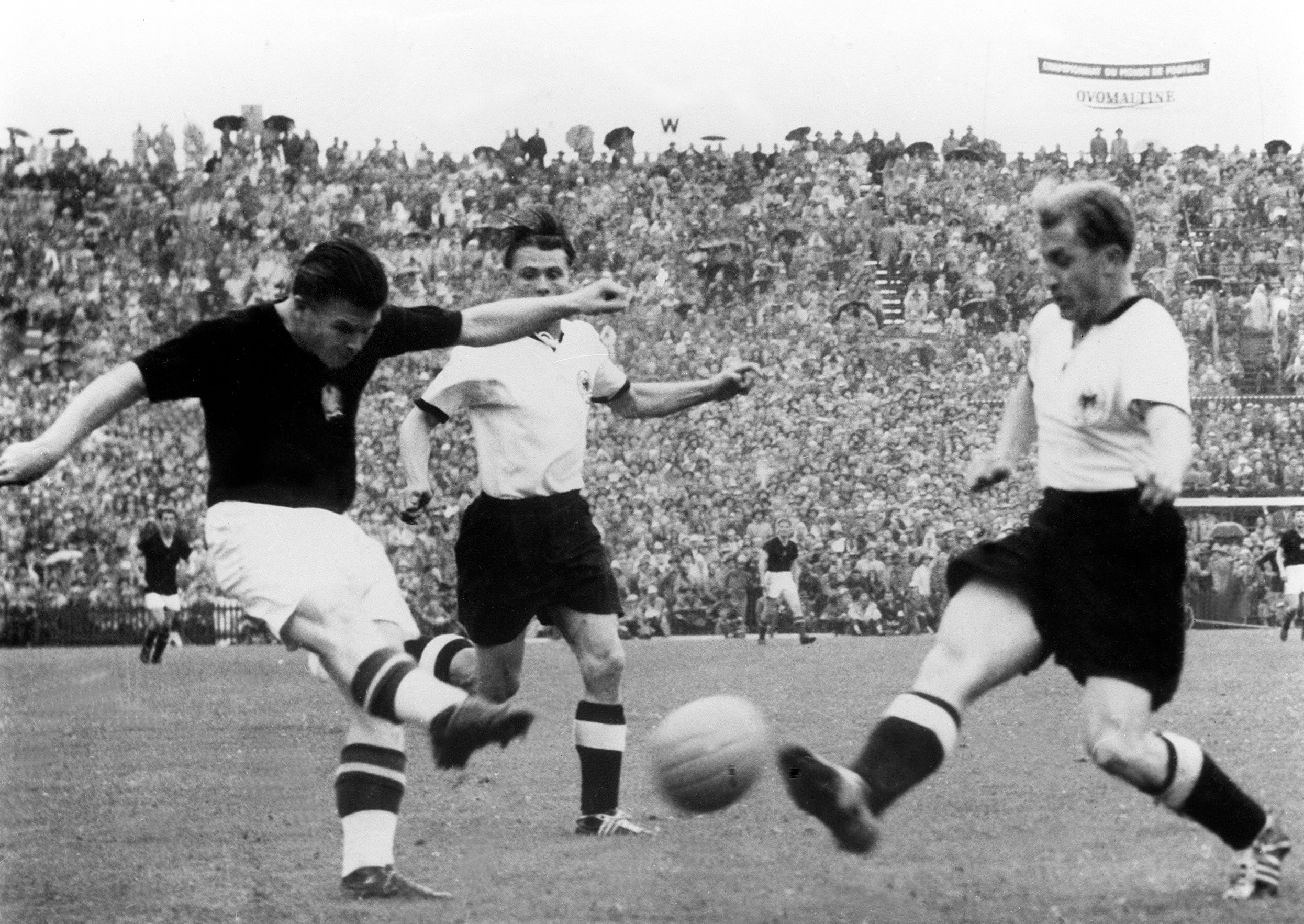
Puskas shoots against West Germany in the 1954 final (DB/Picture Alliance via Getty Images)
As Glanville wrote in his book: “In the event, however, Puskas did play; and it would prove a manifest mistake, a testimony to the captain’s own powers of persuasion rather than the good sense of (Gusztav) Sebes (manager and deputy minister of sport).”
The match, despite the torrential rain, was thrilling and ranks alongside 2022 as the greatest of World Cup finals. Hungary went 2-0 up in the first eight minutes thanks to Puskas and Zoltan Czibor. The West Germans fought back immediately and it was 2-2 just 10 minutes later, thanks to Max Morlock and Helmut Rahn.
At that point, Hungary realised, for once, that things might be different and this would not be another case of simply steamrolling their opponents. Glanville remarked: “It was becoming plain that for all the fury of their beginning, Hungary were not running smoothly. Puskas, clearly hampered by his ankle, was unwontedly heavy and slow.”
Rahn then made it 3-2 to West Germany with just six minutes left to put the Hungarians in full panic mode. They did almost force extra time, but Puskas’ late strike was adjudged to have been from an offside position (a decision that remains debated).
So one of the best teams the World Cup has ever seen left without the trophy and a West German side representing a nation still bearing the scars of the Second World War triumphed.
As Wilson noted in his book last year: “No World Cup win has ever been greeted by the winners with such ambivalence. Not even a decade had passed since the end of the Second World War. Quite apart from the complicated feelings of the east, for West Germany, only constituted in 1949, anything overtly nationalistic was to be avoided at all costs.”
An intriguing and potentially sinister sub-plot to the match is the reports that syringes were found in the West German dressing room, with an investigation by researchers at Humboldt University and the University of Munster in 2013 concluding that it was likely the players were injected with methamphetamine.
Whatever the truth, Hungary’s football team has never been the same since, whereas the Germans have won the tournament three more times.
8. The first World Cup final and a sign of things to come
1930 final: Uruguay 4-2 Argentina
The invention of the World Cup ranks as one of the most consequential moments in all of sport and the fact the inaugural tournament in 1930 was marred by withdrawals, arduous travel and poor pitches is now just a distant chapter in its storied history.
The edition wasn’t all bad, though, far from it. Many of the matches were exciting and hosts Uruguay were probably the best international team at any point before the Second World War (though their peak had been in the mid-1920s). Indeed, part of the reason the World Cup was created was so FIFA could offer an alternative to the then-prestigious football tournament contested at the Olympic Games, which the Uruguayans had won in style in 1924 and 1928 to become self-proclaimed ‘world champions’.
France were perhaps unlucky to go out in the competition’s groups (not helped by the two-week boat journey across the Atlantic) but the teams that made the final, Uruguay and Argentina, were the best at the tournament.
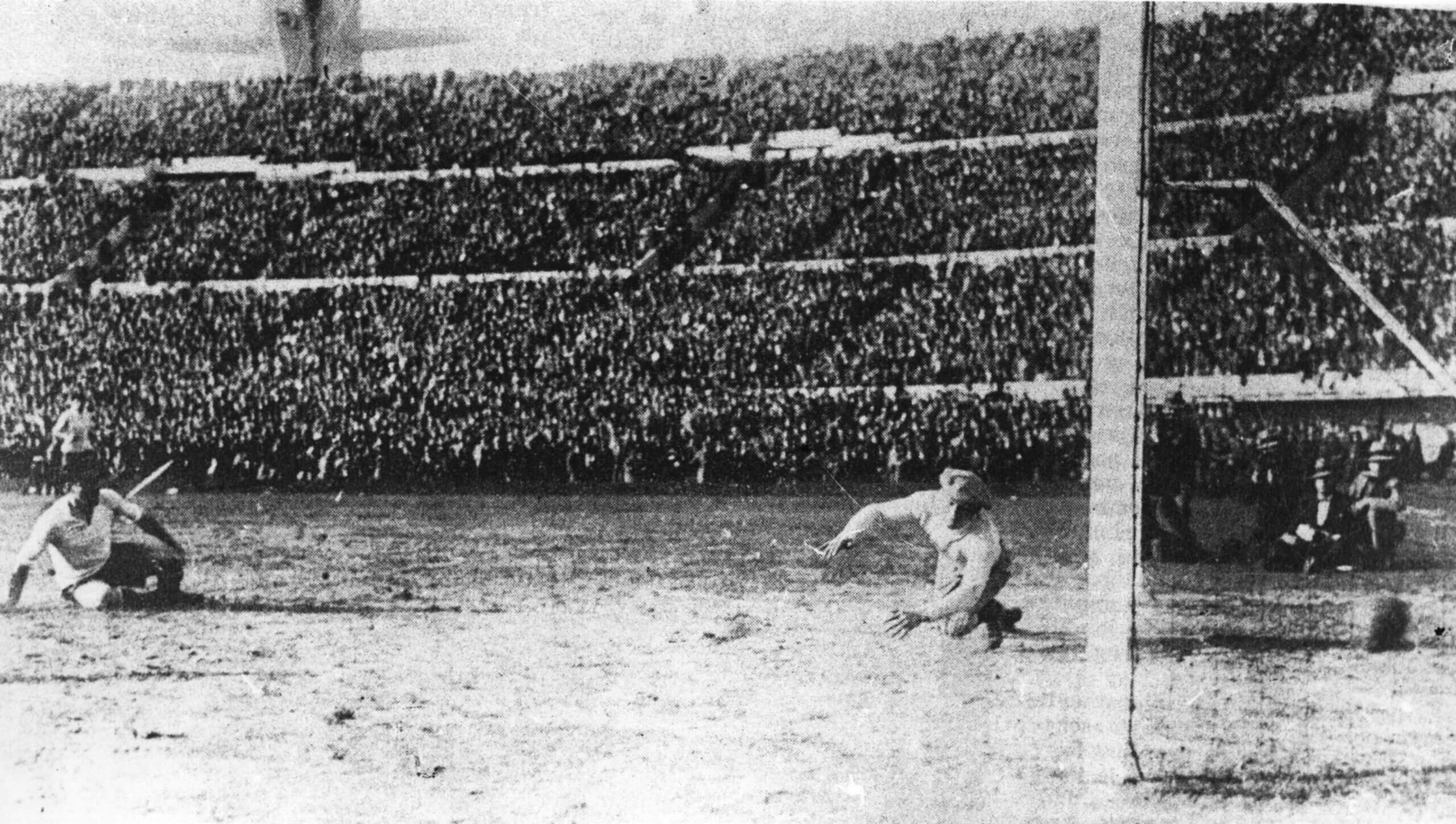
Uruguay score against Argentina in the 1930 final (Allsport/Hulton)
The two South American sides served up a great game in front of a manic crowd which, as well as locals, contained thousands of Argentinians who had been brought over on boats just for the occasion.
In the first of four World Cup finals to finish 4-2, Uruguay fought back from 2-1 down and sealed victory in the 89th minute when Hector Castro, who had lost his right forearm in a childhood accident, delivered a thumping finish.
The build-up to the game had been dominated by the question of which ball would be used, as each side had played with their preferred one en route to the showpiece.
It has long been believed that the Argentinians’ choice of ball was used in the first half and the Uruguayans’ in the second. However, as The Athletic’s Cox pointed out last year in his article on the hosts’ victory, no real evidence exists to support this and it is more likely that Argentina won the toss and got to play with theirs throughout the match.
If so, it wasn’t enough and a great Uruguay team’s denouement was a deserved triumph on home soil that kickstarted the most popular sporting competition in the world.
7. Total Football’s nearly moment
1974 final: West Germany 2-1 Netherlands
It has largely been forgotten now, but the superb Total Football-playing Dutch team from the 1974 World Cup almost didn’t qualify for the competition — only pipping neighbours Belgium on goal difference following a tense 0-0 draw between the sides.
Once at the tournament, though, they were majestic — with captain Johan Cruyff, playing in his only World Cup, typically outstanding.
In a devilishly-hard run to the final, they won their first group containing Sweden, Bulgaria and Uruguay and then also topped their second, with victories over Argentina, East Germany and Brazil.
Their opponents in the decider in Munich were host nation West Germany, whose path to the final had been smoothed as their surprise loss to East Germany in the first group stage (the only time the two Germanys played) meant they fortuitously went into the easier second-round pool with Poland, Sweden and Yugoslavia and avoided the big-hitters Netherlands had to get past.
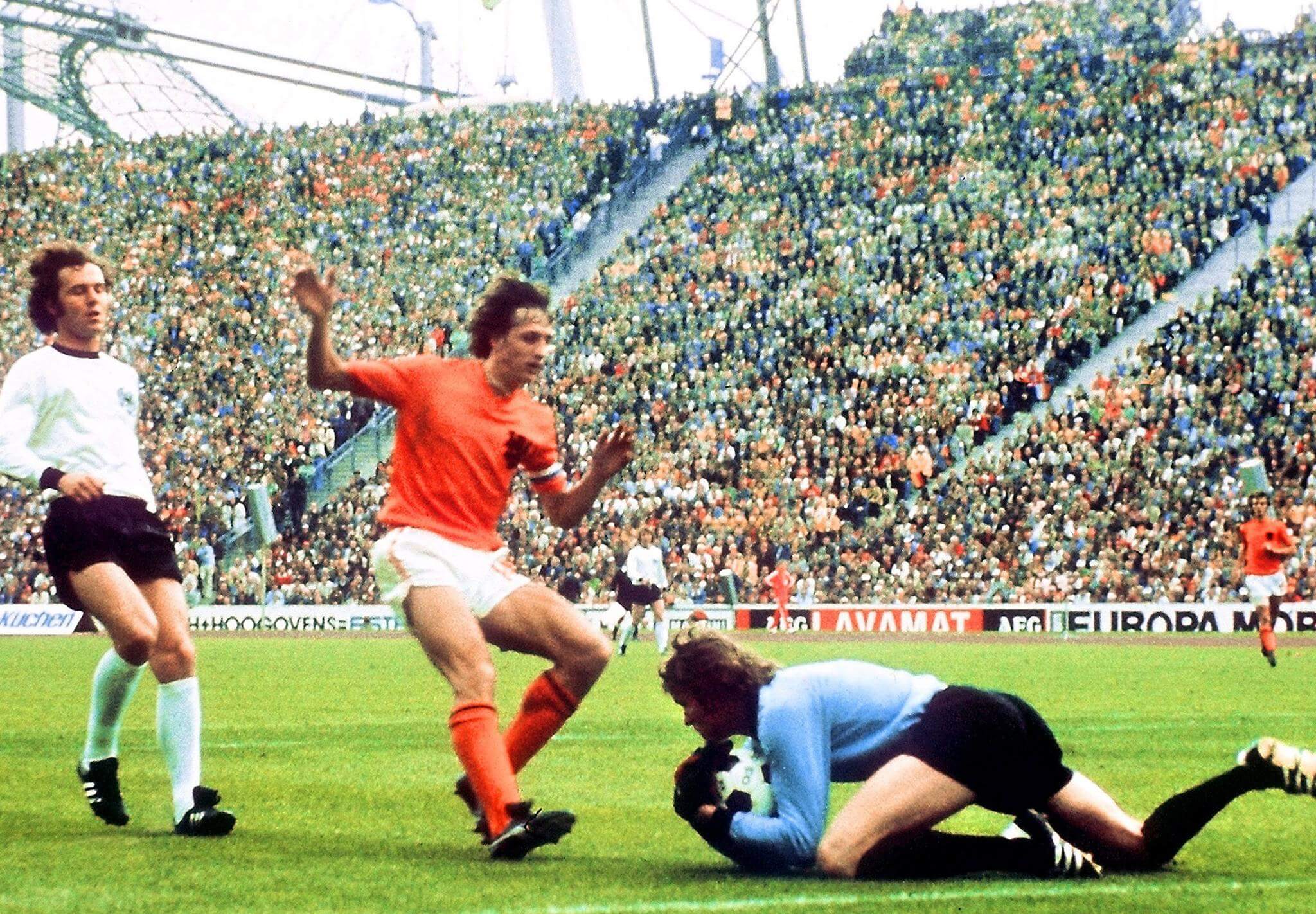
Cruyff is denied in the 1974 final (Staff/AFP via Getty Images)
The hosts were still a great team, though; they had won Euro 1972 and, as well as home advantage, in sweeper Franz Beckenbauer and centre-forward Gerd Muller, had Germany’s two greatest-ever players in their line-up.
Just like in their first World Cup triumph in 1954, West Germany went behind early in the deciding match. Cruyff’s first-minute run from the centre-circle began slowly as he scanned what lay in front of him, before an explosion of thought and speed — combined with dazzling footwork — saw him burst into the opposition penalty box to draw an inevitable foul.
Johan Neeskens converted the resulting penalty which was, for 23 minutes, the only one to be awarded in a World Cup final. Paul Breitner quickly equalised from the spot for the West Germans and then, just before half-time, Muller struck ruthlessly after controlling a cutback.
The goal not only won the World Cup for West Germany, it also meant Muller became the competition’s then-all-time top scorer with 14 goals (10 in 1970 and four in 1974); eclipsing Fontaine’s 13.
Remarkably, this and the 1978 edition were the only World Cups that Netherlands played in between 1938 and 1990; and they were runners-up in both. By the time the tournament reached Argentina four years later, though, the Dutch were not quite the slick — if defensively-flawed — outfit that played in 1974. For starters, Cruyff decided not to travel to South America as he feared for his own safety following a kidnapping attempt.
The Dutch also lost in the final in 2010, though nobody could reasonably argue they deserved to win that tournament ahead of Spain.
So, 1974 remains the high-water mark for Netherlands at the World Cup. And boy were they good that summer.
6. The emergence of the ultimate World Cup legend
1958 final: Sweden 2-5 Brazil
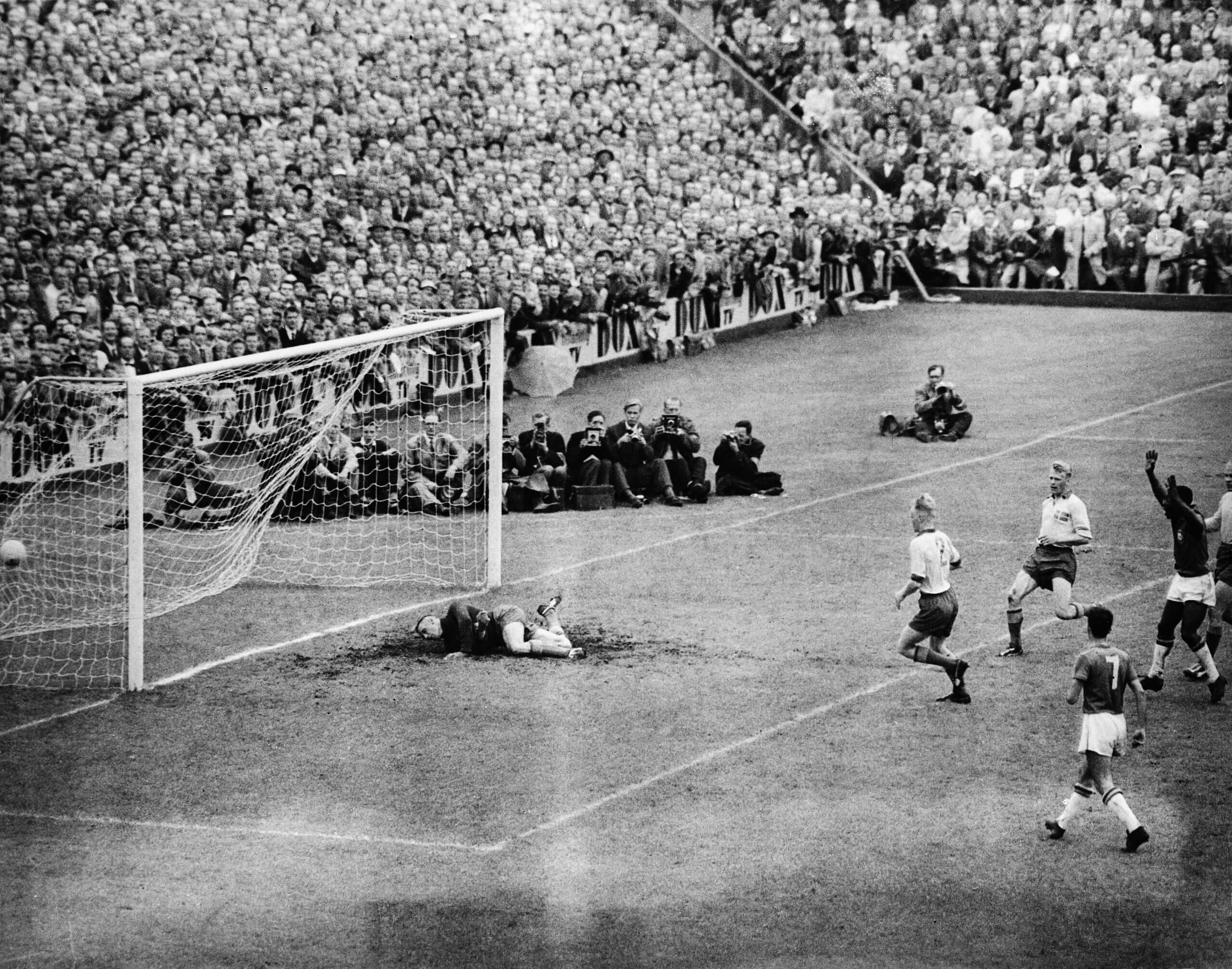
The first of Brazil’s record five World Cup wins is best remembered for the emergence of the 17-year-old Pele — the individual with whom the tournament is most closely associated.
That his pre-eminence still holds true, 56 years after last playing in the competition, is partly due to his unmatched three triumphs and the magnificent Brazilian sides he was at the heart of but, more than that, it is because the World Cup made him the first truly global footballing superstar.
It all started in Sweden in 1958, where Pele became, at the time, the youngest player to both play and score at the World Cup. The latter record still stands.
His performances that summer reached a crescendo in the knockout stage — netting against Wales in the quarter-finals, bagging a hat-trick in the last four against France and then scoring twice in the final against Sweden.
The showpiece against the hosts was the first genuinely one-sided final in the competition, with the Swedes unable to cope with Pele, Vava, Garrincha and the marauding Djalma Santos.
Pele scored Brazil’s third and fifth goals and, had his career ended then, he would still be comfortably nestled in the World Cup pantheon. As it was, he came back for three more bites at the cherry — with the last of those, in Mexico 12 years later, even more celebrated than this. More on that later.
Pele, arms aloft, celebrates scoring for Brazil in the 1958 World Cup final (Getty Images)
5. The hosts humiliated
2014 semi-finals: Brazil 1-7 Germany
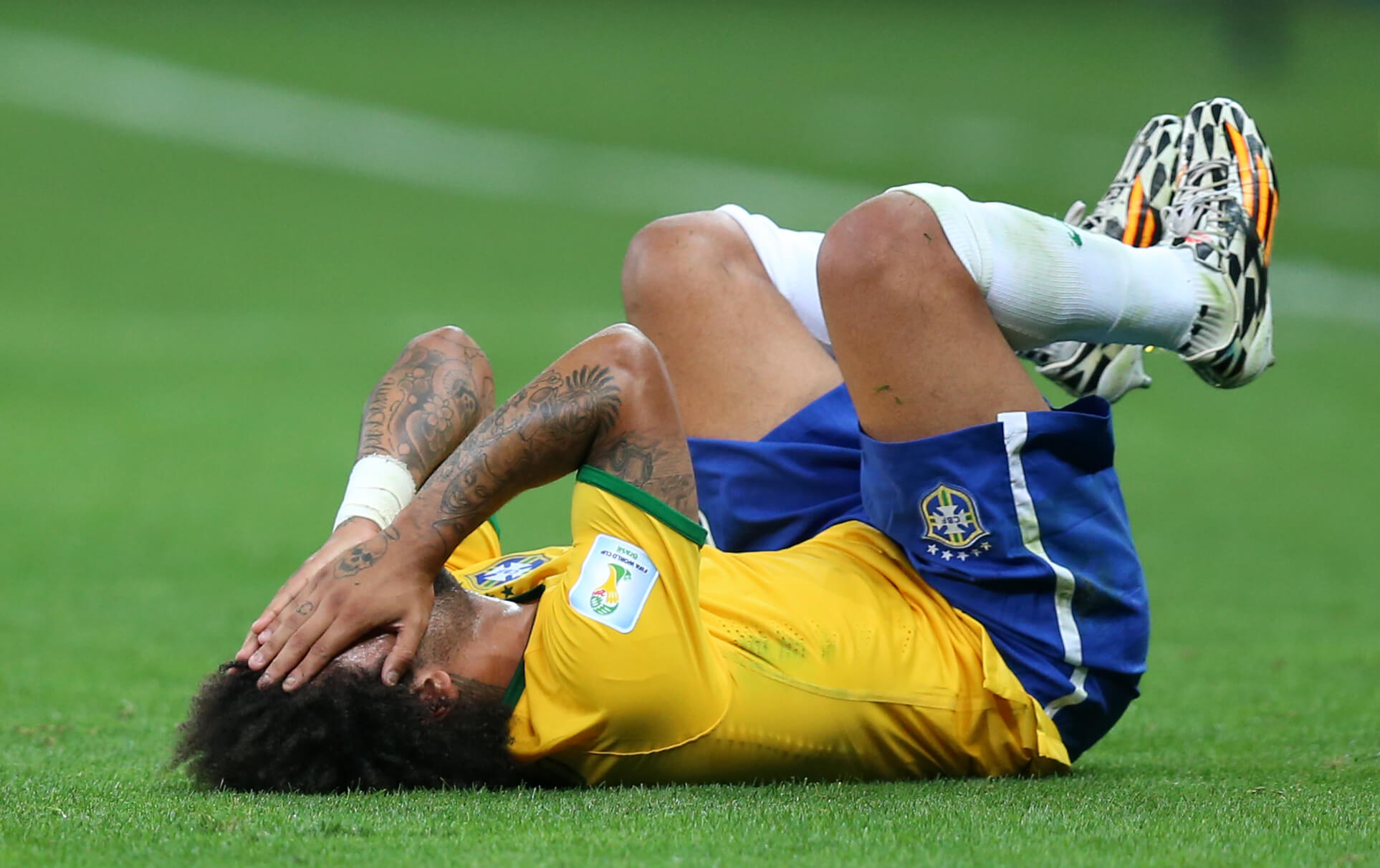
Perhaps the most shocking scoreline in World Cup history, Germany’s demolition of Brazil in Belo Horizonte was as much a triumph for the tournament’s eventual winners as it was cataclysmic for the host nation.
Lost in the Brazilian tears, anguish and confusion was just how clinical the Germans had been. The winners had four fewer shots, but were a supremely well-balanced side who scored with 70 per cent of their efforts on target.
Injury to poster boy Neymar and captain Thiago Silva’s suspension for the match, while weakening their team on the pitch, had done nothing to temper the expectations of 200 million football-obsessed Brazilians who demanded nothing less than a sixth World Cup triumph.
That those hopes were extinguished so ruthlessly only added to the shock of both those supporting and playing.
The match is also notable for Germany’s Miroslav Klose becoming the tournament’s all-time top scorer. His goal — the second of the night — was his 16th in World Cup matches.
This is actually the closest Brazil have got to the final since last winning the competition in 2002, but given their status as hosts and the almighty expectation that came with it — coupled with the humiliating nature of their exit — the defeat must be seen as the country’s most traumatic at the World Cup since losing to Uruguay in the deciding match in Rio de Janeiro in 1950.
The period of mourning was profound and continued long after Germany’s Philipp Lahm had hoisted the World Cup aloft in the Maracana five days later.
Brazil defender Marcelo’s reaction captured the emotions of a nation in 2014 (Mike Egerton/PA Images via Getty Images)
4. The magic and mischief of Maradona
1986 quarter-finals: Argentina 2-1 England
The quality of Diego Maradona’s overall performance at the 1986 World Cup remains without parallel in the competition’s history.
Glanville wrote in The Story of the World Cup: “It will always be remembered as Maradona’s World Cup. In an era when individual talent was at a premium, defensive football more prevalent than ever, Maradona — squat, muscular, explosive, endlessly adroit — showed that a footballer of genius could still prevail.”
Maradona and Argentina played seven games at that tournament in Mexico and it is the fifth of those, the quarter-final against England, which is the most notable.
This would perhaps still be true even if Maradona hadn’t scored arguably the two most famous goals in the tournament’s history in the game, because the off-field background to the match was the bloody, 74-day Falklands War between Argentina and the United Kingdom that had taken place in 1982.
As Paul Hayward wrote in his book England Football: The Biography, 1872-2022: “The graphic nature of the fighting, broadcast in gory detail on television, left a trail of acrimony. It invaded the consciousness of each side.”
Years later, in his autobiography, Maradona remarked: “Before the match, we said that football had nothing to do with the Malvinas War. But we knew a lot of Argentinian kids had died there.”
However, the game — which was played on a dreadful pitch in front of almost 115,000 people at the Azteca Stadium in Mexico City — will forever be remembered for Maradona’s two goals that perfectly encapsulated the split-screen feel to his career. He was a player who scaled previously unprecedented footballing heights but was never far from controversy, including heavy cocaine use, mafia links and on-field violence.
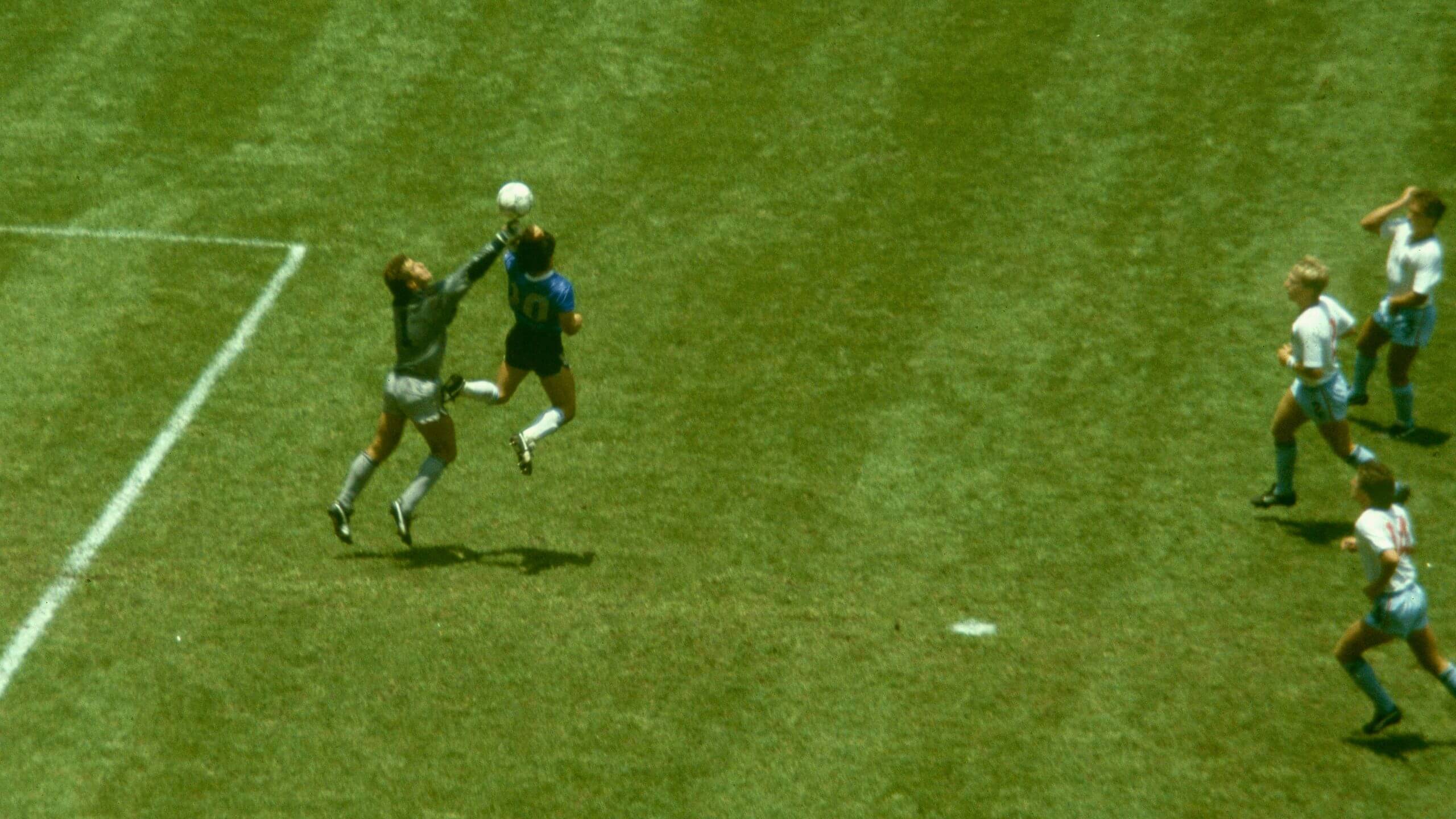
The first goal, in the 51st minute, is still widely considered one of the most controversial moments in the World Cup’s history and the second, just four minutes later, one of the best ever scored.
Punching the ball over England goalkeeper Peter Shilton to make it 1-0, an act immortalised as The Hand of God, was, depending on who you listen to, either an egregious act of cheating or a cunning ploy that should be applauded for its ingenuity.
Maradona’s Hand of God goal is one of the iconic moments in the sport’s history (Allsport/Getty Images)
The second goal, meanwhile, epitomised the astonishing levels of natural ability Maradona possessed; with the ball seemingly superglued to his feet during his wondrous, breathtaking run from inside the Argentina half that ended with him scoring from a few yards out.
It is best summed up by Bryon Butler’s live commentary for BBC radio: “Maradona turns like a little eel and comes away from trouble. Little squat man, comes inside Butcher, leaves him for dead, outside Fenwick, leaves him for dead… and puts the ball away. And that is why Maradona is the greatest player in the world! He buried the England defence!”
Gary Lineker got one back for England but it wasn’t enough and Argentina went on to beat Belgium in the semi-finals (with Maradona again magisterial) and then West Germany in the final, where the 25-year-old was subdued due to heavy marking but still laid on the winner for Jorge Burruchaga.
The final word should come from England’s manager at that tournament, Sir Bobby Robson, who commented: “Let’s just say that without Maradona, Argentina would have no chance of winning the World Cup. That’s how great he is.”
3. Messi’s crowning glory
2022 final: Argentina 3-3 France (Argentina won 4-2 on penalties)
Lionel Messi would not have been any less a footballer if Argentina had been defeated by France in the penalty shootout that decided the 2022 World Cup final. Nor would he have been if his team hadn’t even got close to winning that tournament in Qatar.
Yet the hold the World Cup has over the footballing public’s imagination is such that Messi’s already pinch-yourself career would have been seen as incomplete if he hadn’t won the game’s biggest prize. That he was Maradona’s heir, and that his illustrious predecessor won the competition almost single-handedly, only added to the sense that it would be a case of destiny unfulfilled if he was not able to lift the trophy.
Argentina went into the tournament as one of the favourites, unbeaten in 36 games and fresh off the back of winning Copa America the previous year — Messi’s first international trophy. At 35, he was no longer quite the player he had been for much of the 2010s but was still a devastatingly-effective passer, finisher and dribbler.
Suggestions that he might play in the 2026 edition were then seen as fanciful, so it was Qatar or bust — with the loss to Saudi Arabia in Argentina’s first game feeling seismic.
Everything changed, though, after Messi’s sublime 25-yard strike against Mexico in the second match put his team on the path to reach the knockout stage.
Once there, a combination of Messi’s genius, goalkeeper Emiliano Martinez’s larger-than-life performances, a well-balanced team, and — it must be said — some unsavoury moments of skullduggery by several players, helped Argentina battle their way to the final against defending champions France.
It felt like the right final. They had been the two best teams at the tournament and France, in the then-23-year-old Kylian Mbappe, had the game’s young superstar in their ranks, who was bidding to win his second World Cup.
A virus plagued the French camp before the game, so Didier Deschamps’ side’s preparations for the showdown were far from ideal. Nevertheless, the outcome heading into the match was too close to call.
That changed rapidly as Argentina flew out of the traps and picked apart their jaded opponents, going 2-0 up after 36 minutes, with the first goal a Messi penalty.
Deschamps, who was bidding to become the second manager to win the World Cup twice — after Italian Vittorio Pozzo in 1934 and 1938 — acted decisively by making a first-half double substitution in which Randal Kolo Muani and Marcus Thuram replaced Ousmane Dembele and Olivier Giroud.
France recovered somewhat but were still two goals down as the clock approached 80 minutes. Then, in a flash, everything changed. Kolo Muani was brought down in the penalty area after an incisive run and Mbappe converted the spot kick.
Less than two minutes later, Messi lost the ball near the halfway line and a France move ended with a sumptuous, crushing Mbappe volley hitting the back of the net.
Given the occasion and what was at stake, extra time — and in particular the last five minutes of it — must surely be considered among the most exciting spectacles sport has ever produced.
Messi scored again, Mbappe held his nerve from the spot again and the thrilling, end-to-end action culminated in Martinez’s astonishing one-on-one save from Kolo Muani and then Lautaro Martinez’s missed header from the resulting breakaway.
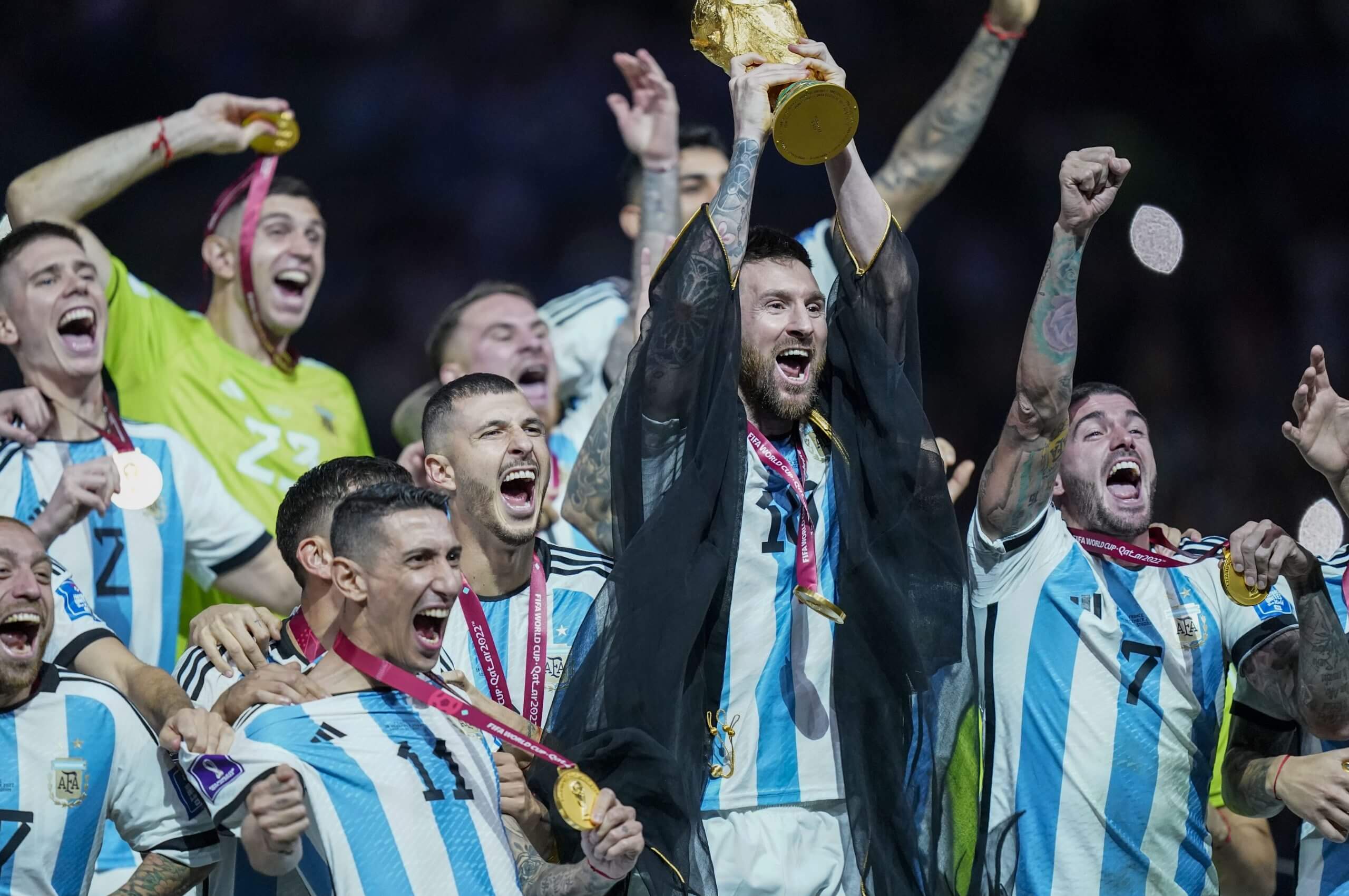
Argentina triumphed in the subsequent penalty shootout to pick up their third World Cup and, crucially, Messi’s first. The captain sank to his knees on the halfway line, mobbed by his exultant team-mates.
His status as the game’s best secure, Messi lifted the trophy in a bisht that had been placed upon him — obliged to share his greatest triumph with the geopolitical forces that had brought the World Cup to the Middle East for the first time.
Messi wears a bisht to lift the World Cup trophy in 2022 (Jabin Botsford/The Washington Post via Getty Images)
2. The worst day in Brazil’s sporting history
1950 final round: Brazil 1-2 Uruguay
Maracanazo. It has its own name. The worst day in Brazil’s sporting history.
The chapter about the 1950 World Cup in Wilson’s history of the competition begins: “‘You players,’ the mayor of Rio de Janeiro, Angelo Mendes de Moraes, said before kick-off, ‘will be hailed as champions by millions of compatriots in a few hours!… You, who I already salute as victors! I fulfilled my promise, building this stadium. Now, do your duty and win the World Cup!’.”
This was spoken on the public address system at the Maracana in Rio de Janeiro and the occasion was the deciding match of a tournament that Brazil had hosted and, up until that point, dominated.
Uniquely, this edition did not have a final. Instead, the four group winners — Brazil, Spain, Sweden and Uruguay — progressed to a ‘final round’ which consisted of a round-robin pool.
As it transpired, the last set of games produced a de-facto final as first-placed Brazil took on second-placed Uruguay, with the host nation only needing a draw to win their first World Cup.
As can be discerned from De Moraes’ pre-match speech, confidence in Brazil was ridiculously high. The thought of failure was intolerable. Even if Uruguay did play the game of their lives, the quality of Brazil’s three main attackers, Jair, Ademir and Zizinho, would surely prove too much for them.
As Glanville wrote in his own history of the World Cup: “The mood in Brazil before the decisive match with Uruguay was one of bounding euphoria. How could they lose? How indeed, could they do anything but win?”
With around 200,000 people in attendance, Brazil dominated the start of the game and only the resolute nature of Uruguay’s defence, marshalled by the outstanding Obdulio Varela, prevented the hosts scoring before half-time.
Friaca put them 1-0 up soon after the break, though — meaning unless Uruguay could score twice, Brazil would be crowned world champions.
But the goal stirred something in Uruguay and, in the 66th minute, Juan Alberto Schiaffino equalised at the near post following a flowing move.
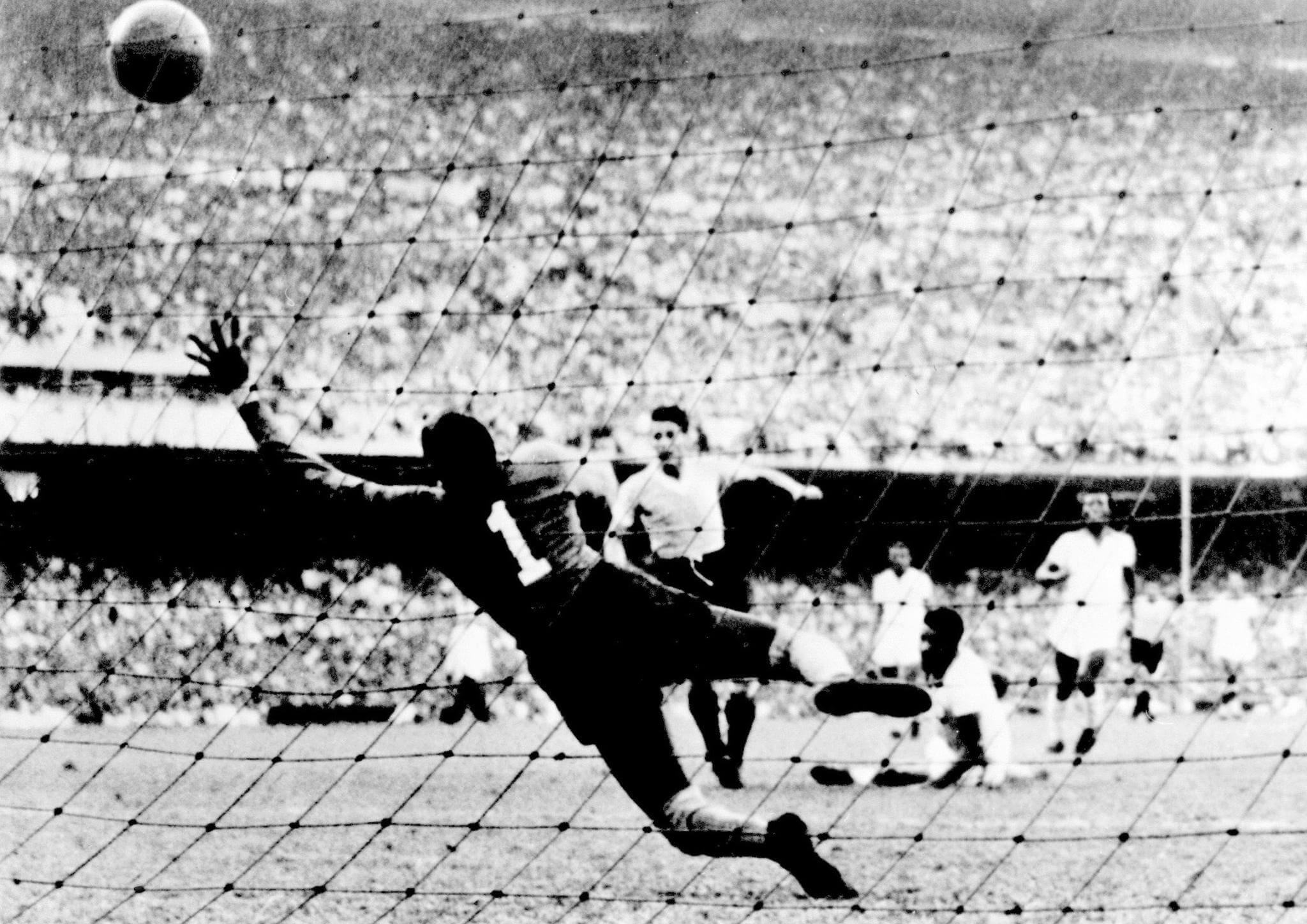
Schiaffino scores Uruguay’s first goal against Brazil (AFP via Getty Images)
It was at this point that the atmosphere in the stadium changed. The carnival-like jamboree quietened dramatically and jubilation was replaced by tension. The same happened on the pitch, Glanville commented: “It was Varela who bestrode the field, nonchalant and indomitable, masterfully breaking up and launching attacks, the old-school centre-half par excellence.”
Then, with 11 minutes to go, it happened. Alcides Ghiggia exchanged a one-two with his Uruguay team-mate Julio Perez, burst into the box and unleashed a shot that beat Brazil goalkeeper Moacir Barbosa at his near post.
Brazil did not come close to the equaliser they needed to win the tournament, with their shellshocked players unable to muster any attacks of substance.
The Maracana descended into silence at full time, as the nation struggled to comprehend what had happened. Brazilian writer Nelson Rodrigues’ remark that “everywhere has its irremediable national catastrophe, something like a Hiroshima. Our catastrophe, our Hiroshima, was the defeat by Uruguay in 1950”, is of course a gross exaggeration but highlights the depth of feeling.
Goalkeeper Barbosa was viewed in Brazil as the main culprit and, sadly and unfairly, suffered abuse for it for the rest of his life.
Uruguay, for their part, joyfully celebrated becoming the second team, after Italy, to win the World Cup twice.
An interesting legacy of the game is that up until that point, Brazil’s first-choice kit had been a white top and shorts with blue trimmings but, as a result of the defeat, it was changed to the famous yellow shirt and blue shorts we know today.
Generations of players have graced the changed strip, none of them more famous than Pele. Legend has it that, as a nine-year-old in 1950, he saw his father crying after the match and vowed to avenge the loss by winning the World Cup himself. He did, three times — with the last of those triumphs the most breathtaking of them all…
1. The immortalisation of the World Cup’s greatest side
1970 final: Brazil 4-1 Italy
The Brazil team that won the World Cup in 1970 is widely considered the best in international history, with the side immortalised by a glorious style of play, the advent of colour television and their blazing yellow shirts.
Their apotheosis came in the blazing afternoon heat of Mexico City on June 21, 1970, when they blew Italy away with a performance of unmatched beauty — summed up by their fourth and final goal, which saw captain Carlos Alberto finishing off a stunning team move with a thunderous strike.
Wilson noted: “Brazil by then had come to feel as though they were about more than games or results, more even than winning the World Cup: they were about an expression of football in its most beautiful form, about pushing the boundaries of human capability.”
Naturally, a big part of this was due to the players at their disposal and their tactical setup. As Cox wrote for The Athletic last August in his article on the team: “On one hand, this was the 4-2-4 approach that Brazil had used at previous tournaments. But it was looser, more free flowing. This side featured five players who were accustomed to playing No 10 for their club — Pele, Tostao, Rivellino, Jairzinho and Gerson, all world class.”
And while a 29-year-old Pele didn’t quite peak at the tournament, Jairzinho certainly did; scoring in every game after finally being granted his wish to play on the right for his country.
The team was managed by Mario Zagallo, who had won the World Cup as a player alongside Pele in 1958 and 1962. As pointed out by Cox, Zagallo was only brought in as manager in the March of 1970 after his predecessor, Saldanha, had fallen out with Brazil’s dictatorial president Emilio Medici.
It worked, though, with a hands-off Zagallo seeing his team beat Czechoslovakia, defending champions England and Romania in the groups before dispatching Peru in the quarter-finals and Uruguay in the semi-finals.
The Italian team that awaited in the decider had just come through a remarkable semi-final against West Germany in near-unplayable temperatures, with their tournament dominated by the debate surrounding midfielders Sandro Mazzola of Inter and Gianni Rivera of Milan.
As John Foot wrote in his book Calcio: A History of Italian Football: “Neither Mazzola nor Rivera, he (manager Ferruccio Valcareggi) believed, could play 90 minutes in the Mexico heat. Neither could be left out completely. So it was to be one half each (in the knockout stage). This compromise worked well until the final, when Valcareggi broke his own rules, giving Rivera a token six minutes (and leaving Mazzola on) with Italy already 3-1 down.”
This decision, and perceived mismanagement, has gone down in Italian footballing history; but even if Valcareggi had found a way to simultaneously get the best out of these two masterful midfielders, his side would still have been no match for Brazil.
Pele, Gerson and Jairzinho all scored for the team in yellow before Carlos Alberto’s piece de resistance.
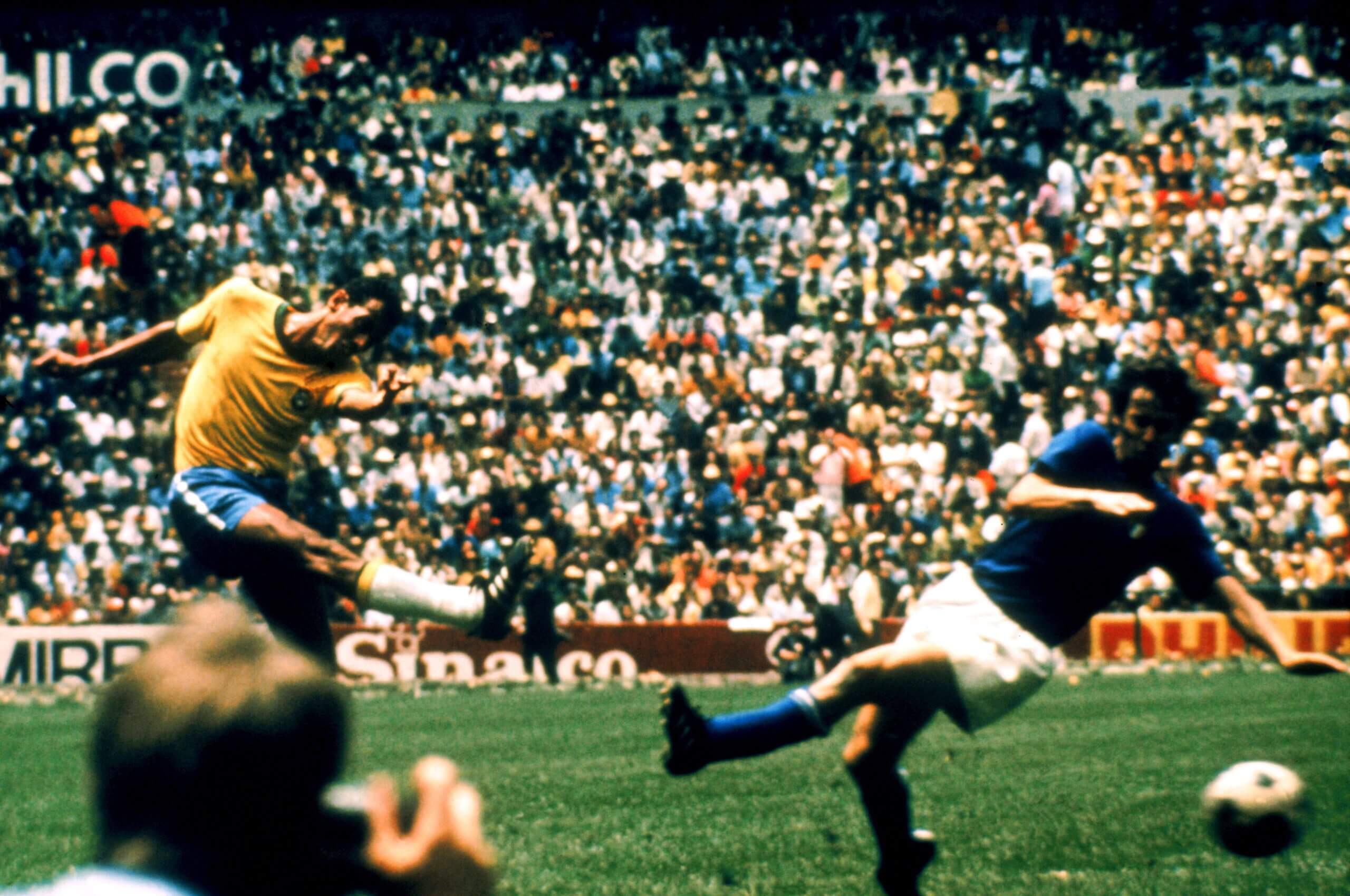
Carlos Alberto scored one of the iconic World Cup goals in the 1970 final against Italy (Peter Robinson/Empics via Getty Images)
That fourth goal, which ranks alongside Maradona’s second against England in 1986 as the best in World Cup history, involved almost the entire Brazil team and included several individual moments of brilliance: Clodoaldo effortlessly beating four opponents in his own half, Jairzinho’s turn, run and then pass to Pele, the nonchalant lay-off that follows and then Carlos Alberto’s thumping finish.
It is fitting, given the standard of that Brazil team, that their victory over Italy earned them the right to keep the Jules Rimet trophy by virtue of becoming the first country to win the tournament three times.
They also won every match they played without needing extra time at any point, a feat only matched by Uruguay in 1930 and Brazil again in 2002.
Ultimately, though, no words can truly do justice to the majesty of their play. You are best served by simply watching videos of them at their very best.