
Jurgen Klopp is back.
Two years after leaving Liverpool, exhausted after nearly a decade in charge, Klopp has agreed to become head coach of the German national team until 2030. This was confirmed on Friday morning.
What a strange road this has been, one that has wound towards a moment which has really been a long time in the making.
Most recently, Klopp’s career had taken an odd turn. He has spent the last 18 months as Red Bull’s head of global soccer, performing a job that nobody was quite able to explain. He worked as a pundit during German television’s coverage of the World Cup, where he had a front-row seat to the country’s latest tournament disaster.
Now, following Julian Nagelsmann’s resignation, it is Klopp’s task to pick up the pieces and restore the morale of a footballing nation that, bluntly, is squandering its pedigree.
The agreement itself was relatively simple. As soon as Nagelsmann’s resignation was made official, Klopp and the German Football Association (DFB) indicated their willingness to reach an agreement. They found the outline of a deal quickly, agreeing in principle to a contract worth €7million-per-year (£5.98m; $8.01m) — roughly the same as Nagelsmann’s — which will run up to and beyond the next World Cup.
Officials from the German football association (DFB) flew to the United States on 10 June, holding talks with Klopp and his agent in New York. Those conversations were primarily strategic. Rather than being recruited simply to select players and pick a team, Klopp will be a head coach with a broad brief. After winning the World Cup in 2014, German football has suffered a succession of failures, losing parts of its identity along the way.
Klopp will be key to restoring it. Germany must win again and play with a recognisable style and without the brittle character that saw the team, most recently, crumble against Paraguay in the round of 32. But there are far-reaching issues that must also be resolved. German football is not producing the players it once did, either in volume or type. There are few natural goalscorers or defensive specialists comparable to those from previous generations. There is a paucity of skilful risk takers, too, and Klopp, who is already part of a Bundesliga (DFL) working group investigating why, will further examine these problems from a new vantage.
Advertisement
Financially, his agreement is broadly the same as Nagelsmann’s. In terms of scope, it is very different. Nagelsmann was a coach and a selector. Klopp has a far bigger mandate and, contrary to expectation, he has been granted a full release by Red Bull managing director Oliver Mintzlaff. He will have no ambassadorial function for his previous employer, nor will he have any further contractual obligation to them.
Instead, the DFB will be making a €1m contribution to Red Bull’s charitable foundation, and he will be fully committed to restoring the Germany national team from this new low. Three internationals will also take place in Leipzig, as confirmed by German FA president Bernd Neuendorf on Friday.
How it got here and how Klopp became the solution is an interesting story.

Nagelsmann’s popularity had been on the wane for months. The home European Championship in 2024, where Germany reached the quarter-final, was a relative success. The team played well, and the elimination to eventual winners Spain was no disgrace.
There was little evolution on the pitch and no sense that the team was growing or improving. While Nagelsmann’s appointment in September 2023 was seen as a coup by the DFB and initially popular, enthusiasm began to dwindle thanks to the team’s poor form and off-field issues that never quite went away.
In April 2025, Nagelsmann had to telephone striker Deniz Undav to apologise for his clumsy remarks about his starting credentials made after the Stuttgart forward had scored a winning goal in the friendly against Ghana.
Advertisement
Weeks before the tournament, having consistently denied that Neuer would return from international retirement and play at the World Cup, Nagelsmann picked the veteran and jettisoned Oliver Baumann, the Hoffenheim goalkeeper who had established himself as the country’s first choice in Neuer’s absence.
Whether Nagelsmann was right in either case is largely irrelevant; both decisions were made from a relatively weak position and helped change the tone of the conversation around the national team. Grumbling about the inclusion of Leroy Sane and Leon Goretzka, both of whom were seen as having been picked on reputation, hardly helped either, meaning that by the time Germany arrived at their North Carolina base for the tournament, all the bullishness that followed Euro 2024 had been replaced by disparate media agendas and trepidation over the team’s structural flaws.
The tournament itself hardly improved the mood. Sane’s continued selection was deeply divisive. Undav’s role became a perpetual source of conflict. And the use of Joshua Kimmich, the captain, as a right-back rather than in midfield proved extremely unpopular. By the time Germany were eliminated by Paraguay, on penalties for the first time in tournament history, they looked a team saddled by neuroses and self-doubt.
The media diagnosis was erratic. Players’ families were too involved, claimed former Germany captain Lothar Matthaus in Bild, as reported by t-online. Communication between Nagelsmann, his coaching staff, and certain players was not what it needed to be, insisted others.
Among the tittle-tattle and self-preservation, the truth was less complicated: Germany were just not good enough, either in performance or composition.

Klopp’s road to and experience at the 2026 World Cup was wildly different.
After leaving Liverpool in the summer of 2024, he was appointed as Red Bull’s global head of soccer.
The announcement was shocking. Red Bull’s presence in German football is terminally unpopular, and Klopp’s decision was not greeted warmly; supporters from his previous clubs, Mainz and Borussia Dortmund, displayed critical banners at matches over the weeks that followed.
Klopp’s actual role was harder to understand. At his unveiling in January 2025 in Salzburg, he described how he would oversee the organisation’s different football teams, spending time between Europe, South America and Asia. He would provide advice and experience, he said, and be a resource for coaches across the network.
The takeaway quote from that afternoon, when he sat between a Formula One car and a Red Bull-branded helicopter while in conversation with managing director Oliver Mintzlaff, was that Klopp was to become the company’s “Doctor Football”.
Over the next 18 months, nobody really found out what that meant. Klopp was clearly an important asset in the signing of players; more than one has spoken of his impact on their decision to join. His presence in hospitality boxes and corporate environments has unquestionably been to Red Bull’s advantage, too, but his input into coaching decisions, while real, has been harder to pin down.
In fact, much of his profile — presumably to Red Bull’s chagrin — has come in connection with vacant positions around Europe. When Xabi Alonso was sacked by Real Madrid in January, Klopp was repeatedly linked to the post. That speculation was inaccurate, and no meeting ever took place. Klopp’s representative also expressed irritation at his name being used for political capital within Madrid’s presidential elections and, again, issued public denials.
The issue that has never gone away is international management. For Klopp, who has long held that ambition, but also for the German people, for whom he represents something unique.
Klopp has been a presence on German television for over 20 years. After the national team’s failure at Euro 2000, Klopp, then coaching Mainz in the 2.Bundesliga, appeared on a Sport1 chat show with Ralf Rangnick and Paul Breitner to discuss what, at the time, was an historic low point. Breitner, the iconic former Bayern Munich and Germany defender, offered a traditional diagnosis, mourning lost mentality and an inability to cope with pressure. Klopp, alongside Rangnick, was more analytical.
Advertisement
As recounted in Raphael Honigstein’s biography, Bring The Noise, he and Rangnick “pinpointed the two most important reasons for German football’s problems: weakness in youth development and the failure to understand football as a collective game.”
Fast forward three years and Klopp was working for ZDF at the 2006 World Cup. He was armed with a digital touch screen and a gift for making complicated football ideas simple, with a personable quality that spoke to viewers at home, the hardcore and casual fans alike.
It helped that 2006 was a reviving moment in the sporting and social sense for the national team, and that Klopp became entwined with what, today, is remembered as the “Summer Fairytale”. The more significant effect of his 2006 work, the 2003 Sport1 appearance and his punditry at the 2010 World Cup — and everything in between — was that it made him both enormously popular and, in a way, television’s version of a national team head coach.
In the 16 years since, his star has obviously brightened. He won a Bundesliga and DFB-Pokal double at Borussia Dortmund and then built his Premier League and Champions League-winning teams at Liverpool. Back in Germany, he has rarely been off the television. Klopp advertises beer, gym equipment, financial planning services, moisturisers and all sorts of other products, making him a near-constant presence.
For the 2026 World Cup, that was even more the case.
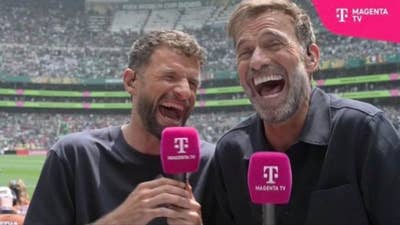
Alongside Muller, he was a star pundit for Magenta TV, the German streaming service with rights to every game. It meant that while national team coaches had been stalked by the spectre of Klopp before, none of them had ever experienced that problem in quite such a literal way. The oddity of that dynamic was immediately apparent, even before the opening game against Curacao.
Muller and Klopp were pitched as a double act. They were jovial and loose, wearing replica shirts and having a good time, and sometimes that got out of hand. After Klopp had drawn a media rebuke for suggesting that Undav replace Jamal Musiala in Germany’s starting line-up, he was more conciliatory on the following night’s broadcast, telling the people at home “not to worry, because Julian Nagelsmann was picking the team. For now”.

That “for now” hung in the air, with Muller laughing nervously in response. Everybody knew that Klopp would be the favourite for Nagelsmann’s job if the tournament ended badly and he was pilloried, with former internationals Andreas Moller, Stefan Effenberg and Matthaus all expressing their disapproval and accusing him of causing a needless distraction.
Advertisement
Klopp apologised to Nagelsmann on air after the Curacao game, but it set the tone for the rest of the tournament. Every time Germany turned in a disappointing performance, Klopp would explain why and recommend how it could be improved. It could be entertaining, but it was also uncomfortable.
During his half-time analysis of the Paraguay game, given when Germany were 1-0 behind, Klopp brutally dismantled the defending that had led to the game’s only goal and said that performance, which was static and unimaginative. It “brought tears to the eyes”.
It’s possible to sympathise with Nagelsmann. He is not as naturally charming as Klopp and is not as comfortable in the spotlight. However, his exchanges with the media could still be needlessly blunt or overly defensive.
After the defeat to Ecuador, Johannes B Kerner, the veteran presenter and journalist, asked Nagelsmann whether his players, having already qualified, showed enough application to beat a determined opponent. “Stop with that nonsense,” Nagelsmann responded, before some of his players — including Kimmich — directly contradicted him in the mixed zone, conceding that Ecuador had “wanted it more”.
It was nothing more than a mistake, but it was an error that nobody would imagine Klopp making.

A few days later, after the defeat to Paraguay on penalties, the cameras lingered on Nagelsmann in his dugout, where he rocked back and forth, paralysed by what had just happened. And there was Klopp, on television, addressing the nation, and knowing exactly what to say about what needed fixing.
The optics were difficult to ignore, and by that point, the next steps were inevitable.
There were still strong defences of Nagelsmann. Toni Kroos and Felix Kroos, in conversation with Michael Ballack on their TikTok channel, took issue with the availability of talent, saying that Germany do not “have a single world-class player. We have players with world-class potential. But that’s a long way from saying they’re world-class”.
Advertisement
Arsene Wenger, speaking on the same podcast, said that Nagelsmann had not “made any major mistakes in this tournament… You can see in this tournament just how important a proper goalscorer is… Germany don’t have one at the moment.”
But both were describing a task and a job that was bigger than Nagelsmann. He is a head coach and a good one, but Wenger and Kroos each diagnosed problems with talent-development, playing style and infrastructure, well beyond the remit and standing of — frankly — anyone other than Klopp.
Nagelsmann resigned on July 3. That night, before England’s game against DR Congo, Klopp appeared again on Magenta to discuss the situation unfolding in front of him.
“We need to change things fundamentally,” he said, which was probably the first time all tournament that the Germans back home were all nodding in universal agreement.
And now he will be the one charged with delivering that fundamental change. Germany wants that, too, and has done for a long time.