
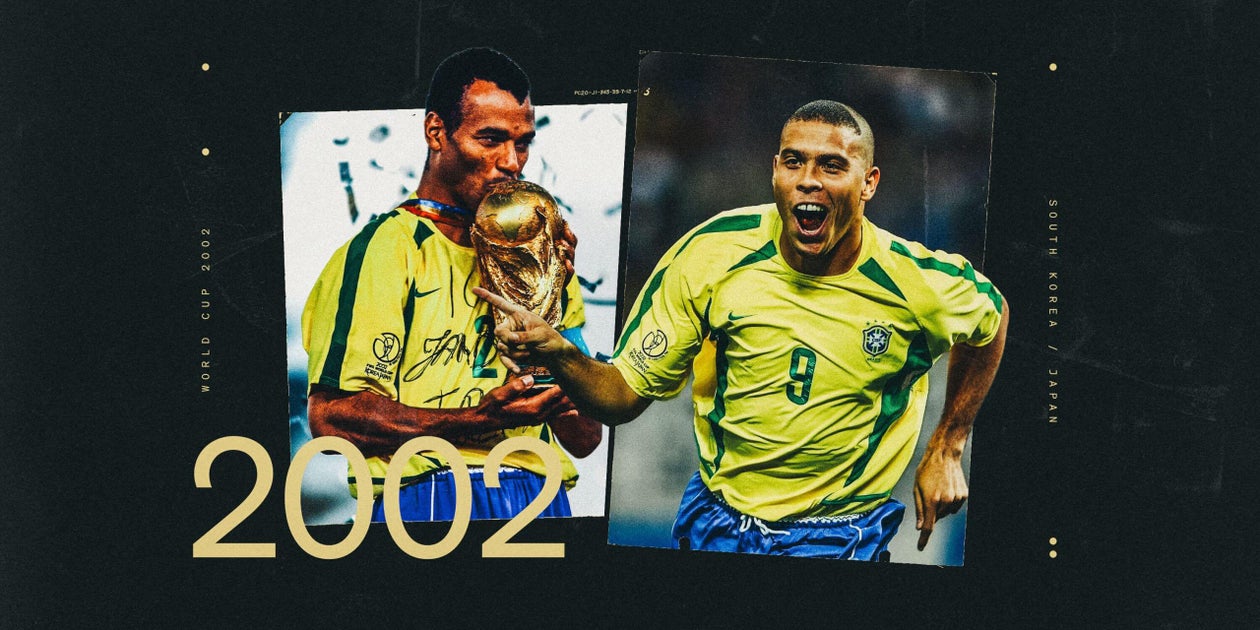
This is the 17th article in a series by The Athletic looking back at the winners of each men’s World Cup.
Previously, we’ve looked at Uruguay in 1930, Italy in 1934 and again in 1938, Uruguay in 1950, West Germany in 1954, before a Brazilian double in 1958 and 1962.
Next came an England success in 1966, another Brazil win in 1970, a second West Germany triumph in 1974, Argentina’s first win in 1978, Italy’s third in 1982, Argentina’s second in 1986, West Germany’s third in 1990, Brazil going clear with a fourth World Cup in 1994 and France joining the party on home soil in 1998. Now it’s time for yet another Brazilian triumph.
Introduction
Three outstanding attackers, seven wins from seven matches, and a fifth World Cup. Brazil’s 2002 side are remembered very fondly almost half a century on, but how good were they considered at the time?
You might be surprised to learn…
Brazil, the only side to participate in every World Cup, came relatively close to missing out in 2002. In qualification, they lost six of their 18 games, to Paraguay, Chile, Ecuador, Uruguay, Argentina and Bolivia. There briefly seemed a very real possibility that Brazil could be forced into a two-legged play-off against Australia, or even miss out altogether, and went into their final match against Venezuela needing a victory to qualify. They managed it, with a comfortable 3-0 win.
But after a dreadful qualification campaign that featured 65 players, five different managers in the dugout, and not a single appearance from Ronaldo, Brazil just about made it to the World Cup. Their only qualification campaign as bad as this one? The most recent one.
The manager
Luiz Felipe Scolari was appointed when Brazil were in a real state, and focused on discipline — on and off the pitch — to ensure qualification for the tournament. Scolari had won the Copa Libertadores with both Gremio and Palmeiras, but had won few admirers for his style of play.
With the national side, he omitted players he suspected would cause problems, selected lots of relatively unknown domestic-based footballers as his squad members (giving playing time to his entire squad with the exception of the back-up goalkeepers), and focused on off-field harmony. He spent hours watching videos of Brazil’s opponents in the build-up to the tournament — and, a little more surprisingly, formulated tactical plans by listening to the Bee Gees.
Largely unpopular going into the tournament, Scolari basically thought Brazil needed to wake up and modernise. And he was proven right. “Thirty years ago, you had one or two players who would make a difference to the game. Now we have an ensemble. If you don’t have a well-organised group, you don’t win,” he said. “Brazilian players have great technical ability, but are not much given to tactics. They have flashes of creativity, amazing moves, but without organisation these days, no one wins anything.”
Luiz Felipe Scolari is congratulated by Pele, one of his biggest critics, after the World Cup final (Toshifumi Kitamura/AFP via Getty Images)
One of his chief critics was Pele, and Scolari took great delight in rubbing Brazil’s triumph in his face. “I believe that Pele knows nothing about football,” said Scolari. “He has done nothing as a coach and all his analysis always turns out to be wrong. If you want to win a title, you have to listen to Pele and then do the opposite.”
Tactics
Scolari was previously regarded as a back-to-basics 4-4-2 man who liked playing with a big target man for others to feed off. But he’d never coached a side with this calibre of attackers, and to Scolari’s credit, he based his side around getting the best from his three star attackers. As it became clear that he was building something exciting, the Brazilian press reported on his tactical plans with genuine shock.
Rivaldo and Ronaldo brought out the best in each other for Brazil (Patrick Hertzog /AFP via Getty Images)
The three Rs of Ronaldo, Rivaldo and Ronaldinho — always listed in that order — were allowed to remain in central positions, drift around, and combine at will. All three were considered the best player in the world at some point (roughly 1997, 1999, and 2005 respectively), and while they weren’t quite on the level of the 1970 side in terms of their combination play, they clearly enjoyed playing together. Rivaldo had struggled to find his best form during Ronaldo’s extended absence from the national side, but the No 9’s return brought the best from the No 10. Ronaldinho played a little deeper, and the system was listed as both 3-4-1-2 and 3-4-2-1.
The formation brought the best from Cafu and Roberto Carlos: very good full-backs, but outstanding wing-backs. Not only did they provide the attacking width and allow the forwards to remain in positions close together, but they also had a habit of playing long crossfield balls to one another. They were, despite playing on opposite flanks, a genuine partnership.
Wing-backs Cafu (left) and Roberto Carlos (right) formed a cross-field partnership (Antonio Scorza/AFP via Getty Images)
The midfield situation was interesting. Scolari started the tournament with the disciplined Gilberto Silva — once a centre-back — in the holding midfield role, while Juninho Paulista was allowed to break forward into attack. But, as is often the case for World Cup winners, the fourth attacking player was sacrificed midway through the tournament in favour of extra midfield discipline. Juninho made way for Kleberson, who pushed forward more than Gilberto, but was a more defensive option than Juninho, a pure playmaker.
Gilberto and Kleberson formed an unfashionable midfield duo largely unknown outside Brazil. Gilberto had made his international debut the previous October, and Kleberson had made his four months before the tournament. Many in Europe would even have been unfamiliar with the names of their club sides, Atletico Mineiro and Athletico Paranaense. They were only together in the side because of the absence of captain Emerson, who dislocated his shoulder in a pre-tournament training session while filling in as a goalkeeper.
Advertisement
The defence was adequate rather than solid. Roque Junior was considered something of a joke figure by many Milan fans, Lucio was the hardman but made a terrible error to let in Michael Owen to open the scoring in the quarter-final, while Edmilson pushed forward at times and provided the best example of joga bonito with a superb overhead kick in a 5-2 group stage win over Costa Rica.
Star player
Ronaldo — although up until the semi-final stage, the focus was on the three Rs rather than any individual.
Both Ronaldo and Rivaldo had scored once in each of Brazil’s first four matches, while Rivaldo kept up his record by scoring in the quarter-final win over England. Later in that game, Ronaldinho scored the winner in a 2-1 win with his memorable ‘did he mean it?’ free kick that sailed over David Seaman and in. Shortly after that, however, he was sent off and therefore suspended for the semi-final.
17 years ago #OnThisDay , everyone was asking, did 🇧🇷@10Ronaldinho mean it 🤔
After seeing the player he became, are there still any doubters? 🤙 pic.twitter.com/RYZ3RDqvXU
— FIFA World Cup (@FIFAWorldCup) June 21, 2019
Rivaldo, meanwhile, wasn’t overwhelmingly popular due to his embarrassing playacting to get Turkish defender Hakan Unsal sent off in a group game, but he was at least as good as Ronaldo. World Soccer magazine called him “consistently Brazil’s best player over the seven games”.
At the semi-final stage, Ronaldo took charge, scoring a toe-poked finish which caught out Turkey goalkeeper Rustu Recber and then both goals in the final. By the end, it was Ronaldo’s tournament.
That was partly because he’d scored eight goals in seven matches, the most in a World Cup since Gerd Muller in 1970, and partly because it was such a great story after what happened in the 1998 final.
Ronaldo didn’t score for Brazil between September 1999 and a pre-tournament friendly in May 2002 because of repeated knee injuries. He’d played only 17 games for Inter in the three seasons leading up to this tournament. It’s difficult to think of another footballer who has missed such a substantial part of his career and returned to such a high level — Ronaldo wasn’t quite as explosive as during the 1998 tournament, but he was livelier than anyone expected and remained an outstanding finisher. After the final, he was keen to credit his physiotherapist, Nilton Petrone.
Ronaldo celebrates scoring the second of his two goals in the World Cup final (Pedro Ugarte/AFP via Getty Images)
Ronaldo won that year’s Ballon d’Or ahead of his team-mate Roberto Carlos, who was favoured by some, having won both the European Cup and World Cup. Ronaldo’s triumph was solely about the World Cup. In the calendar year, he scored only nine league goals; four with Inter before the tournament, and five with Real Madrid, having forced a transfer shortly afterwards. This angered many at Inter, who had waited three years for him to find fitness, had celebrated his superb tournament, then found him desperate to leave the club immediately.
Advertisement
The final
The strangest thing about the final between Brazil and Germany was that it was their first-ever World Cup meeting, despite the fact that they were the two most successful nations in its history, with four and three victories apiece at this stage.
Germany were not a particularly good side, and were overwhelmingly reliant on attacking midfielder Michael Ballack, who scored the winner in 1-0 victories over the USA and South Korea in the quarter-final and semi-final. In the latter, he also received a booking that put him out of the final. Without their best outfielder, Germany stood little chance.
They did, at least, have the man who had been voted the tournament’s best player on the eve of the final — goalkeeper Oliver Kahn. But the World Cup final during this period had a curious habit of making the main man the fall guy: Roberto Baggio in 1994, Ronaldo in 1998, Kahn here, and — spoiler alert — Zinedine Zidane in 2006. When Kahn fumbled Rivaldo’s shot from the edge of the box, Ronaldo was on hand to convert the rebound.
Ronaldo helps up Germany goalkeeper Oliver Kahn during the 2002 World Cup final (Patrick Hertzog/AFP via Getty Images)
Germany offered little attacking threat, although a 30-yard Oliver Neuville free kick was turned onto the post by goalkeeper Marcos. Brazil dominated without ever turning on the style, although their second goal was a rare example of good combination football, when Rivaldo dummied a pass from Kleberson — probably the best player in the final — for Ronaldo to slide home a second goal and ensure that this was his final.
🇧🇷🏆 On this day in 2002, Brazil won their fifth #FIFAWorldCup! pic.twitter.com/lv9S06mnUh
— FIFA World Cup (@FIFAWorldCup) June 30, 2025
The trophy was lifted by Cafu, who had become the first and only man to play in three World Cup finals. He stood up on the somewhat wobbly plinth to lift the trophy, with ‘100% Jardim Irene’ — the name of his hometown — scribbled on his shirt, and mouthed ‘I love you’ to his wife as he held aloft Brazil’s fifth, and most recent, World Cup.
“Brazil are a wonderful team,” said Germany manager Rudi Voller. “They deserved to be world champions.”
The defining moment
More than his two simple finishes in the final, it was Ronaldo’s semi-final winner against Turkey that probably lives longest in the memory.
Advertisement
There’s no doubt it was an error by Recber — another goalkeeper who had been excellent until one fatal error — but given his injury problems, there was something deeply satisfying about watching Ronaldo being, well, Ronaldo. He came short to receive the ball, showed a decent turn of speed, and then surprised Rustu with a toe-poked finish, which brought to mind his old strike partner Romario (hero in 1994, out injured in 1998, and controversially omitted here).
🇧🇷 @Ronaldo’s toe poke sent Brazil to the Final on this day in 2002! #FIFAWorldCup pic.twitter.com/wvGsUfc21O
— FIFA World Cup (@FIFAWorldCup) June 26, 2025
There were other great moments, too: Edmilson’s overhead kick against Costa Rica, Rivaldo’s calm finish to equalise against England after some classic Ronaldinho trickery, and then Ronaldinho’s free-kick winner later in that game.
Were they definitely the best side?
Yes, without question, especially given they won all seven games without the need for extra time or penalties.
But they were helped by the fact that the other pre-tournament contenders completely flopped. Joint-favourites France and Argentina, who both had exceptional records coming into the World Cup, both failed to get out of their group. The other two sides ranked ahead of Brazil in the pre-tournament betting, Italy and Spain, both fell to co-hosts South Korea. Of the traditionally strong nations, Brazil only needed to get past England and Germany, neither of whom had a particularly golden generation at this point.
None of this is Brazil’s fault, but there were clear flaws in this side that weren’t exposed in a strange World Cup with plenty of great stories, but very few great sides.