
Get free access to the most comprehensive World Cup coverage in The Athletic app.
The U.S. men’s national soccer team, often known as the USMNT, is about to take over the American sporting scene. It will introduce itself to the country on Friday, when its 2026 World Cup begins with a primetime opener against Paraguay (9 p.m. ET, Fox).
But why wait for that? Here is everything you need to know about World Cup co-hosts, the United States…
Tell me the story of this U.S. team in 25 words
The players were supposed to be a “golden generation.” As a team, they haven’t lived up to hype. This World Cup is their golden opportunity.
What’s a ‘golden generation’?
Essentially, there were several American boys, all born around the turn of the century, who seemed to have more talent than prior generations of U.S. soccer players. This group, led by Christian Pulisic, Weston McKennie and Tyler Adams, broke into the USMNT and jumped to prestigious European club teams as teenagers. So, naturally, fans hoped that they’d develop into the best U.S. men’s soccer team ever.
And at times, they’ve looked capable. Many have excelled at their professional clubs. As Team USA, they flopped at regional tournaments in 2024 and 2025, but now, under a big-time foreign coach, Mauricio Pochettino (more on him later), they seem close to unlocking potential.
When are the U.S. group games? And how can I watch them?
The co-hosts are in Group D along with Paraguay, Australia and Turkey. If the U.S. finishes first or second, they are guaranteed a place in the next round (the round of 32), and if they finish third… let’s just say it could get a bit complicated.
- Friday, June 12 vs. Paraguay — 9 p.m. ET, SoFi Stadium in Inglewood, Calif.
- Friday, June 19 vs. Australia — 3 p.m. ET, Lumen Field in Seattle
- Thursday, June 25 vs. Turkey — 10 p.m. ET, SoFi Stadium in Inglewood, Calif.
All U.S. games will be on Fox (in English) and Telemundo (in Spanish), as well as their respective streaming services, and The Athletic will cover every game live, too.
A win in the round of 32 is the expectation. A round-of-16 victory would equal a success. A third knockout win, which would take the U.S. to the semifinals, would be unprecedented.
The USMNT’s best finish at a modern-era World Cup was its quarterfinal run in 2002. (It reached the semifinals in the inaugural 13-team World Cup in 1930.)
Who’s the USMNT’s best player, and how good is he?
Pulisic, a quick and skilled winger, has been the face of the USMNT and the best American men’s soccer player for several years now.
He had a rough 2025-26 season for Milan, his Italian club, but at his best, he’s probably one of the top 100 players in the sport. (He’s not in the top 50, though.)
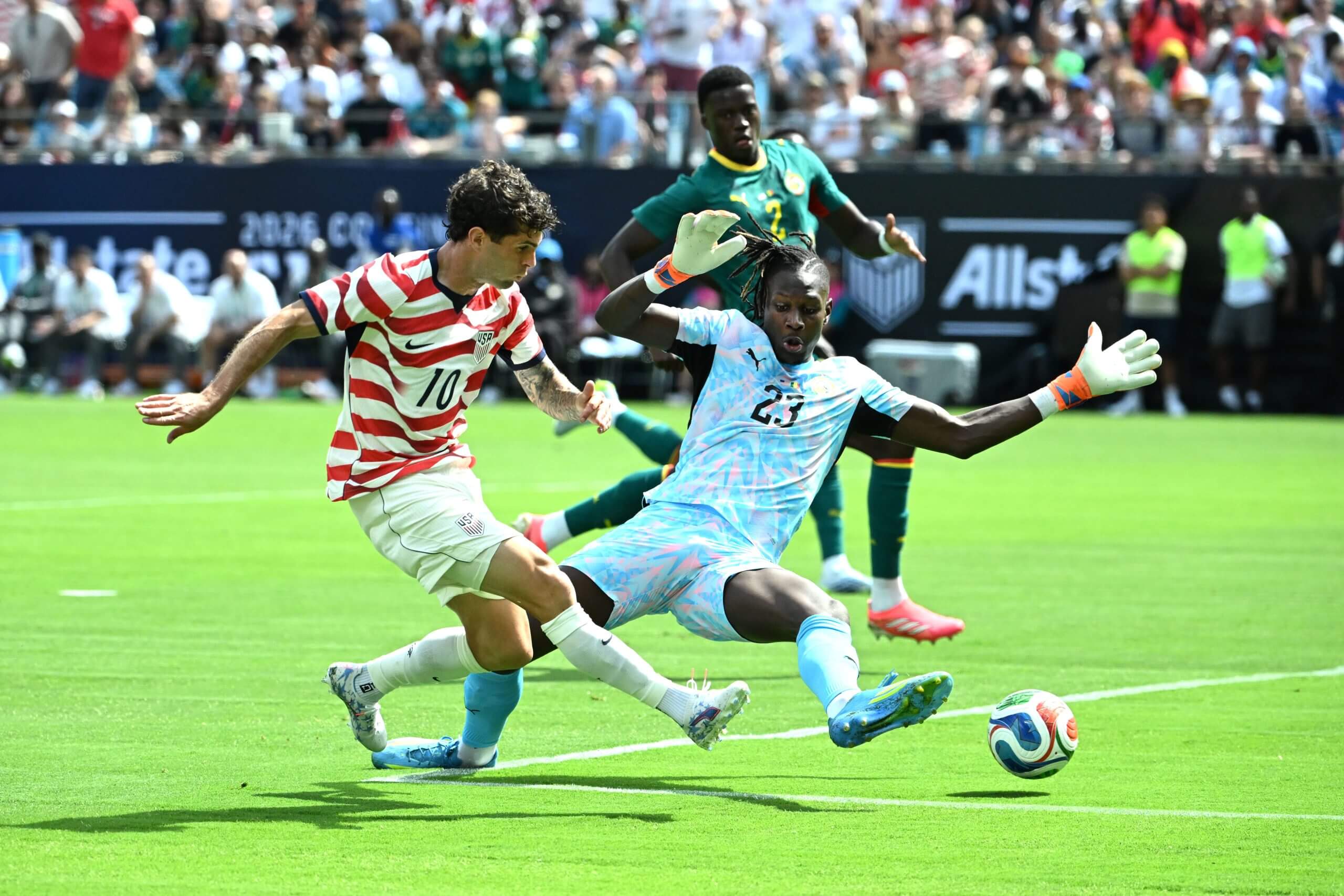
Christian Pulisic (No 10) is the face of the U.S. team (Bob Donnan / Imagn Images)
Who are the most likeable players?
McKennie is a character. On the field, for Italian side Juventus and the national team, he’s a do-everything midfielder who runs everywhere. He celebrates goals with a Harry Potter wand wave. Off the field, he’s a jokester, a self-described “social butterfly” who lightens the mood.
Chris Richards is also a comedian, but with an introspective side and a competitive edge. Born and raised in Birmingham, Ala. — not exactly a soccer hotbed — he developed into a strong central defender. If he can overcome an ankle injury, he’ll anchor the U.S. back line after winning a European trophy with his club side, Crystal Palace of the English Premier League.
Sergiño Dest, a fullback turned winger who plays for Dutch team PSV, is maybe the trickiest, most audacious player on the U.S. squad.
Adams, the team captain in 2022, won acclaim for how he carried himself and represented his country at that World Cup. He’s a pugnacious defensive midfielder who, even at a slender 5-foot-9, won’t back down from anyone.
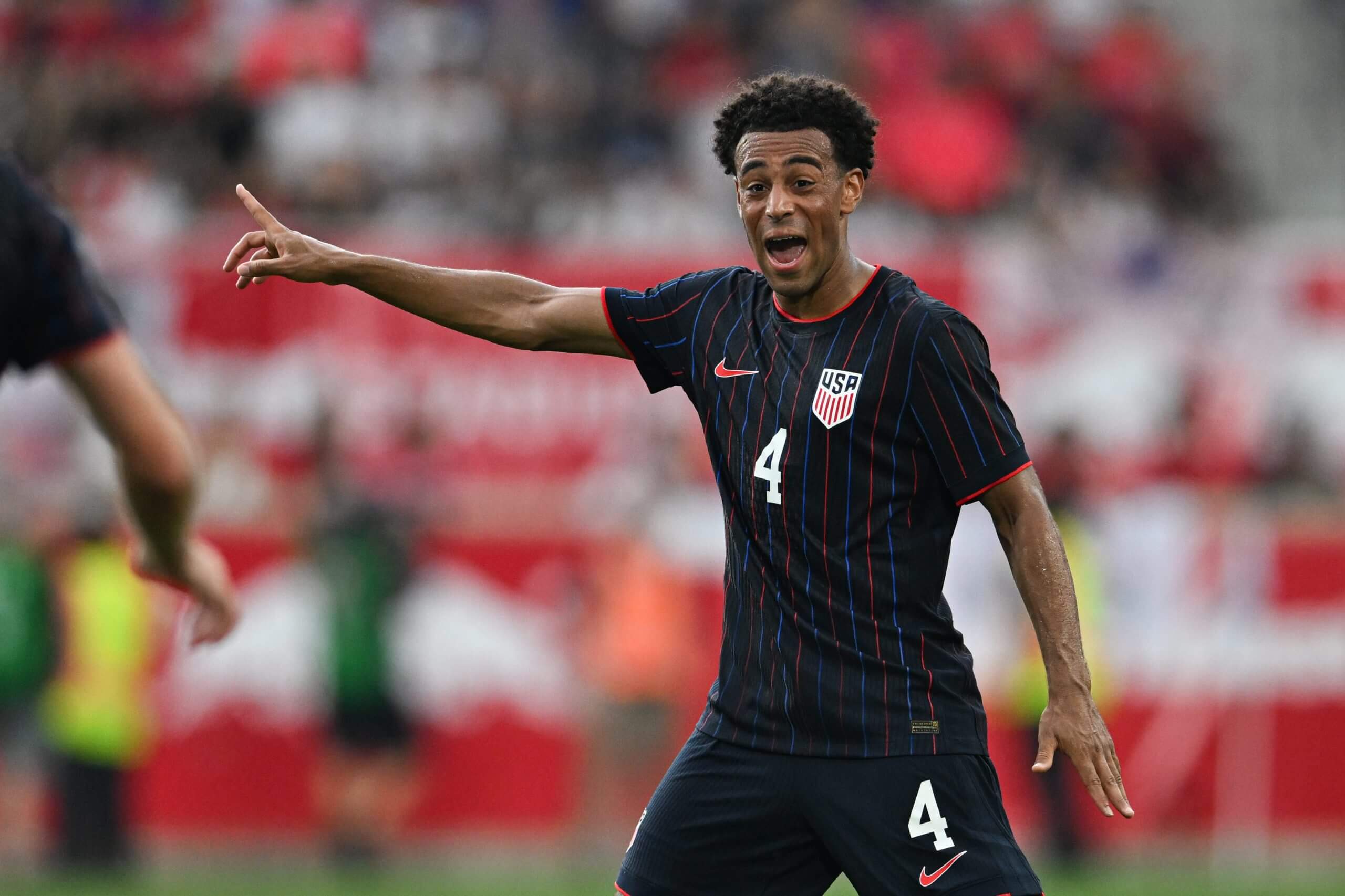
Tyler Adams plays for English Premier League side Bournemouth (Stephen Nadler / ISI Photos / ISI Photos via Getty Images)
Who’s the captain?
Tim Ream — “the grandpa of the group,” as Adams said a few years ago.
Ream, at 38, will be the oldest player to ever appear for the USMNT at a World Cup. He’s the team’s elder statesman by a margin of nearly seven years.
And the defender, who plays for MLS’ Charlotte FC after a switch from Premier League club Fulham, has a pretty cool story. Four years ago, he “made peace” with the likelihood that he’d never play at a World Cup. Now he’s headed to his second as the team’s wise, serene leader.
Who’s the main goalscorer?
Folarin Balogun, who plays his club football for Monaco in the top French league.
The USMNT, for years, had been weak at the striker position. Then, in 2023, they recruited Balogun — born in Brooklyn, bred in London — away from England. (Balogun, one of several dual nationals on this U.S. team, was eligible to represent either country or Nigeria, where his parents are from.)

The pressure is on Folarin Balogun to bag the U.S.’ goals… (Emilee Chinn / Getty Images)
Who else will be in the U.S. starting lineup?
The most likely starters are:
- Goalkeeper: Matt Freese
- Right back: Alex Freeman
- Center back: Chris Richards
- Center back: Tim Ream
- Left back: Antonee Robinson
- Defensive midfield: Tyler Adams
- Central midfield: Malik Tillman
- Attacking midfield: Weston McKennie
- Right wing: Sergiño Dest
- Left wing: Christian Pulisic
- Striker: Folarin Balogun
Give me some more fun facts about the players
OK, here we go…
Freese, the goalkeeper who plays in MLS for New York City FC and is a self-described “nerd,” went to Harvard and wrote a big research paper about penalty kicks.
Freeman, who plays for Villarreal in Spain, is a rapidly rising defender and the son of former NFL wide receiver Antonio Freeman.
Tim Weah, of France’s Marseille (on loan from Italian side Juventus), who scored at the 2022 World Cup, is the son of George Weah, a legendary former soccer player who later became the president of the African country Liberia.
Sebastian Berhalter, a backup midfielder who plays in MLS for Vancouver Whitecaps, and who’s been described as a “freak” and “monster” due to his work rate, is the son of former USMNT player and coach Gregg Berhalter. (Gregg was fired in 2024, around nine months before Sebastian worked his way into contention for a call-up.)
Antonee Robinson, of English Premier League side Fulham, is nicknamed “Jedi” after the Star Wars characters, and does backflips when he scores — as he did last weekend.
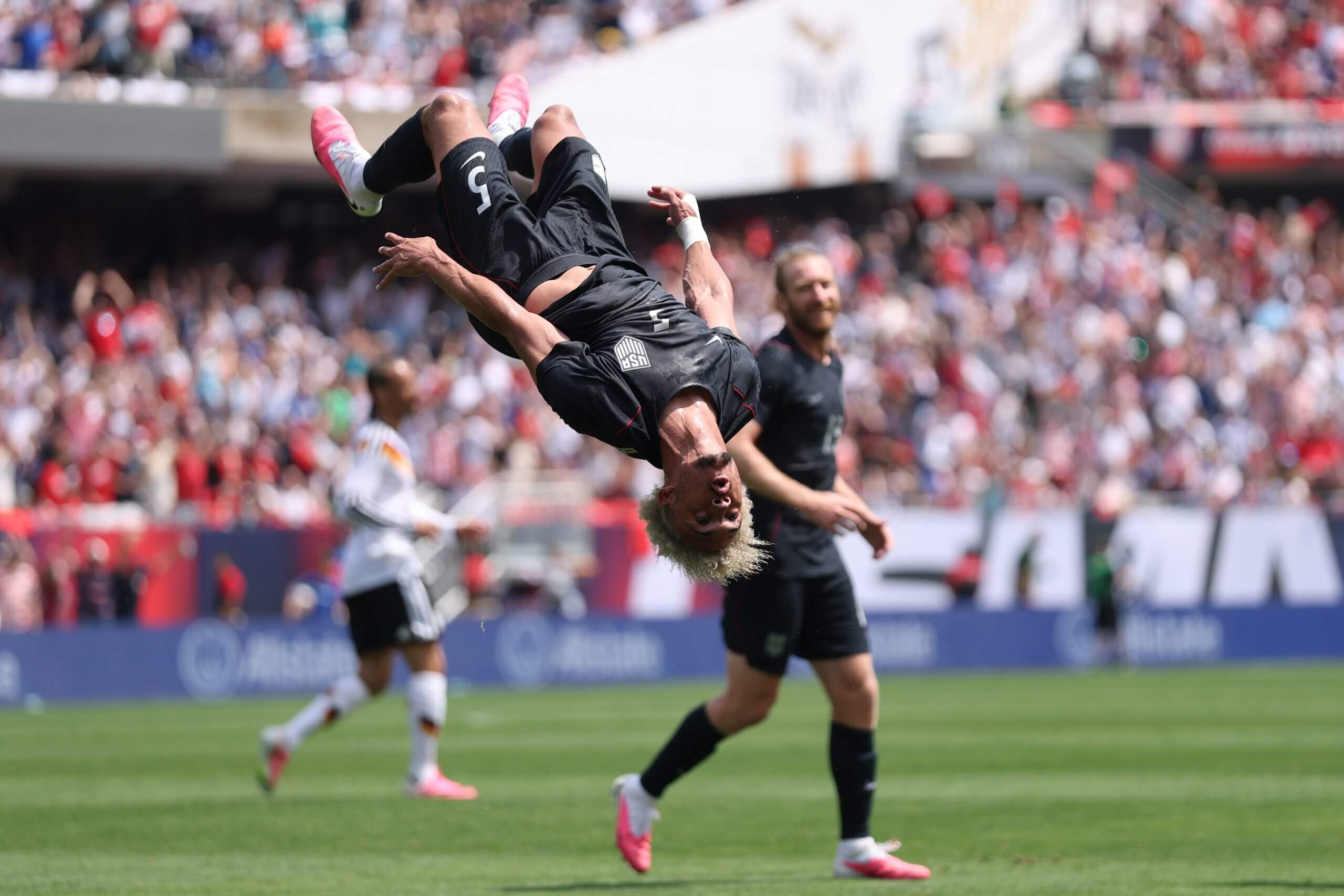
Antonee Robinson (No 5) has a decent line in celebrations too (Jamie Squire / Getty Images)
Mark McKenzie, of Toulouse in France, is a charismatic and media-savvy defender, and is into photography — but not with his smartphone. He uses an actual retro camera, so that he can stay present and avoid scrolling.
Leeds’ Brenden Aaronson, an attacking midfielder who’ll come off the bench, briefly departed training camp a couple weeks ago to get married.
Cristian Roldan (Seattle Sounders), another reserve midfielder, had been off the USMNT radar for years until he got a call while on vacation last September; he immediately drove home, took a red-eye to training camp in New Jersey, and hasn’t relinquished his roster spot since.
Where are the players from?
Of the 26 players, 20 were born in the U.S., and 22 mostly grew up stateside. Of those 22, half identify with hometowns in the northeast.
The four players reared abroad — and eligible to play for the U.S. either because they were born here or have an American parent — are Balogun (London), Dest (Almere, Netherlands), Bayer Leverkusen’s Malik Tillman (Fürth, Germany) and Robinson (Liverpool, England).
Only two players share a hometown: Ricardo Pepi (PSV) and Alejandro Zendejas (Liga MX side Club América), who are both from El Paso, Texas, a border town. Both were born to Mexican parents, and coveted by both the U.S. and Mexican national teams. Both chose the U.S.
Upon making his decision at age 18, Pepi — who would regularly cross the border as a kid to visit friends and family in Ciudad Juarez — wrote: “I have grown up always immersed in my Mexican heritage. I love everything about my culture, my people, my food, and I am very proud to be Mexican-American.
“At the same time, I was born and raised in the USA. This country has given me and my family a home, and endless possibilities to achieve my dreams.”
Did most of the players go to college like American sports stars?
Nope. Eight of the 26 did. The rest turned professional as teens, either in the U.S. or overseas.
A growing number of top soccer prospects now skip college, and the very best go straight to Europe. Gio Reyna (now of German side Borussia Mönchengladbach), for example, moved from New York to Borussia Dortmund in Germany at age 16.
The college soccer path, though, is still a viable one. Max Arfsten (Columbus Crew), for example, went to the University of California, Davis, and slowly worked his way up to the national team. Matt Turner (New England Revolution on loan from Lyon), a goalkeeper, went to Fairfield University and didn’t debut for the USMNT until age 26.
Who is the USMNT coach?
Pochettino is the most accomplished coach the USMNT has ever had.
Born in Argentina, he moved to Europe five years into a long playing career and never looked back. As a hard-nosed defender, he played for Espanyol in Spain and two French clubs, including Paris Saint-Germain (PSG).
But he really made his name as a coach — first with Espanyol, then Southampton and Tottenham in England. He took Tottenham all the way to the Champions League final, the most prestigious annual soccer match in the world.
He then went to PSG, where he coached three of the sport’s biggest stars, Lionel Messi, Neymar and Kylian Mbappé. After that, English side Chelsea. After parting ways with Chelsea in 2024, U.S. Soccer called and, with financial help from corporate sponsors and deep-pocketed donors, wooed Pochettino to the United States.
Wait, so the coach of the American team isn’t American?
Correct. This is relatively common in international soccer and other sports. Simone Biles’ coaches, for example, were French. The English soccer team’s coach is German, and Brazil’s is Italian.
Most USMNT coaches this century have been American, but back in 2024, when the U.S. Soccer Federation fired its previous coach, Berhalter, it went in search of a globally renowned coach for the 2026 World Cup. And it got one.
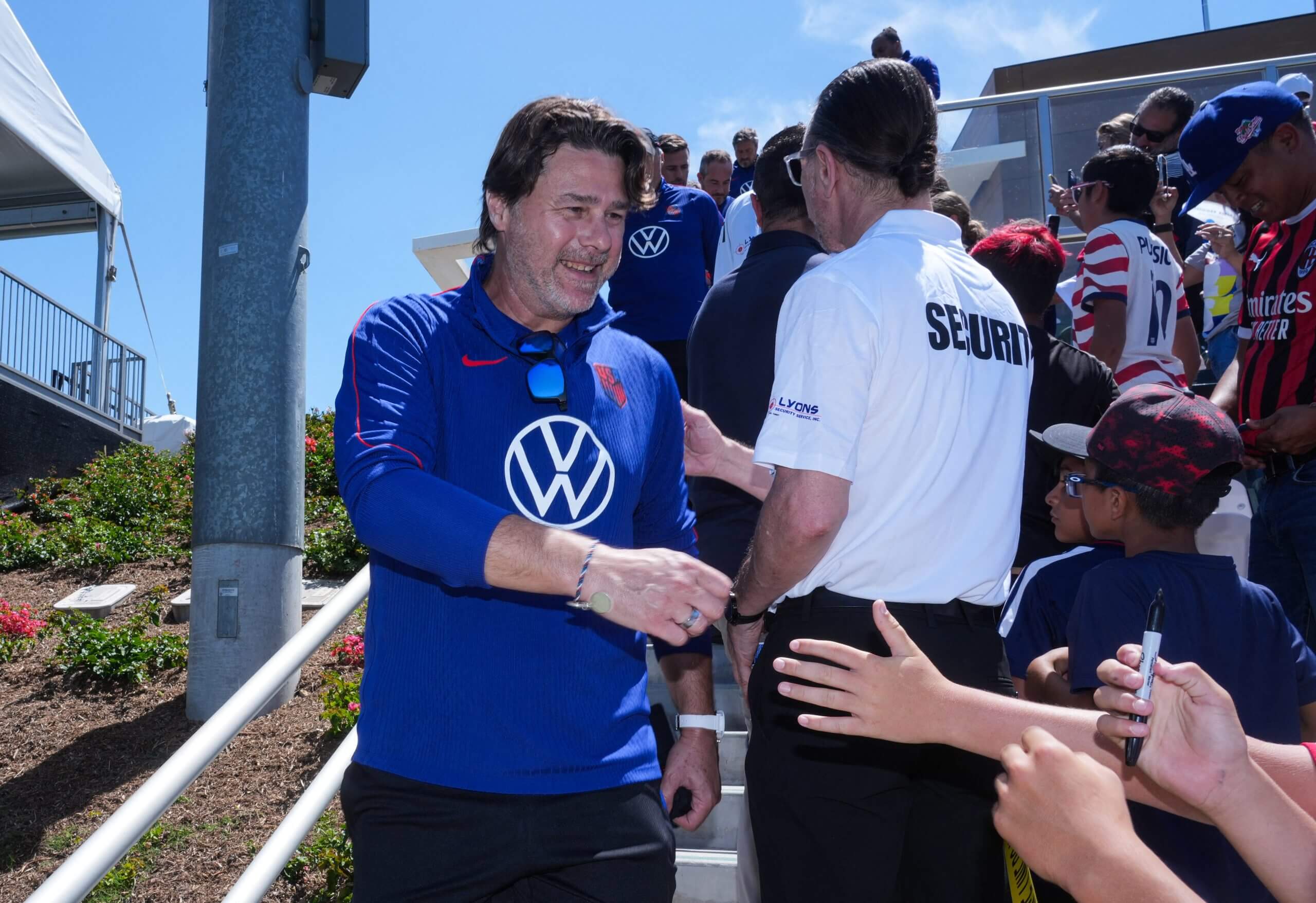
USMNT manager Mauricio Pochettino greets fans at an open training session in Irvine, Calif. (Kirby Lee / Imagn Images)
Do fans like him?
For the most part, yeah. They haven’t always — a six-month stretch in 2025 was particularly rocky — but his résumé has given him the benefit of the doubt, and his rebuild seems to be bearing proverbial fruit.
Rebuild? What did the coach have to rebuild?
Basically, the core players had gotten too comfortable. Some, it seemed, felt entitled to their positions, either in the starting lineup or on the squad. Pochettino tried to unsettle them by handing opportunities to younger, less experienced players — that, he hoped, would generate competition and reform the team culture.
Whether it worked is subjective, and to be determined this month. But objectively, many — though not all — of the top players are now back in the starting lineup and playing reasonably well for the national team.
What is Pochettino’s style?
As a man-manager, he can be a bit quirky and old-school. He kept lemons in his office because they supposedly “absorb negative energy and cleanse the air.” He does not call players when he omits them from rosters — even the World Cup roster. Players simply get an email from U.S. Soccer.
On the field, though, Pochettino is progressive. He constantly implores his players: “Be aggressive!” They pressure opponents and attack fluidly, sometimes at the expense of defensive solidity.
So… can they win the World Cup?
Anyone can win the World Cup. Realistically, the Americans are longshots. The Athletic’s statistical forecast gives them a 1.2% chance.
But they have not shied away from dreaming big. Their coach, Pochettino, has asked them: “Why not us?” His message, to his players and fans, is simple: “Believe.”
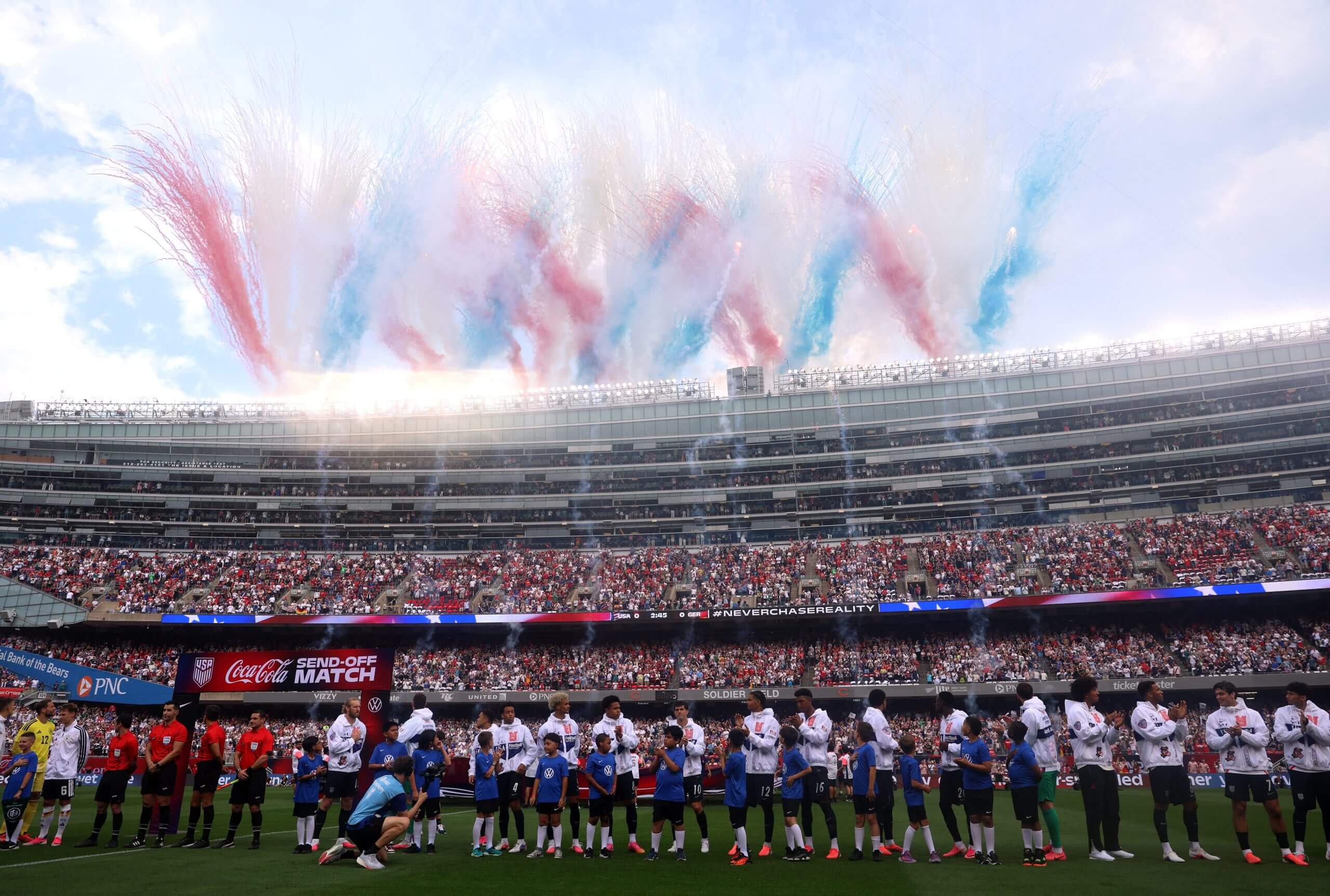
U.S. World Cup players are introduced at their send-off match vs. Germany at Soldier Field in Chicago (Talia Sprague/Imagn Images)
Why should I root for them?
Because they’re underdogs — and because, in that sense, they’re unique. The U.S., as a nation, is anything but an underdog. It’s an economic and geopolitical juggernaut. In sports, it has won the most Olympic medals at every Summer Games dating back to the 1990s. Its national teams in basketball, softball, baseball, hockey and so on regularly dominate, or at least contend for titles.
The men’s soccer team is different. It offers Americans a chance to feel overlooked. It is overshadowed by traditional soccer powers such as Spain, England, Argentina and Brazil — and also by other sports, such as American football, in its own country.
That’s part of why millions of people latch onto the USMNT. “It’s the opposite of frontrunning,” Jon Strauss, a Boston-area fan since the 1990s, told The Athletic. “It’s that ethos: Get in on the ground floor and work your way up.”
Why isn’t the U.S. better at men’s soccer?
- Because other countries had a decades-long head start; soccer culture here is still relatively nascent; and
- Because the U.S. youth system is “broken,” as Matt Crocker, the U.S. Soccer Federation’s now-former sporting director, told The Athletic.
So is the USMNT fun?
It sure can be! It should be the most proactive, free-flowing U.S. World Cup team in decades, and maybe ever.
In full flight, as they were for 40 minutes in a late-May friendly against Senegal, these U.S. players are brilliant, and their ceiling is high.
What could their impact be?
If they do what everyone hopes they can — if they win a few games, and endear themselves to the American public, and make a few indelible memories — their impact will be massive. The TV audiences for their games could shatter records. Millions of impressionable kids could take to soccer, and this World Cup’s legacy could be long-lasting.
So much of it rests on the USMNT. And the players know that. Under Berhalter, their former coach, back in 2023, they adopted a mission statement for this World Cup cycle: “Change soccer in America forever.”
The Athletic’s Emily Giambalvo contributed data reporting to this story.