
Four years before he’ll captain the United States at a home World Cup, Tim Ream “made peace” with the likelihood that he’d never get to one.
He was 35 and seemingly frozen out of the U.S. men’s national soccer team. “I had been gone, out of the picture,” Ream recalls, left off rosters for over a year leading into Qatar in 2022.
So, he did what many well-paid fathers of three would do with a month-long break from his busy job in November.
As the USMNT planned for Qatar, Ream planned a family vacation to Disney World.
He didn’t agree with head coach Gregg Berhalter’s decision to exclude him from camp after camp. “It annoyed me more than anything,” Ream says. But he sort of understood it. He accepted it. He didn’t need a World Cup, he convinced himself, to validate his multi-decade career or who he was as a person.
Then, weeks before that World Cup, his phone rang. It was Berhalter. Ream, who was playing some of the best soccer of his life at Fulham in the English Premier League, was needed.
He didn’t immediately accept the call-up. He told Berhalter: “I need to sleep on it.” He thought about disappointing his elementary school-aged kids, who’d been talking for weeks about Disney. “Is that something that I’m prepared to do, selfishly, to reach a goal of mine,” Dad asked himself, “and to make a dream come true?”
The kids were asleep, so, at their home in London, Ream sat down with his wife, Kristen. She helped him realize: “If this is such a big thing … are you really prepared to let it pass?”
Tim looked her in the eyes and, he recalls, said: “OK. I’m going to call [Berhalter] tomorrow. I’m going to go to the World Cup. And I’m going to play every single game.”
In Qatar, and over the years that followed, Ream did that and much more. He re-established himself in the USMNT as both a savvy center back and a calm, perceptive leader. As he aged, he somehow improved and made himself invaluable, as much for his positioning and line-breaking passes as his attitude and experience.
“He’s amazing,” U.S. coach Mauricio Pochettino recently raved. “So lucky to have a player like him, with his personality and his character, involved and helping the young players.”
Pochettino, who replaced Berhalter in 2024, named Ream captain for his very first game that October. He was instantly struck by Ream’s positivity and “values.” They developed a rapport that pulls Ream to the side of training sessions for 1-on-1 chats, and positions him as a link between players and coaches.
So it was entirely unsurprising when Pochettino announced that Ream, now 38, will be the USMNT’s 2026 World Cup captain — “my captain,” Pochettino said.
But it still touched Ream. “Wow,” Ream said as emotions tried to choke him. “This is more than a dream come true.” It was a reward for decades of work, and for Ream’s refusal to let his national team career fade into anonymity.
USMNT World Cup captains (1990-present)
| WORLD CUP | PLAYER | AGE |
|---|---|---|
|
1990 |
Mike Windischmann |
24 |
|
1994 |
Tony Meola |
25 |
|
1998 |
Thomas Dooley |
36 |
|
2002 |
Claudio Reyna |
28 |
|
2006 |
Claudio Reyna |
32 |
|
2010 |
Carlos Bocanegra |
31 |
|
2014 |
Clint Dempsey |
31 |
|
2022 |
Tyler Adams |
23 |
|
2026 |
Tim Ream |
38 |
A recall ‘out of left field’
Ream, born and bred in St. Louis, took the longest of long roads to this grand stage. He rose from youth clubs, through high school, to Saint Louis University. After a four-year college career, the New York Red Bulls drafted him in the second round of Major League Soccer’s “SuperDraft.” From there, after two pro seasons, he went to Bolton Wanderers in England. At Bolton and then Fulham, he spent more than a decade bouncing between the Premier League and the second tier, gradually asserting himself as an unremarkable but reliable defender. And back home in the States, he battled on the fringes of the national team.
After nearly four years without a U.S. start, he worked his way into 2015 lineups. Then he fell away. Following the USMNT’s failure to qualify for the 2018 World Cup, he went a year and a half between appearances. The World Cup dream seemed distant.
At age 31 in 2019, Berhalter brought him back into the fold. But at 34 — after Ream asked out of an October 2021 camp for family reasons — the national team turned elsewhere. Ream’s aging legs supposedly weren’t a fit at the base of a youthful team. As the 2022 World Cup approached, “there were no nerves, there was no stress,” Ream remembers — because there was no hope or expectation that he’d be there.
When Berhalter called, it “came out of left field,” Ream says.
He quickly decided that Disney could wait, but “the hardest part,” he says, was still “breaking the news” to his three kids, Aidan, Theo and Lilia. Aidan was “just starting to get into sports,” Ream says, but the other two weren’t old enough to comprehend the World Cup’s gravity.
To explain, Dad asked them: “What do you guys want to be when you grow up? What’s the biggest dream you could ever imagine wanting to do and achieve?”
They responded. “OK,” Ream said, “now imagine I wanted to be a soccer player, and I wanted to play in a World Cup.”
“Are you going to be able to do that?” the kids asked.
“This,” Ream said, “is my opportunity.”
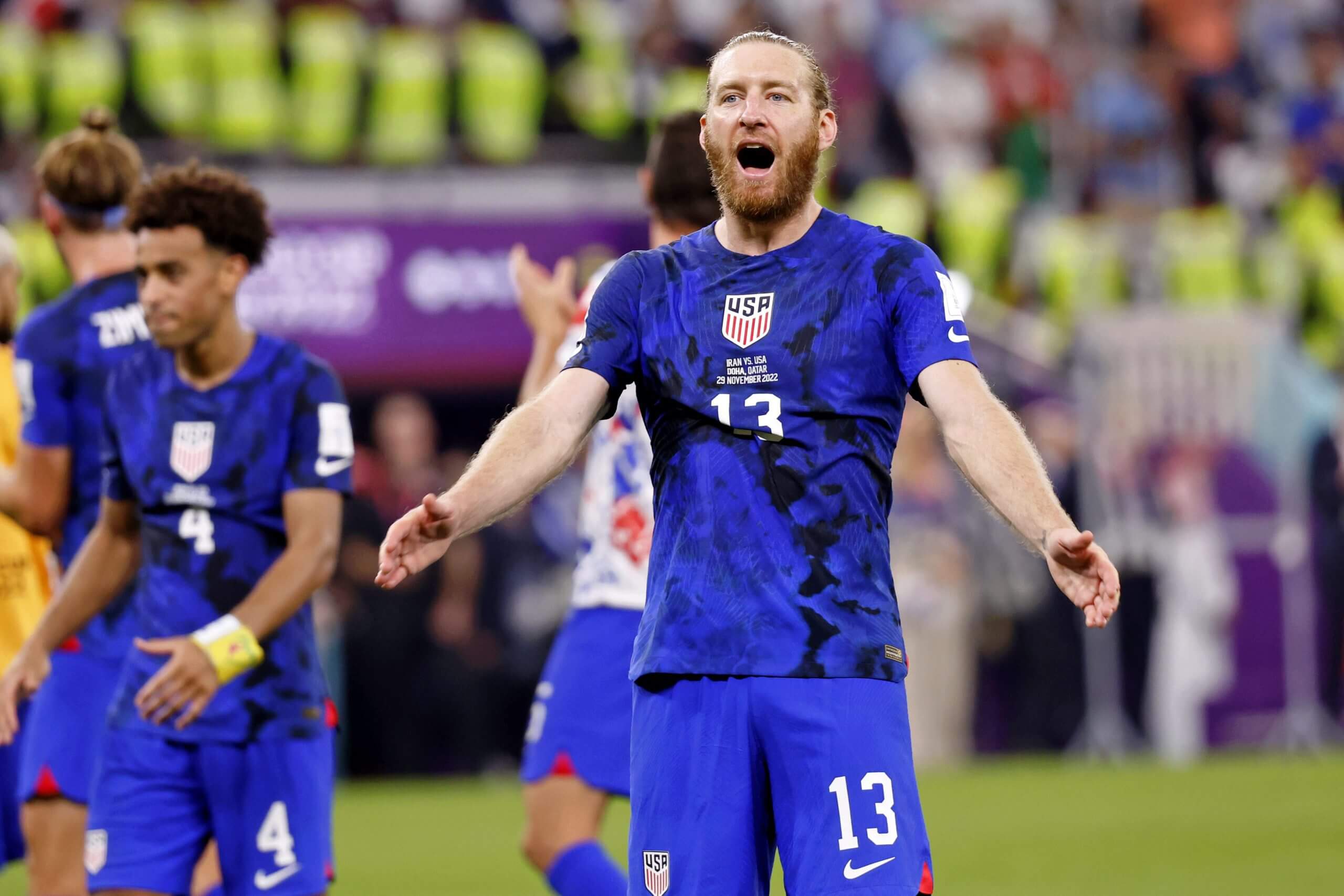
Tim Ream celebrates a 2022 World Cup win over Iran that clinched the U.S.’s place in the round of 16 (Yukihito Taguchi / USA TODAY Sports)
So, instead of Disney, they went to Doha. Tim went straight into the U.S. starting 11, anchoring a defense that conceded just two goals in three group games. He became “the grandpa of the group,” as 23-year-old captain Tyler Adams said. And after a knockout loss to the Netherlands, his 50th appearance for the national team, he reflected on his career and his message to younger teammates.
“You’re never guaranteed anything in this game,” Ream said in the bowels of the Khalifa International Stadium. Sure, some youngsters were seemingly “guaranteed another World Cup,” he acknowledged, but “for me, that’s not going to happen.” He’d tried to convey the impermanence, urging his USMNT grandkids to “treat each and every training session as if it was the last.”
“Tomorrow, if it all finished,” he’d ask them, “and your career was done, would you be happy with it?”
“And I can honestly say that was the case for me,” Ream said. “Yes. I’ve given it everything.”
He would later tell Kristen: “I think that’s probably it.” Years later, he confirms that he thought: “OK, that’s my one and only World Cup.”
“But the more I thought about it,” Ream said last year, “I was like, well, why does it have to be? Everyone else can try to retire me, but I’m still going, still playing. Why not continue on?”
The thought of being finished, he realized, was merely an assumption based on soccer norms. “It’s never been like me to just roll over and say, ‘OK, someone else, it’s your time, you can have the spot,’” Ream decided.
A couple months after Qatar, interim USMNT coach Anthony Hudson flew to London to meet him over coffee. “Listen,” Ream recalls Hudson saying, “we still need you, we still want you to be a part of the group.” Then a question: “Do you still want that?”
Ream’s answer was unequivocal.
“I would never say no,” he says.
Instead, he would do whatever he could to help the USMNT — and whatever he could to get to 2026.
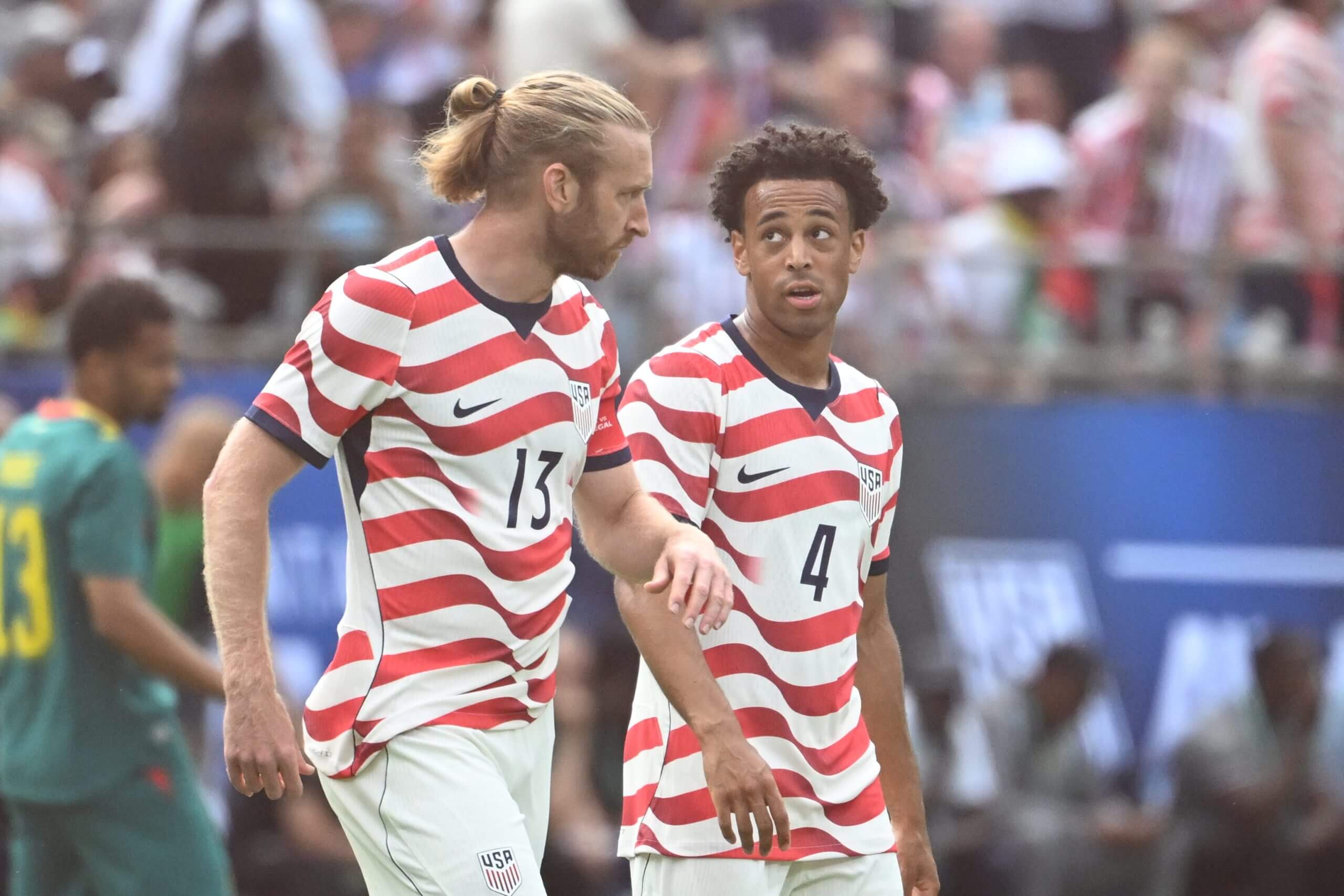
The 2026 and 2022 USMNT World Cup captains, Tim Ream and Tyler Adams, in last weekend’s 3-2 win over Senegal (Bob Donnan / Imagn Images)
‘Grandpa’ and his leadership style
Ream is here, three-and-a-half years later, because he kept on learning and working. He adapted to different coaches and deepened his understanding of soccer. He started Premier League games at age 36; and even when the Prem began to outpace him, his on-ball ability and human qualities gave him national team staying power.
In Qatar, Ream was one of several leaders. Berhalter had empowered players within a “leadership council.” Ream had been absent for 14 months, “but you go in, and immediately you’re the oldest guy in the group,” he recalls. He felt like he had perspective and wisdom to lend.
“You have Tyler’s voice, and you have Weston [McKennie]’s voice, and you have Christian [Pulisic]’s voice,” Ream says of the 2022 dynamic. “You had Matty T[urner]’s voice. All these voices, they end up complementing each other. I just ended up going in and being a little bit of an older, more level, calmer voice than the rest of them.”
He continued using that voice through 2024. And when Pochettino arrived, dynamics shifted. The leader of the national team, Pochettino recently explained, “is who needs to lead in every single team: the coach.” But the coach also needed a bridge, a veteran who could relay messages in various directions.
Ream became that.
He is not rah-rah, but in Pochettino’s eyes, he doesn’t have to be. “In a national team, you don’t need to do too much,” Pochettino said in March when asked about leadership. “But you need to do the right things. And sometimes, you need to say one word — and sometimes maybe not talk — if you want to be a good leader.”
Ream, of course, talks. He is not boisterous, but he is a connector. He connects serenely with a hint of dry humor. And he helps connect Gen Z-ers with the 54-year-old Pochettino, an Argentine with an old-school streak.
“You just feel that leadership, you feel the experience when he talks,” Sergiño Dest said.
Ream speaks with both Pochettino and players during and after training. Pochettino, Ream says, “will ask me what I feel, what I think the group might be needing in that moment, what they might be feeling.”
They never talk “specifics about specific players,” Ream clarifies. “That’s a sticky situation, and a slippery slope, and I’m thankful not to be put in that position.”
But Pochettino will use Ream to gauge the group’s mood, its needs, its vibe, its desires.
“And I think that’s important, to get the pulse of where everyone is at,” Ream says.
Pochettino, for his part, sees Ream as a positive influence who’s also “fair” and honest. “He knows what it means to play in Europe and travel here and play, and have the values, and [be] the human being and the character, to have the capacity to help teammates,” Pochettino said in March.
So it was Ream to whom Pochettino vented on the side of a training pitch after a deflating 1-0 loss to Panama last March. “I feel like s***,” Pochettino said, “because you expect [players to] fight. … You need to put your country first. If you want to play for the national team, it’s not your name, it’s the badge, it’s the flag.”
Ream, in an exchange captured by the “U.S. Against the World” docuseries, agreed: “It’s something bigger. You’re a part of something much bigger.”
Pochettino, for more than a year, never formally named Ream his captain. But Ream would wear the captain’s armband whenever he started. As the World Cup approached, Pochettino decided there was no need for a player vote, no need for team-wide discussions. Pochettino himself, together with “people I want to listen [to] and deserve to be listen[ed to],” decided: “Tim is the captain.”
He is not, though, simply the coach’s best friend.
“Tim is that grounding force, he’s calm and all-knowing in a lot of aspects,” fellow U.S. defender Miles Robinson told The Athletic. “He is very humble and demanding on the field, he’s someone to learn from, but he enjoys himself with the guys on the team as well. It’s not like he’s a grandfather.”
Wingback Max Arfsten noted that Ream “takes a lot of s***” from teammates for his age. And yes, he still gets called “grandpa.”
“But he’s a good sport about it,” Arfsten said with a smile. “He definitely has the respect of everyone.”
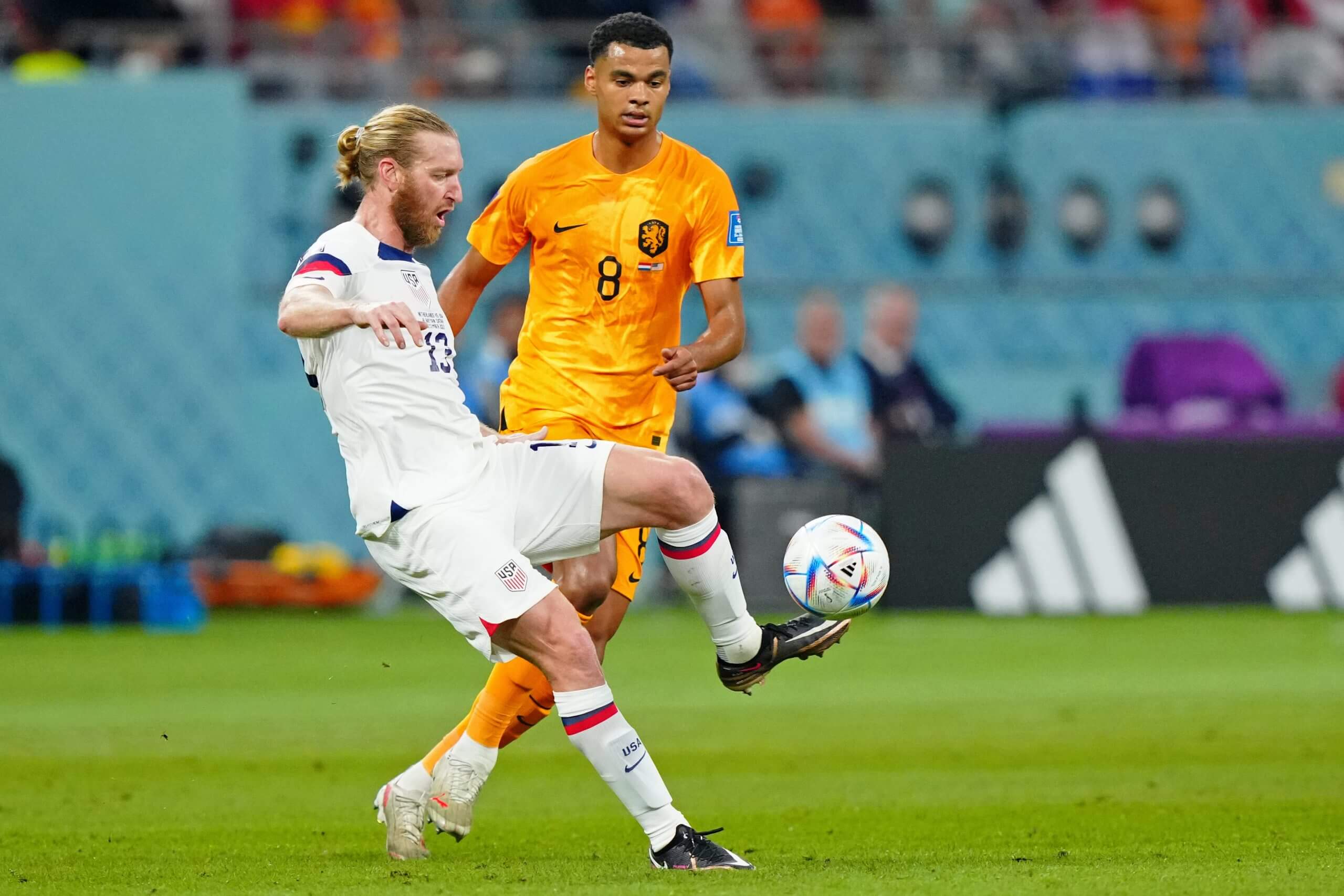
Tim Ream defends Netherlands forward Cody Gakpo in the last 16 of the 2022 World Cup (Danielle Parhizkaran / USA TODAY Sports)
History in the making
If and when Ream takes the field on June 12 against Paraguay — or on June 19 against Australia, or June 25 against Turkey — he will be the oldest player to ever appear for the U.S. at a men’s World Cup.
And to many fans, he’ll be a source of worry. On the surface, he is not the player he was at age 35 or 31. His USMNT longevity is a function of his quality, yes, but also of a shaky depth chart.
When asked if he feels he can perform at this World Cup as he did in Qatar, though, Ream says: “The short answer is yes.”
“The longer answer,” he continues, is that he’s wrestled with a few injuries in 2026. There was a calf injury in preseason, then a groin injury in April. He has had to protect against “overdoing it.”
But, he says, “I feel great now. … I have no doubts that I can perform at the same level.”
He moved from Fulham to Charlotte FC in 2024, and according to the sports performance staff in Charlotte, Ream says, “all of my numbers are the same as they were last year, the year before, and the year before that.”
Some of his peers in Charlotte like to joke that he’ll be playing for the U.S. until age 45, long after his club career has finished. “Guys,” Ream responds with a smile, “I just don’t think that works anymore.”
On the other hand, at any point over the past several years, he could have pulled back from the national team. Plenty of players do in their 30s, either to prolong club careers or prioritize family. The latter aspect is the one that sometimes tugs at Ream. Soccer constantly takes him away from his three kids and six dogs. “There’s so much that we miss as professional athletes,” he says. He estimates that he’s missed all but one of daughter Lilia’s birthdays.
“But,” he says, “I want to set an example for my own kids, [and] the wider fan base or kids growing up, or anybody who looks up to the national team.” The message he wants to send is: “Guys, you can do whatever you want to do for as long as you want to do it.”
“Eventually, yes, things will catch up to you,” he notes. “But if you set your mind to something, go and do it! Why not?”
Ream never felt satiated, not in 2022 nor today. “I have not done everything that I’ve wanted to do,” he says. “And so I kept going.” After captaining the team through last summer’s Concacaf Gold Cup, he felt energized. He also looked at a calendar, and realized 2026 was coming into focus.
As it approached, nerves and stress set in. When his phone began “blowing up” on May 22, with messages that he’d made the World Cup squad, stress evaporated. Relief, excitement and pride took over. All the tough decisions, the sacrifices, had been worthwhile.
And the captaincy was the cherry on top.
“I’ve done everything possible to be a part of this group, to help this group along, and I’m really, really grateful to be sitting here, to have this honor,” Ream said last week. “And I’m not going to take that for granted.”