
Get free access to the most comprehensive World Cup coverage in The Athletic app.
Walk through the halls of American soccer’s largest convention, weaving through tracksuited coaches and egos, and you’ll hear buzzword after buzzword, opinion after opinion on why the United States has never produced a world-class men’s soccer player.
You’ll hear about philosophies and methodologies, about human and player development, about pathways and pyramids. You’ll hear about the cost of playing soccer in America, and dozens of other ills that do contribute to the dearth of U.S. stars among the world’s top 50.
But the answer, many believe, to the question that will burn as the 2026 World Cup begins — why has the U.S., the planet’s richest and most successful sporting nation, never had a male soccer superstar? — boils down to one word.
Culture.
“This is a sport that is driven by culture,” says Tom Byer, a youth development guru who helped transform Japanese soccer.
“Until we, as a nation, adopt a more consistent soccer culture,” says John Hackworth, who’s coached for decades at various levels in the U.S., “we will always be faced with more challenges than our counterparts around the world.”
Some believe the adoption is happening, slowly. But America’s belated embrace of soccer, decades after it became the dominant sport in Europe and Latin America, created handicaps that no amount of money, facilities or coaching education can fully unwind.
And in the absence of culture, capitalism took hold. The American youth soccer system sprouted around economic opportunity and competition rather than around the needs or wants of kids who, someday, could become the first true superstar.

Youth soccer remains popular in the U.S. Harnessing the youth development system, however, remains a daunting task (Adam Hagy / ISI Photos / USSF / Getty Images)
“Irrespective of who I’ve spoken to, at whatever level of the game,” then-U.S. Soccer sporting director Matt Crocker told The Athletic earlier this year, “everybody agrees that the system is broken.”
Those are the prevailing reasons that the U.S. men’s national team, according to its own head coach and just about any other objective index, does not even have a top-100 player in global soccer in 2026. Some would argue luck and random chance also play a role; but randomness does not explain why around 80 percent of those top 100 players come from only 10 countries: the eight who’ve won the men’s World Cup in its century of existence, plus the Netherlands and Portugal.
Cultures and systems explain that.
They are the common threads that run through nearly every male superstar in soccer’s modern era. Lionel Messi, Cristiano Ronaldo, Kylian Mbappé and Lamine Yamal were all born with supreme talent, of course. They were also born into cultures where soccer was everywhere. They developed addictions to the ball. They played with it whenever and wherever they could. They then progressed to clubs that didn’t make them pay exorbitant fees, where they could learn from erudite coaches. They trained with and played against similarly obsessed peers, who pushed them to maximize their natural abilities. They ascended, sharpening themselves against grown men as teens, in Spain, Portugal then England and France.
In other words, they had innate gifts; they also had circumstances that rarely exist in the U.S.
An early mastery
Messi grew up in Rosario, Argentina, and Mbappé in Bondy, a dense suburb of Paris, two cities where soccer courses through daily life. “Football is just different for us,” Mbappé once wrote. “It is essential. It is every day. It is like bread and water.”
Both were introduced to it at age 2 or 3. Messi remembers having a ball at his feet from the time he started walking, and playing with friends or family “all the time” at age 4. Mbappé, at 2, would toddle with a ball through the hallways of the amateur club where his dad coached. At 3, he got a toy truck for his birthday, but “I always left the car in a corner to go play football,” he recalled. “I just wanted the ball. To me, the ball was everything.”
That, of course, is far from the sole reason Mbappé became a world champion and $200 million forward as a teen. But the point is that there are millions of ball-addicted kids like him across France, Spain, Portugal, Germany, Holland, England, Argentina, Brazil, Colombia, Uruguay, dozens of African countries, and so on.
Christian Pulisic, meanwhile, grew up in Hershey, Pa., “about as normal an American town as you can get,” he said in a recent docuseries, and “a pretty good example of a place that could compare with most of the rest of the U.S. when it comes to not giving two damns about soccer.”
Pulisic had soccer-playing parents and a childhood year in England. If you search long enough, in urban enclaves and suburban living rooms, you will find American kids like him who grow attached to the game. But you won’t find a ubiquitous soccer culture, one that pulls kids to local parks or squares to play spontaneously, day after day. You won’t find a soccer ball in nearly every home, as you would in a country like Uruguay, where a ball is the first memorable gift that countless boys receive.
Those balls, and the hours in parks and streets or living rooms, are essential, many experts believe.

Christian Pulisic chases Kylian Mbappé in a UEFA Champions League match (Jean Catuffe / Getty Images)
In soccer, “the ball-handling skills are so difficult that you really need to do it from a young age on,” says Marije Elferink-Gemser, a Dutch professor who studies sport and talent development. And ideally, she adds, young kids should be allowed to “explore” those skills in unstructured environments, without overbearing instruction.
“This is a sport,” Byer says, “that unfortunately takes a ridiculous amount of time to become good at it.” He argues that the “golden age” for skill acquisition and “ball mastery” is the first six or so years of a child’s life, at which point they must have the “building blocks” to join a team and benefit from coaching.
“But a majority of kids in America,” he explains, join a team around that age “to learn the basics,” without a mastery developed on their own. “So they’re already starting at a deficit,” Byer says. “In the strong football cultures, the start line is a mile ahead.”
Some American kids, of course, do start early, and others catch up. Development isn’t linear. Nobody would argue that superstardom at age 26 is impossible without ball mastery at 6. Some say the learning phase, or “Zone 1,” extends all the way to age 12. And nobody, to be clear, is arguing that kids should specialize in soccer that young — in fact, research has shown playing multiple sports is beneficial.
“But it’s really important, also, that you start with the main sport from a young age,” Elferink-Gemser says.
Crocker, a Welshman who left his U.S. Soccer role in April, agrees: “If the basic fundamentals aren’t put in place at a young age — movement patterns, technical skills, social skills, and most importantly they gotta love the game — if they don’t have those four things, players aren’t gonna swim through the system and end up at the ages where you can potentially have world-class coaches develop [them].”
And if they don’t, the ones who do ascend won’t be challenged.
Culture, in this sense, is also a multiplier. To improve, “players need to play with and against the best players. The talent has to get concentrated,” says Jared Micklos, who’s worked in development both with U.S. Soccer and internationally.
This happens naturally in, say, the Paris suburbs — which, as a result, churn out dozens and dozens of top-flight pros annually. As teens and pre-teens, they push one another, both in pickup games and leagues. The best get scouted and taken to Clairefontaine, the French Football Federation’s famed academy, which layers on tactical awareness and discipline.
In the U.S., on the other hand, there simply haven’t been enough kids who’ve developed both technical skills and a soccer obsession. And those who have enter a system that is flawed and fractured.
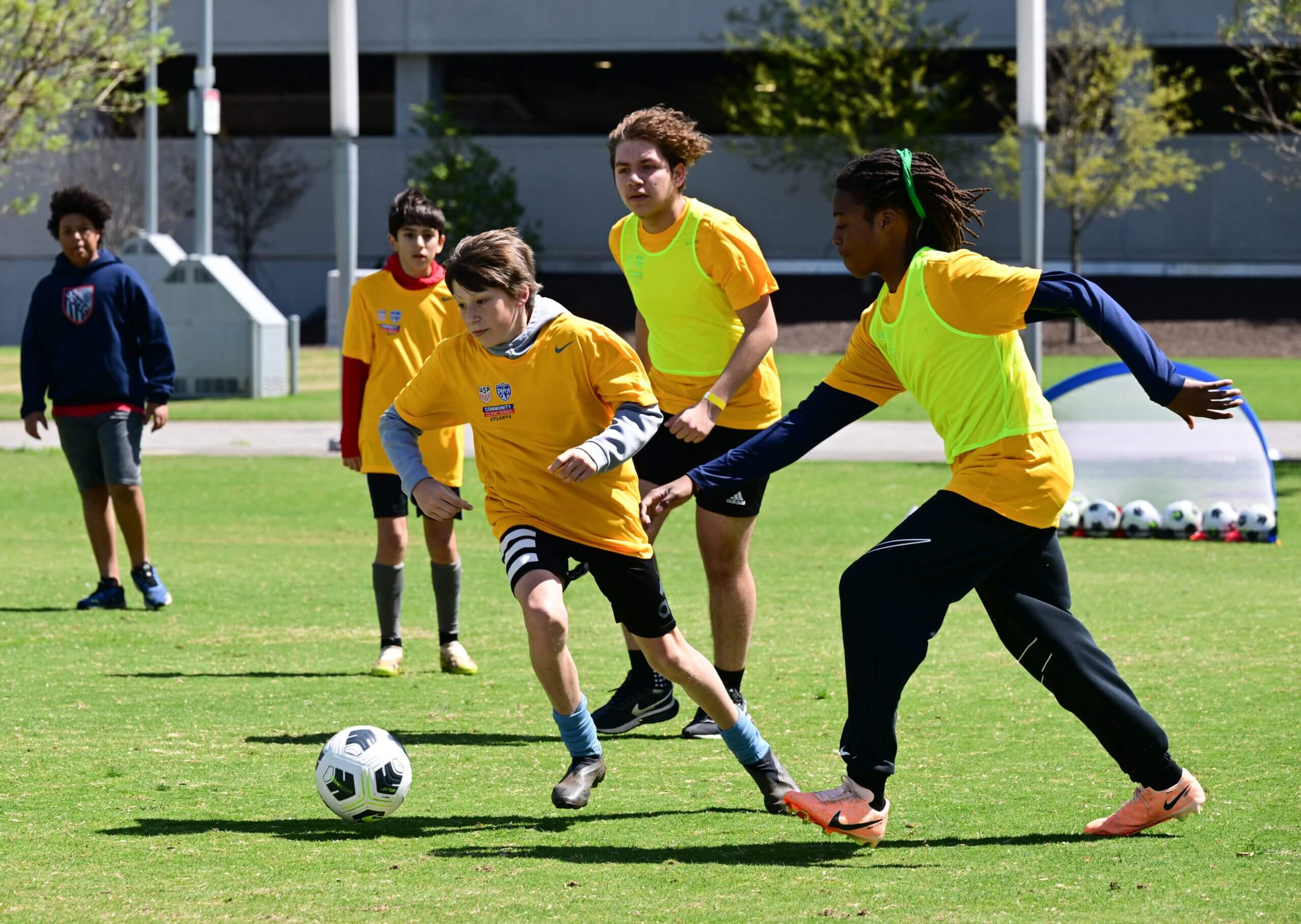
Children play at an AYSO event in Atlanta in 2024 (Adam Hagy / ISI Photos / USSF / Getty Images)
The ‘complex’ and ‘political’ U.S. youth system
Much has been written and ranted about the American youth soccer system, a messy, dollar-driven landscape of leagues, teams and sanctioning organizations that many parents struggle to understand.
On top of it are elite academies run by Major League Soccer franchises. Over the past two decades, they’ve poured hundreds of millions of dollars into youth development and largely improved the peak of the so-called pyramid.
“For the most part,” says Hackworth, who recently worked at St. Louis City SC, “MLS academies are doing a really good job.”
But below them, there are amateur clubs who fight over players, who wage petty political wars, who charge exorbitant fees, or who employ unqualified coaches. Some who’ve worked to reform the space, including Crocker and Micklos, argue that many clubs and coaches prioritize winning — which improves the club’s or coach’s brand — at the expense of player development.
“I haven’t spoken to anybody who feels that we have a player development system that is working, thriving, where everybody is working together in the best interest of the child,” Crocker said a month before departing U.S. Soccer. “There’s not one person that has come to me and has gone, ‘Oh, this is great.’”
He continued: “There’s so many challenges. There’s challenges in the pay-to-play model, there’s challenges in [that there’s] so many leagues, and different facets that provide the same or different things, … which feeds the beast and makes the game even more expensive, because the travel costs go up for kids” — because they drive or even fly to tournaments or “showcase” events rather than playing a team from another league one town over.
Crocker, in his two-plus years as sporting director, tried to create what he calls “a clear, simple pathway.” His predecessor, Earnie Stewart, wanted something similar. But by the time they left the role, both were frustrated by friction and the slow pace of change. “It’s a bigger beast than I ever expected,” Crocker said. “It’s so complex. It’s so political.” He hinted that clubs and organizations were resisting reforms that might impact their financial bottom lines.
After venting, Crocker signed off from a 30-minute interview with an exhale and a few telling words: “I really enjoyed that. It was like therapy.”
It also provided the second piece of the answer, a systemic limitation that cuts down the number of elite American athletes who can become elite soccer players.
In the sport’s most successful countries, “you have very clear talent development systems,” says Hans Vander Elst, the director of football at Belgian consultancy DoublePass. The clarity, he explains, allows players to “move really quickly” from grassroots clubs to the youth arms of semi-pro clubs to professional clubs, always seeking out trained coaches and appropriate challenges.
In the U.S., on the other hand, “there is a lot of talent,” Vander Elst says, “but the pathways and the pipelines are not so well-developed.”
‘We will become an international force in this game’
There are, of course, other opinions, other reasons that arise in interviews and conversations across U.S. soccer’s landscape.
Some argue that despite the progression and professionalization of MLS academies, they still lag behind the best in the world. Others point to the pathway’s final step, the leap from academies to the pros; they argue that top prospects don’t get sufficient opportunities in MLS first teams, and stagnate playing for reserve teams in empty stadiums without pressure.
Others touch on talent identification, on geography, on overloaded schedules, on rules. But the piece that’s nearly inarguable, and central to the answer, is the foundational one: culture.
And the question, then, is what can be done to create it.
The prevailing answer is: Be patient. Cultivation takes time.
Certain initiatives can accelerate it. U.S. Soccer’s “Soccer at Schools” mission is, hopefully, one of them. Halfway across the globe, Byer speaks about how “we’ve created an artificial culture” in Japan. A years-long campaign leveraged media and pop culture, such as comics, to essentially convince parents to introduce their preschoolers to soccer at home. Some mastered the ball, and pushed the sport forward.
But the crux of the answer is generational. Decades ago, soccer was nearly invisible in America; parents who hadn’t grown up with the game had little reason to nudge their sons into it. But the NASL, the 1994 and 1999 World Cups, MLS and the internet began to change that. “When we have parents who have grown up playing the sport, watching the sport, they give their kid a ball,” says Micklos, who’s now the strategy chief at YSC Academy. And gradually, a culture starts to organically take hold.
It will never be as deeply ingrained as it is in, say, France or Uruguay, where football is intertwined with national identity. There are too many other sports here in the U.S., and too many other routes to riches and fame.
But there are also now hundreds of thousands of Americans at professional soccer matches every weekend. There are millions playing the game. Tens of millions will watch the World Cup this summer; some will feel inspired, and might pass their newfound love on to their children in a way their parents didn’t do for them. “They’ll buy a jersey, they’ll watch a game, they’ll give their kid a soccer ball, they’ll sign them up for AYSO,” Micklos says, referencing the American Youth Soccer Organization.
And eventually, perhaps soon, perhaps decades from now, top-50 players could appear.
“I do believe that, in time, we will become an international force in this game,” Micklos says. “We’re already scratching surfaces.”