
Get free access to the most comprehensive World Cup coverage in The Athletic app.
It was 13 minutes after 2pm on the first day of the 1994 World Cup.
A colourful, optimistic, slightly chaotic opening ceremony at Soldier Field in Chicago had given way to Germany vs Bolivia, the first fixture of 52 scheduled to take place over the course of the following month.
Those present that day report a crackle of anticipation in the air. These were the opening beats of soccer’s big moment in the U.S., an opportunity for the most popular sport in the world to shake off its localised underdog status. “I’m Coming Out,” Diana Ross had sung to an ecstatic crowd before kick-off, capturing the prevailing mood.
“It was the perfect song for what we were trying to do,” says Scott LeTellier, the president of the World Cup ’94 organising committee. “We had got tired of the rest of the world saying we weren’t a soccer country and we were looking forward to proving that we could be.”
That mission had started many years before the Germany game. A full evaluation of its success would have to wait until further into the tournament. In that moment, though, the early indicators were positive. The stadium was packed. Ticket sales had been strong. The U.S. team would take the field the following day and stoke further interest.
There was just one problem. Around 1,700 miles west, in Los Angeles, a story that had been bubbling away for days was just about to boil over. Across a few hours, it would become one of the biggest news events of the decade.
In Illinois, Germany attacked down the left. Striker Karl-Heinz Riedle had a looping header saved by Bolivia goalkeeper Carlos Trucco. The break in play allowed ESPN commentator Bob Carpenter to provide the channel’s viewers with an update on the situation.
“Coming up at half-time, we’ll bring you a SportsCenter report with the latest on the charges against O.J. Simpson,” said Carpenter. “The big story is that he hasn’t turned himself in.”
In the early hours of June 13, 1994, the bodies of Nicole Brown Simpson, the ex-wife of O.J. Simpson, and her friend Ronald Goldman were found outside the front door of Brown Simpson’s condominium in the Brentwood section of Los Angeles.
Simpson, the winner of the NFL Most Valuable Player award in 1973 and a Pro Football Hall of Fame inductee, became the prime suspect for the double murder.
The Los Angeles County District Attorney filed murder charges against him on the morning of June 17. Simpson, who was hunkered down in a house in the San Fernando Valley, was told to surrender by 11am Pacific Time. That deadline came and went.
At 1.50pm, Los Angeles Police Department spokesperson David Gascon told reporters there was an active search underway for Simpson. At 3pm, Gil Garcetti, the D.A., issued a statement of his own, describing Simpson as “a fugitive of justice”.
Shortly before 6pm, Simpson called the police from the back of a white Ford Bronco. He was being driven by Al Cowlings, a boyhood friend and former Buffalo Bills team-mate. Five minutes later, television helicopters — there would be more than 20 of them in the sky before long, their signals overlapping, scrambling footage — picked up the Bronco, tailed by police cars, moving up Interstate 5.
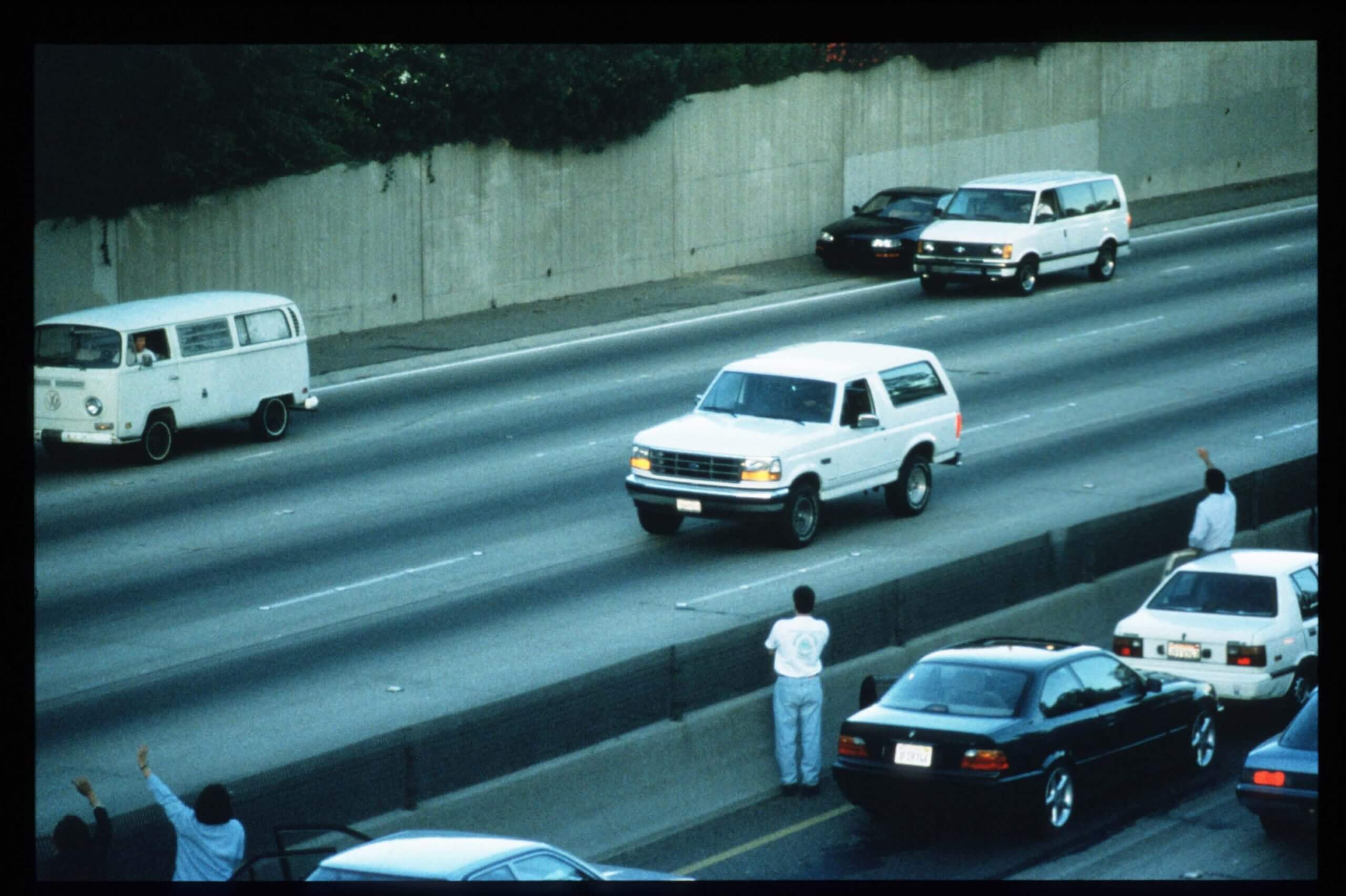
Crowds gather as the car carrying O.J. Simpson travels down Interstate 5 in 1994 (Jean-Marc Giboux/Liaison)
What followed — the two-hour, slow-motion pursuit; the harrowing phone conversations with the police negotiator; the roadside crowds, drawn out either by their belief in Simpson’s innocence or by some macabre fascination; Simpson’s eventual surrender at his home — seared itself onto the American consciousness.
Simpson, who died in 2024, was acquitted on both counts of murder in October 1995. The jury in a subsequent civil case found him liable for the wrongful deaths of Brown Simpson and Goldman.
Around 95 million people watched the chase live on television. Two-thirds of all American households tuned in.
Nor was it just the dedicated news channels broadcasting developments. NBC cut away from footage of game five of the NBA Finals — a seismic event in its own right — during play in the second quarter.
“We are witnessing tonight a modern tragedy and drama of Shakespearean proportion being played out live on television,” said NBC News anchor Tom Brokaw at half-time before the channel pivoted back to the NBA.
Bob Costas, who was leading NBC’s sports coverage, clearly felt the same. “It is somewhat surreal for us to sit here and do the only thing we can do until we hear of new developments, which is to continue with our coverage of this basketball game,” he said.
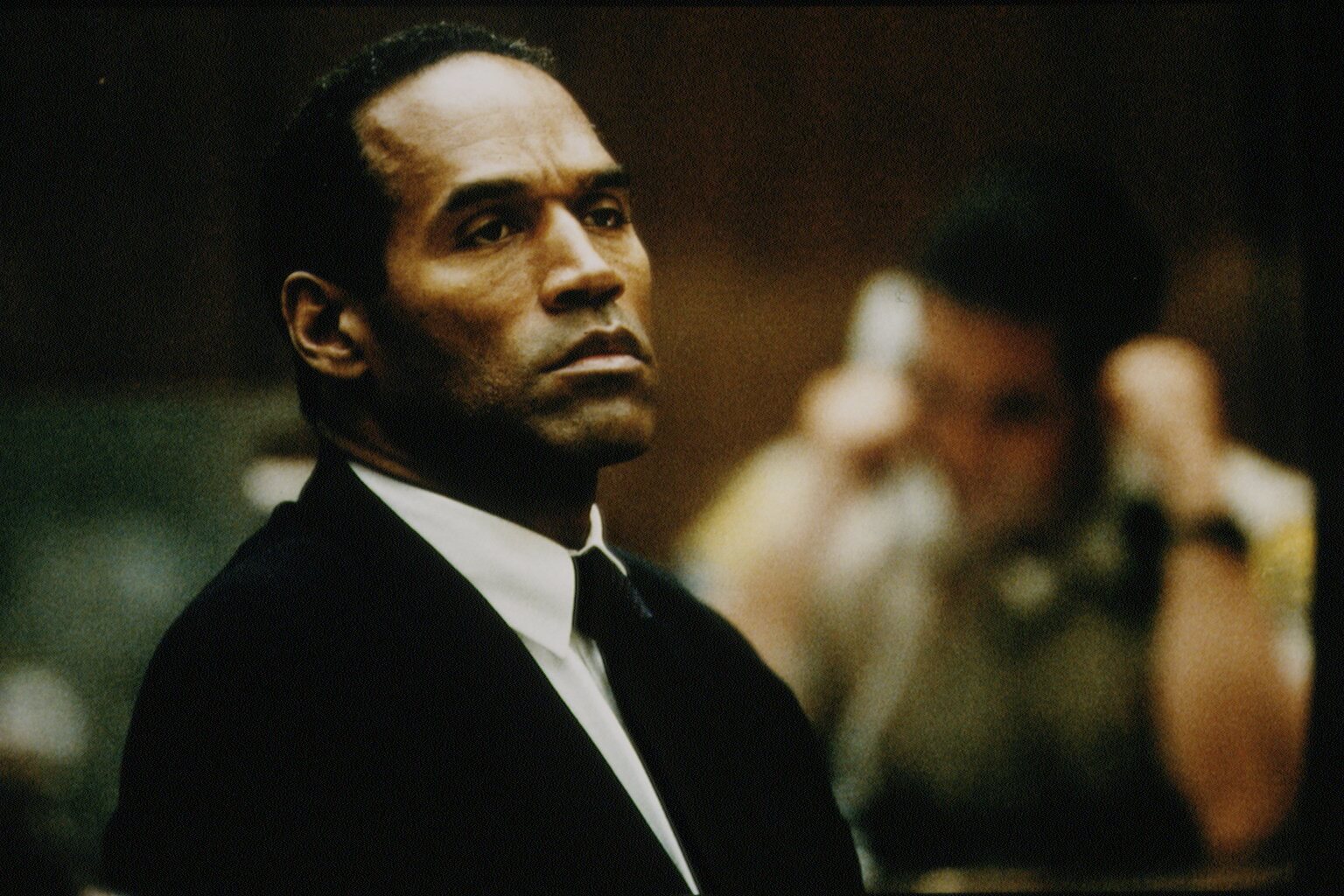
O.J. Simpson appears in court in 1994 (Ted Soqui/Sygma via Getty Images)
Germany vs Bolivia, which kicked off at 2pm Central Time, was finished long before the Bronco chase. Understandably, the day’s developments did not come onto the radar of U.S. Soccer officials at Soldier Field.
“We were so tied up with what we were doing,” says LeTellier. “I kept hearing things about some O.J. situation but I didn’t know what it was. We had a lot to deal with right there in Chicago, so I wasn’t watching. I only saw everything that had happened in the newspapers the next day.”
The second World Cup match of the day, Spain vs South Korea, started at the Cotton Bowl in Dallas at 6.30pm CT. Simpson had been declared a fugitive 90 minutes earlier. The chase would begin halfway through the second half of the game.
The broadcast situation was a little different in 1994 from how it is today. ESPN and ABC had the World Cup rights but only the more significant fixtures were shown free-to-air. The Spain match, like the Germany one before it, was on cable only. Unlike with NBC’s coverage of the NBA, there was no public-service argument for interrupting coverage.
“ESPN is a sports network,” Randy Hahn, the lead commentator on the Spain game, tells The Athletic. “It’s not something we would have broken into our programming to update on. There was no mention of it.”
The Simpson situation did, however, puncture the media bubble after the final whistle. In the press room at the Cotton Bowl, print and broadcast journalists gathered around a television set to watch coverage of the pursuit.
“There was an inner circle of American journalists, maybe some support staff, crowded around,” says Hahn. “Then there was an outer layer of foreign journalists, guys from South Korea and Spain, trying to figure out who O.J. Simpson was. They were puzzled. In retrospect, it was quite comical.”
Also spellbound were assorted members of the U.S. national team.
With their opening game against Switzerland the following day, the U.S. players had a light training session and returned to their hotel at around dinner time in Pontiac, Michigan. The TV downstairs was showing the Simpson chase.
“We stopped in the bar area and watched until we had figured out what was going on,” recalls U.S. midfielder Tab Ramos. “It was the main topic of conversation that day.”
After eating, the players returned to their rooms. But they could not tear themselves away from the coverage.
“I hate to say it, but we were all glued to the TV,” laughs U.S. defender Marcelo Balboa. “It was shocking and surprising, something you never expected to see. We wanted to see what he was going to do, where he was going to go, whether (the allegations) were true or not. You know when you watch a movie and you’re glued to the TV? That was us.”
Kick-off against Switzerland was at 11.30am the following day. The players were due to meet at 6.30am. The three-hour time difference between Pacific and Eastern meant the news coverage stretched late into the evening, however.
“None of us got a whole lot of sleep,” U.S. forward Eric Wynalda has said of that night. Goalkeeper Tony Meola told ESPN in 2014 that he nodded off with the television on. “I was exhausted come breakfast time,” he admitted. Alexi Lalas, the U.S. defender, has called it “the ultimate reality show” and could not tear himself away. “I remember turning to Brad Friedel, who was my room-mate, and saying, ‘O.J. is going to keep me up on the biggest night of my life’,” he told the Daily Mail in 2024.
“It was an interesting evening,” Friedel tells The Athletic. “I wasn’t playing the next day. I stayed out on the couch and watched a lot more of it than he did.”
Balboa, too, found it hard to flick the off switch, even when it became clear the noise from the television set was keeping room-mate Fernando Clavijo awake. “He’d roll over every once in a while and tell me to turn it off,” says Balboa. “I was like, ‘Dude, hold on, hold on!’. That did end up being something of a late night. Eventually, Fernando got mad and told me to turn it off.”
The challenge facing U.S. Soccer was laid bare by a Harris poll conducted three weeks before the World Cup. Seventy-one per cent of respondents had no idea the tournament was taking place in the United States. Sixty-two per cent did not even know what the World Cup was. The front page of the New York Times included a tiny, 22-word blurb about the opening day on June 17. Three of those words were “amid American indifference”.
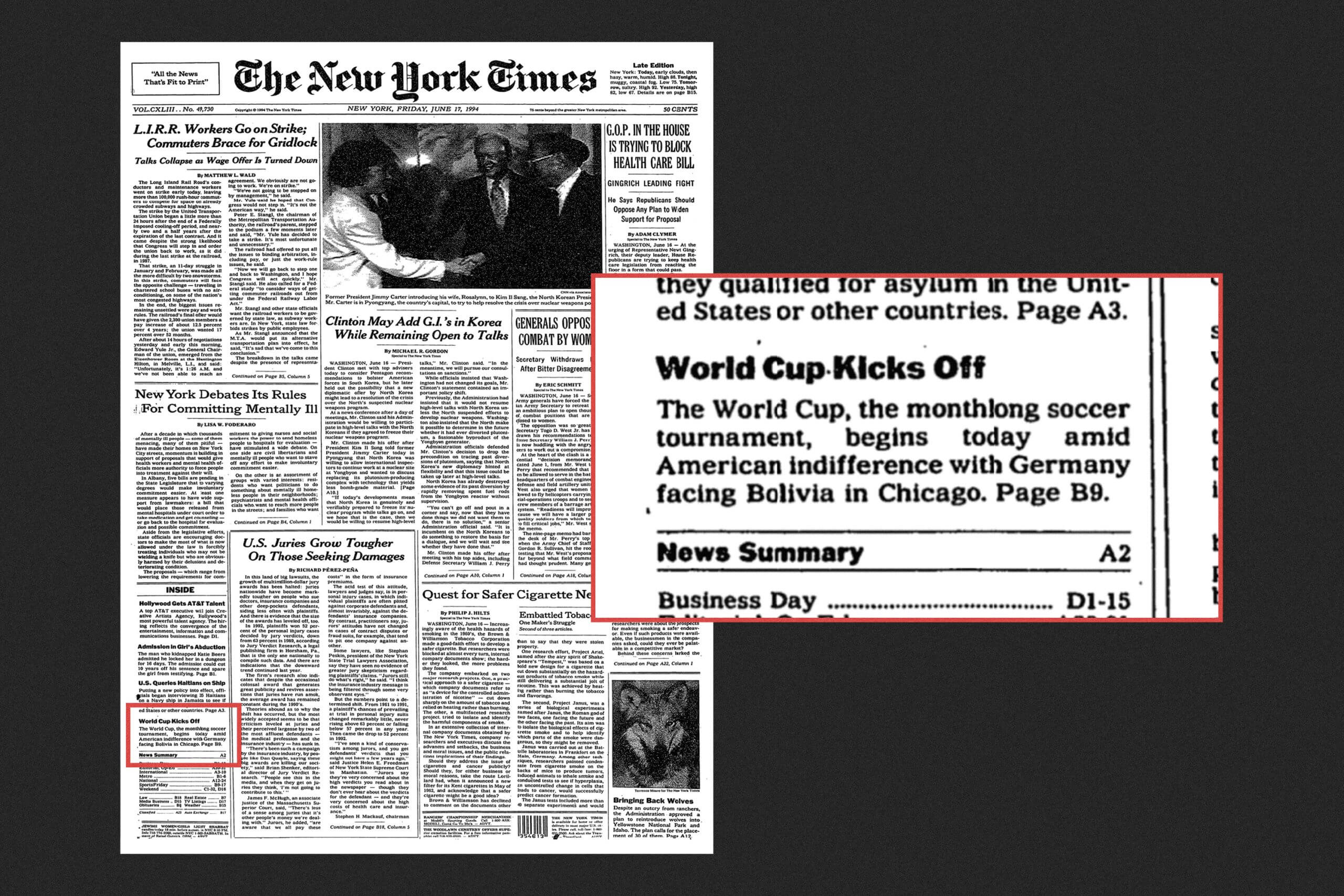
The front page of the New York Times on June 17, 1994 (New York Times)
That was at home. LeTellier, the president of the organising committee, says he also felt a degree of scepticism from the wider soccer community over whether the U.S. could stage a successful World Cup.
“The perception among many in the FIFA world was that not having a good team meant we couldn’t organise a good event,” he says. “It was one thing to say we couldn’t play on the field — which we actually did surprisingly well, at least in beating Colombia and getting to the next round — but there’s no correlation. We had put guys on the moon. We had just come off the greatest Olympic Games in 1984.”
LeTellier says he and his U.S. Soccer colleagues were keen to put on a show and prove the doubters wrong. “We figured this was our big chance,” he says. “We spent the money on the opening ceremony. We had a plan to launch a pro league after the World Cup had ended. It was all part of our whole objective.”
The confluence of several major sporting events — the NBA Finals, the conclusion of the Stanley Cup, the US Open — in the same week as the start of the tournament meant competition for eyeballs was always going to be high. The Simpson situation only complicated things further.
“American competition for the World Cup includes the baseball season, in which new stars are threatening the game’s greatest records,” wrote Ian Thomsen in the International Herald Tribune. “Fans figure to care more about the National Basketball Association championship series, which should be completed next week, and even by something as bizarre as the double-murder involving the American football star, O.J. Simpson, a tragedy whose social and cultural implications are probably far more engaging to Americans than this foreign visitation.”
Thomsen wrote that before the car chase. After it, there was no “probably” about it.
“Every time you turned on a TV, no matter what channel you chose, it was all about O.J.,” says Balboa, the U.S. defender. “It wasn’t about the World Cup. It wasn’t about the opening ceremony. It was O.J. It was everywhere.”
LeTellier remembers feeling crestfallen when he looked at the major newspapers the morning after the chase. The front pages of the Los Angeles Times and Washington Post carried small items about the World Cup below big Simpson hits. The front pages of the New York Times, Boston Globe and Houston Chronicle had nothing about soccer at all.
“We were anxious to get off to a fast start,” says LeTellier. “The O.J. situation dramatically affected the coverage. We were bounced off the front page of newspapers the next morning, and off a lot of the news shows. It was a disappointment.”
There was a sense of frustration among the U.S. players, too. This was not just the federation’s big moment in the sun; it was also a chance for the team to show what it could do — and win over some new fans.
“Without question, it deflected attention,” says Ramos. “U.S. Soccer and the players had worked really hard to get to that moment. What were the chances that some other big story was going to take over? It was really unfortunate.
“I was part of that generation of players who felt we had a responsibility to grow the game. We needed those moments, you know? It was inevitable that we were going to feel bad about not having a little bit more attention. I remember being disappointed about that.”
It was, in truth, only a temporary setback. The U.S. team performed well, making the second round, winning hearts and minds, just as they had hoped to. The tournament itself was widely viewed as a success and exceeded targets for home viewership.
In the final reckoning, those surreal few hours would be remembered best as a brief reminder of the old maxim made famous by Harold Macmillan. The thing most likely to derail the best-laid plans, according to the former British prime minister? “Events, dear boy, events.”