
On Wednesday, The Athletic reported that Saudi Arabia’s Public Investment Fund (PIF) is preparing to pull its multi-billion-dollar funding of LIV, the rebel golf league, according to golf industry sources.
The controversial project was launched in 2021, with hundreds of millions of dollars being offered to golf’s leading names. It led to a bitter schism in the sport, with the likes of Brooks Koepka, Bryson DeChambeau, Dustin Johnson, Phil Mickelson, and Jon Rahm among those to sign up for the tour.
Four years of events and billions in losses later, LIV has struggled to attract viewers and interest or come anywhere close to repaying the huge investment.
PIF also announced its strategy for the next five years on Wednesday and appeared to signal a change in priorities. Mohammed bin Salman, the crown prince of Saudi Arabia and chairman of the PIF, approved a plan that will “focus on delivering competitive domestic ecosystems to connect sectors, unlock the full potential of strategic assets, maximise long-term returns, and continue to drive the economic transformation of Saudi Arabia and further enhance the quality of life of its citizens”.
PIF’s homeward turn had been in evidence even before the new strategy sign-off. The overseas proportion of the wealth fund’s investments hit a high of 30 per cent in 2020, but has been in steady decline since.
Company filings to the end of 2022 showed investments in countries beyond Saudi Arabia and other Gulf Cooperation Council members — Bahrain, Kuwait, Oman, Qatar, and the United Arab Emirates — totalled 23 per cent of PIF’s portfolio. Two years later, that had dropped to 19 per cent.
On Thursday, Saudi Pro League football club Al Hilal was sold by PIF. In a statement, Yazeed A. Al-Humied, deputy governor and head of Middle East and North Africa investments at PIF, said: “Today’s announcement aligns with PIF’s strategy to maximise returns and redeploy capital within the domestic economy.”
Here, The Athletic explains what this all means for Newcastle United.
Why is that an issue for Newcastle?
Unless you found yourself under a rock in October 2021, and for much of the four and a half years since, you’ll know Newcastle are now majority-owned by the Public Investment Fund. It was back in that autumn that Mike Ashley sold the club for £305million ($412m) after 14 years as owner.
Advertisement
Not all of the money came from PIF, which took up an initial 80 per cent shareholding. Its stake increased following the departure of Amanda Staveley from the ownership group in July 2024, whose 10 per cent slice upon arrival mirrored that of another owner, Jamie Reuben. As of today, PIF owns 84.64 per cent of Newcastle; Reuben owns the remaining 15.36 per cent.
Newcastle were largely self-sustaining save for the early days under Ashley, but the situation shifted dramatically upon his departure. For that reason, any concern around PIF’s appetite to fund its investments is naturally a concern for Newcastle.
Even ignoring the purchase price, and a small sliver of club debt repaid by the new owners to Ashley on the day he left, Newcastle have received £491.9m in cash from their owners in the past half-decade. In England, only Chelsea and Everton have received more. The vast majority of Newcastle’s funding has come from PIF.
Chris Weatherspoon
How dependent are Newcastle on PIF for financial support?
One of the reasons PIF’s arrival — and Ashley’s departure — was so welcomed on Tyneside was the expectation of new funding flowing into a club, which had mostly been getting by on its own resources. Save for £15m to help the ultimately successful Championship promotion push of 2016-17, Ashley injected no new funds in his final 11 years as owner (and even that amount, plus a little more, was repaid to him two seasons later).
PIF’s ability to juice Newcastle in the manner seen at Manchester City and Chelsea previously was inhibited by financial rules not in place at the time of their own seismic takeovers, though there’s still been a stark shift at St James’ Park.
Across four seasons of PIF ownership to the end of June 2025, Newcastle’s free cash flow — cash generated after covering operating costs and capital spending, such as that on transfers — was negative to the tune of £392m. The vast majority of the club’s cash went toward buying players: in those four seasons, a net £350m went on transfer payments.
That £392m gap was principally plugged by the owners and, by extension, PIF. £335m in new owner cash arrived during that time. The remainder of the cash flow hole was filled by £52m in external borrowings and using £5m of Newcastle’s existing cash balance.
Newcastle’s operating cash flow has been £29m positive under PIF ownership, almost all of that surplus coming in the 2023-24 Champions League season. A return to the competition will have helped cash flow this season, and, on an operating basis, a Newcastle in the Champions League could theoretically get by without extra funding.
Yet that would leave no cash to spend on anything else, such as transfers. The vast majority of PIF’s spending has gone on those, with Newcastle opting to pay more up front rather than racking up liabilities. Their net transfer debt of £52m at the end of last June was one of the lowest figures in the Premier League.
The bumper sale of Alexander Isak to Liverpool should have brought that down further, though Newcastle still spent a net £141m on transfers last summer. How that was funded is unclear, but it looks likely that PIF kept up the policy of paying early more than other clubs do; in the final quarter of 2025, a further £151.5m of owner funds were injected into the men’s team entity.
Newcastle upsized their revolving credit facility from £25m to £50m last July. That left them around £42m headroom to draw on if they so chose, and with such low transfer debt, there’s a world in which the club returns to a form of self-sustainability, albeit not one which would facilitate competing at the highest level.
Newcastle would have little to no money to fund transfer spending, or any infrastructure improvements (£58m went on those in the past four seasons). Without decreasing the club’s existing wage bill and operating costs, sustainability would hinge on regular Champions League appearances, something made much harder by that lack of transfer funds.
What’s more, a departure of PIF would likely hit Newcastle’s day-to-day revenues, further hurting any chance of sustainability being achieved. Turnover remains some way from the level club officials hope to reach, and £34.4m, or 10 per cent of 2024-25 income, was attributable to sponsorship deals inked with fellow PIF-owned companies.
Chris Weatherspoon
Advertisement
What has PIF said about the future of its investment?
“No comment.” As is the PIF way. Getting anything on the record from PIF, beyond managed public briefings such as the one Yasir Al-Rumayyan, governor and Newcastle’s chairman, gave on Wednesday in the Middle East, has always been extremely difficult.
But those familiar with their thinking are adamant that despite the reassignment of investments, Newcastle will be unaffected. PIF’s 203 companies are being split into three separate pods: Vision 2030 (which is their domestic portfolio), “financial”, and “strategic”.
Newcastle, it is claimed, fall into the final category. The insistence is that funding committed to the club is not expected to be scaled back, nor increased, but will remain at similar levels to before.
When it comes to the prospective sale of Al Hilal, the message over the past year has been that there is no correlation between what happens with the four PIF-owned Saudi Pro League (SPL) clubs and Newcastle.
The claim is that the SPL clubs were bought for different reasons and that the intention was always to sell them at some stage, whereas Newcastle was purchased as a long-term investment. An eventual sale was part of that plan, but not at this point.
PIF regards Newcastle as a successful purchase so far, according to those familiar with their thinking, and is not looking to offload the club in the short-to-medium term.
Al-Rumayyan — a golf-lover who fronted the LIV project and is also the chairman of Newcastle United, hence the supposition that the latter may also be affected — was not asked directly about Newcastle on Wednesday, so did not specifically address PIF plans for the club.
PIF’s Newcastle investment sits under the ‘Media and Entertainment’ industry grouping in the fund’s financial statements, just like LIV and those SPL clubs. Newcastle’s placing within that “strategic” pod is of greater importance, but what happens to others within the media and entertainment bucket may be instructive — and soon, too.
Advertisement
Magic Leap, an American company that specialises in augmented reality, sits in the same space and is heavily loss-making. Accounts filed for a UK-registered subsidiary detailed Magic Leap’s reliance on PIF funding; forecasts projected a requirement for new cash in each of January, March, April, June and September of this year. If PIF pulls funding from there, it will be swiftly apparent.
Chris Waugh and Chris Weatherspoon
How much are Newcastle potentially worth?
Club valuations are a tricky business, and for all Ashley’s apparent business acumen, plenty saw the £305m sale of 2021 as a bit of a steal for PIF, Reuben, and Staveley.
When The Athletic conducted its own valuation exercise for Premier League clubs a few months ago, we agreed with the consensus view that Newcastle’s value has more than doubled under new ownership.
Commercial revenues are growing even withstanding those PIF-related entities; Newcastle were the only non-‘Big Six’ Premier League club to top £100m in 2024-25. At St James’ Park, even without a long-awaited decision of revamping the ground or moving elsewhere, matchday income has about doubled under the current owners.
We put Newcastle’s valuation in the £700m-£770m range, which would be an underestimation if Champions League status became more expected than not. But Newcastle aren’t there yet, and a rocky summer of transfers last year has done little to improve the club’s worth.
Most key to that improvement would be a decision on the future of St James’ Park. PIF has spent more than Ashley on both Newcastle’s home and the training ground, though that wasn’t especially difficult to achieve. The focus has mostly been on building a team that can compete on the pitch.
That is understandable and has moved the club’s value upwards, but without any significant shift in the broader footballing economy (a sudden surge in domestic broadcast rights, for example), the eschewing of longer-term projects means there’s a limit to what PIF could realistically seek if they were to sell any time soon.
Chris Weatherspoon
Advertisement
What are people at Newcastle saying?
Those at the top of the club echo the same message: nothing has changed. They go further, in fact, insisting “emphatically” that Newcastle will be unaffected.
Al-Rumayyan and Reuben met earlier this month, before PIF’s funding announcement, to discuss Newcastle specifically. Sources close to the Reubens, the minority owners, claim they have not been informed of any change in commitment from PIF.
PIF has communicated to the hierarchy that these latest announcements do not relate to Newcastle, and there has been no change or drawing back of funding or ambition. Sources claim that the usual daily dialogue between St James’ executives and ownership remains ongoing, with Jacob Solis, a PIF director, often the main direct point of contact.
Whether senior figures at Newcastle would be warned of a potential scale-back is another matter, though the continued support and engagement of the ownership means insiders believe PIF is genuine with its assurances.
The view of some inside St James’ is that Newcastle stacks up against any other company in the PIF portfolio when it comes to the long-term investment potential, whereas LIV is no longer a viable business opportunity.
While in the long run there is an expectation that PIF will sell at some stage, as was always said to be the plan, sources feel Newcastle’s potential value is not yet close to being realised, so that point is not close.
Howe’s future is among the issues the club’s owners have shown an interest in (Stu Forster/Getty Images)
While those at the top of the club have received affirmation from the owners, some employees did admit to feeling a degree of angst after PIF’s announcement on Wednesday. That was tempered, at least for some, by what they see as the clear continued interest shown by PIF in day-to-day matters, including regarding Eddie Howe’s future and ongoing plans for a new training ground.
It does not appear that there was internal, club-wide communication provided to reassure staff.
Advertisement
It is important to note, however, that doubts over PIF’s commitment are not necessarily a new phenomenon, even inside the club. For the past three years, some senior figures have privately questioned at times whether PIF will follow through on its infrastructure and investment promises.
For now, the insistence is that normal practice continues. For a start, Al-Rumayyan is due to visit Tyneside at the end of the month to conduct his usual annual departmental reviews — which always take place in the spring and, insiders insist, should not be conflated with present noise surrounding Howe’s position or the team’s 14th-placed positioning in the Premier League — and potentially for another off-siting ‘away day’, similar to the summit at Matfen Hall in February 2025. Reuben is also expected to attend.
What’s more, having allowed Newcastle to drift without an active CEO or sporting director last summer, the club’s ambition has been restated (and feels reinvigorated) under David Hopkinson and Ross Wilson respectively.
Since Hopkinson was appointed as chief executive in September, the Canadian has pledged to turn Newcastle into one of the best clubs in the world by the end of the decade. After conducting a 100-day review of Newcastle’s operations, he delivered a near-400-page report to the ownership outlining his path towards Vision 2030, which was passed at a board meeting over the winter.
Hopkinson, right, has grand ambitions for the club (Serena Taylor/Newcastle United via Getty Images)
Hopkinson has managed to streamline executive-level decision-making, bringing greater autonomy to the hierarchy based at St James’, so that fewer calls have to be ratified in Riyadh. Those concessions are designed to make decision-making speedier and more dynamic at the top of the club, with PIF’s “process-driven” approach often blamed since the takeover for why some key calls have not been enacted.
Time will tell as to how effective those tweaks prove to be, and as to whether PIF’s engagement remains as strong.
Although he has not spoken on the latest developments, Hopkinson did discuss PIF’s commitment in February.
Advertisement
“The No 1 thing I talk to the ownership about is ambition,” Hopkinson told talkSPORT, the UK radio station. “That’s the magic word here, having the correct ambition.
“We have total alignment on that. This is a club that, by 2030, will be consistently contending for the top prizes in global football. We have a lot of wood to chop between here and there. When I see Newcastle United, everywhere I look, I see opportunity.”
Nobody from Newcastle has spoken on the record about PIF this week, although Howe will doubtless be asked about this topic at his pre-Bournemouth press conference on Friday morning.
Chris Waugh and Adam Crafton
How quickly could PIF divest?
It depends on how much PIF would want for the club. One of the reasons Ashley struggled to sell, and then sold for a figure which now seems low, was the years of stasis under his hand; Newcastle United were not presented attractively.
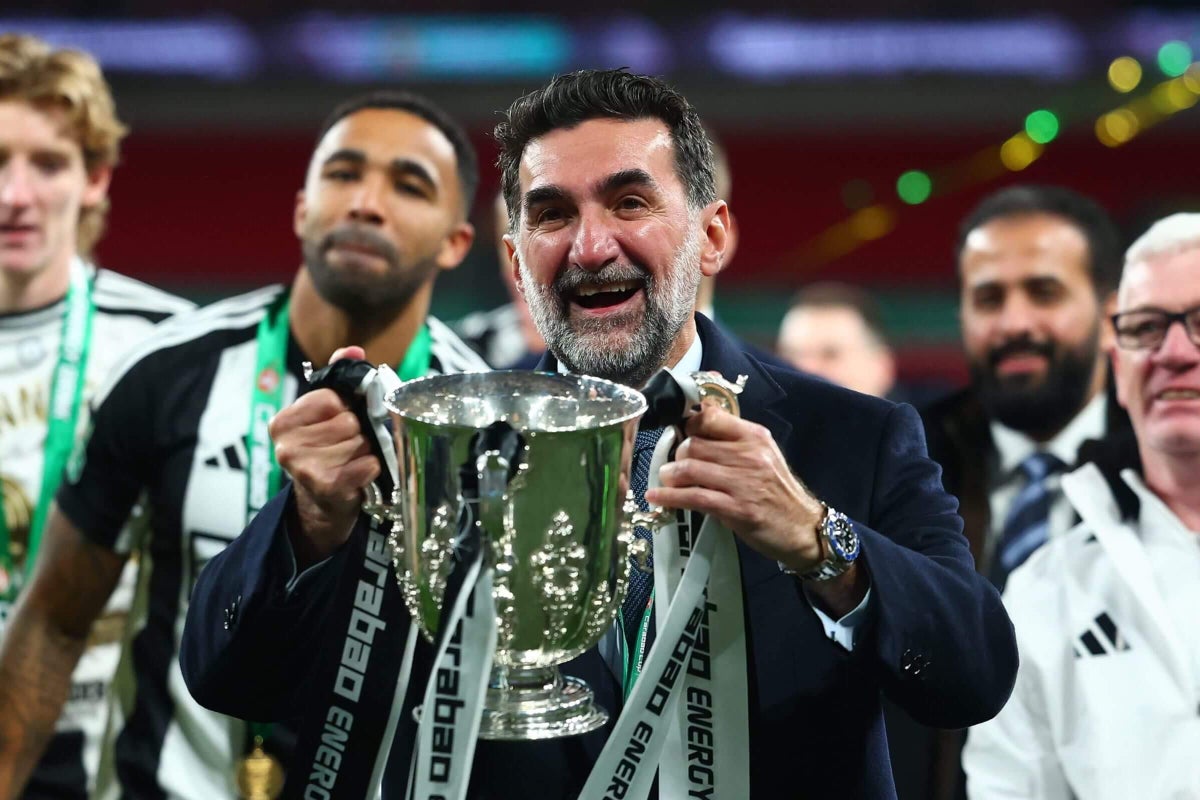
That has changed under the current owners, not least because winning games of football — and, in the form of last season’s Carabao Cup, an actual trophy — tends to shine a brighter light on matters.
A doubling of the 2021 purchase price looks eminently feasible, though of course that doesn’t take into account how much has been poured into the club since. In total, inclusive of their share of the purchase price, PIF’s overall commitment to the Newcastle project tops £660m.
Breaking even, therefore, wouldn’t look too arduous, but it’s unlikely they’d settle for that. A £1billion-plus valuation would surely be sought. Whether that is feasible at this stage is a matter for debate. One of the key future value drivers at Newcastle is the very thing PIF has equivocated over since its arrival: the fate of St James’ Park.
Assuming a buyer was found at the right price, the Premier League’s Owners’ and Directors’ Test would need to be passed, theoretically placing Newcastle in limbo if PIF funding dried up.
Advertisement
The club has existing borrowing facilities it could draw on, and could take out further lending in the interim period if needed. But any drawn-out process would hinder them in the transfer market given that is principally where funding has been directed under PIF and co.
Chris Weatherspoon
How heavily has PIF invested? Has it improved Newcastle’s infrastructure?
As outlined above, the best part of half a billion pounds has been invested into the club by the owners, with more than 80 per cent of that coming directly from PIF, the majority stakeholders.
For the most part, that money has been used to facilitate a gross transfer outlay of around £785m — and, on a net basis, £534m has been spent on improving the squad since October 2021. Without the persistent injections of capital from their owners, expenditure at such levels would not have been possible (and it would likely have been significantly higher, too, but for the Premier League’s profit and sustainability rules).
There has also been more than £30m spent on improving the current Benton training centre, which has already been significantly upgraded, but the footprint of which will expand by around 50 per cent once the present renovation is completed. The STACK shipping-container fan zone on Strawberry Place next to St James’ Park opened in August 2024, too, after the club bought back the lease on the land, which Mike Ashley, the previous owner, had sold in 2019.
As well as investing in the academy, departments have also swollen in size across the club, with staff numbers significantly up and an executive-level structure put in place, which previously did not exist (with further hires to follow under Hopkinson’s management).
But, despite the sizeable investment, the level of expenditure has not quite matched the expectations brought about by the takeover. Beyond PSR constraints, neither of the big-ticket infrastructure projects — the stadium or training ground — has been announced yet.
Advertisement
Internal debates over whether to expand St James’ Park or construct a new stadium on Leazes Park next door — as well as how to finance either of those options — remain ongoing, even if the latter has been the clear preference of some senior figures for an extended period. A new state-of-the-art training ground is closer to being confirmed, with a site in Woolsington, near Newcastle Airport, identified, though that is still not finalised and is unlikely to be completed until the end of the decade.
The future of Newcastle’s stadium remains in limbo (Getty Images)
A multi-club ownership (MCO) model remains theoretical, with plenty of research carried out behind the scenes but no additional outfit yet acquired (and uncertainty over whether there ever will be).
The failure to announce any of those has led to some insiders, as well as players and a significant portion of the fanbase, to regularly query PIF’s commitment to and interest in Newcastle.
The official line has always been that such big decisions cannot be rushed, and while there is some validity to that stance, some senior figures at the club have expressed frustration at actual delays, a lack of investment, and apparent limbo.
What’s more, Newcastle have never attempted to challenge the Premier League or UEFA’s financial rules, or really looked to exploit potential relationships with PIF-owned clubs in the Saudi Pro League. While in LIV Golf they have acted like a market disruptor, in the Premier League, they have almost gone out of their way to try to present themselves as good citizens, willing to play by the rules.
In reality, there has been a misrepresentation of what this ‘project’ has meant to PIF from the start. PIF always viewed Newcastle as a long-term investment, one they could make a significant return on, rather than solely as a vanity project on which they would lavish untold funds. Or at least that is what people at the ownership level have preached from the beginning (and continue to do so).
Chris Waugh
Advertisement
What would it mean for Newcastle if PIF sold up?
That is the great unknown and would obviously be largely dependent on the identity of the purchasers, how wealthy they are, and indeed what their intentions and ambitions for Newcastle are.
It would, however, leave the club in a state of limbo, at least temporarily. First, when it comes to infrastructure and whether a new stadium and/or training ground will ever come to fruition, but also almost existentially.
The grand idea has been that Newcastle would be transformed into a perennial Champions League outfit and serial trophy winners, neither of which has yet come to pass. PIF deciding to offload the club would only add to present doubts about Newcastle’s ability to ever fulfil those aspirations.
The insistence from those inside Newcastle and those familiar with PIF’s thinking is that it is simply not the case, though, and that they have no intention of selling the club in the short-to-medium term.