
The inquest began before the final whistle even sounded, before Belgium Trump-danced on the U.S. men’s national team, before the USMNT’s World Cup officially ended. America began to ask why; why was it out in the round of 16 yet again? And why was a country of 11.8 million people so much better at soccer than one of 340 million?
Inevitably, and often correctly, answers zeroed in on youth soccer.
The “pay-to-play” system flooded to the forefront of discourse and shouldered blame.
Behind the scenes, it was also a point of discussion, before and after the USMNT’s elimination, but solving this decades-old problem is a monumental task — because the “pay-to-play” moniker oversimplifies it.
The term, “pay-to-play,” generally refers to a U.S. youth soccer landscape where families must pay for their kids to play on amateur teams. They pay hundreds of dollars annually for their 6-year-old to play recreational soccer; thousands of dollars for their 12-year-old to play competitive “travel soccer”; and in some extreme cases tens of thousands of dollars for their teenager to play for an elite club, perhaps to pursue a professional career or college scholarship.
On the boys side, the most talented teens can ascend to the academies of Major League Soccer clubs, where they play for free; but to get noticed by MLS, they likely have to come through an amateur club that charges annual fees, plus additional money to travel to showcase tournaments. Developing into a top soccer player, therefore, requires some degree of privilege in the United States, contrary to other countries where the sport is an all-class game.
The U.S., to be clear, is far from the only country where families pay for their kids to play soccer. But the costs are greater here than anywhere else.
And soccer is not the only sport that’s expensive in the U.S. But it gets the most attention because it’s a global sport in which U.S. player development lags behind Europe.
So, the U.S. system is worth an examination as the 2026 World Cup rolls on without its cohost.
USMNT future and Poch’s contract after exit
Why is ‘pay-to-play’ a problem?
In some ways, the answer is obvious. If soccer costs money, millions of kids can’t afford to play it.
In addition to being unfair on an individual level, the cost restricts the pool of talent available to U.S. national teams. A country of 340 million people becomes, in soccer terms, a country of much fewer. Many of the supposed advantages associated with a large population simply don’t apply.
But the cost is also symptomatic of deeper structural issues that lead to other distinct problems. For example, because most youth clubs are not in any way connected to professional teams, A) there are no revenue streams to subsidize the club other than parents, hence “pay-to-play”; and B) the club’s main incentive is not to develop players into pros. Instead, it’s to win games — which enhances the club’s reputation and attracts customers (parents of soccer-playing kids). Oftentimes that desire to simply win clashes with individual player development — which is why some countries, such as Norway, a nation of 5.6 million people about to play a World Cup quarterfinal, effectively ban league tables and championships until a kid reaches adolescence.
The U.S. system “is not a youth-centered or a talent-development system,” Tom Farrey, executive director of the Aspen Institute’s Sports & Society program, told The Athletic. “It’s primarily a system set up to use kids to make money for adults.”
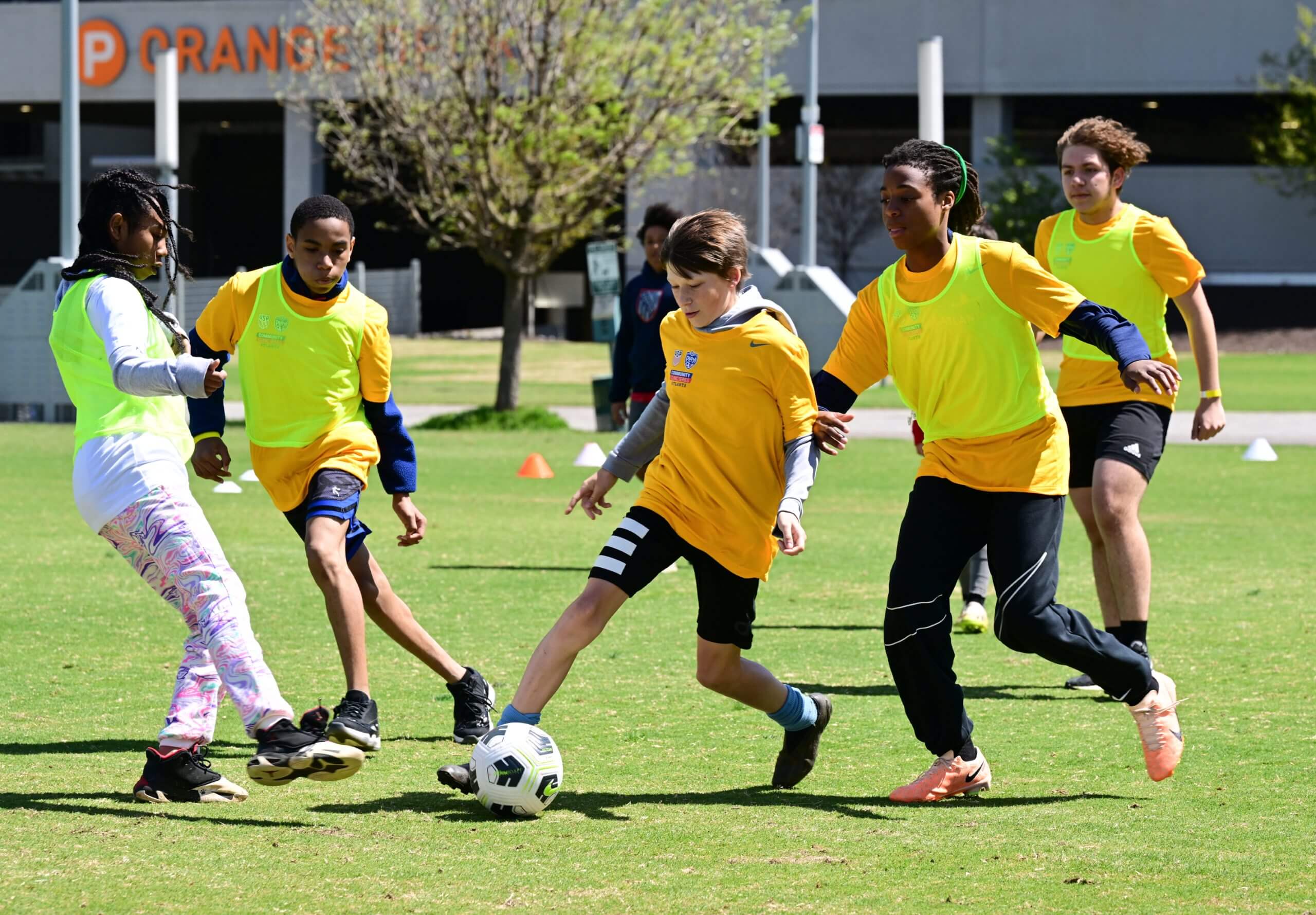
Players at an AYSO/U.S. Soccer youth soccer clinic in Atlanta in 2024 (Adam Hagy / ISI Photos / USSF / Getty Images)
Why does ‘pay-to-play’ exist?
Playing youth soccer costs money in the U.S. because:
- Somebody has to pay for coaches, for playing fields, for referees, for balls and kits and all the other things required to run a soccer team; and
- When soccer got popular as a participation sport last century, there were no systems in place to subsidize those costs.
In other countries, youth soccer is often subsidized by governments or professional soccer clubs. But in the U.S., under the Amateur Sports Act of 1978, the federal government does not fund any Olympic sports. And until the 2000s, there were no stable professional clubs with youth arms. Even during the North American Soccer League’s run from 1968-1984, its franchises had no academies; they were disconnected from the youth soccer landscape.
The landscape, therefore, became a “Wild West,” as Farrey puts it. Anyone could start a youth soccer organization — if they had a viable business model to sustain it. And the most viable model was to start a club in upper-middle-class suburbs, hire coaches, rent fields and ask the upper-middle-class parents to pay for all of it. The ones with enough money would pay, because these clubs were often the only way to get their children into organized soccer, and in some cases because they saw soccer as a route to a college scholarship. (In other words, some saw it as a good investment.)
By the time MLS franchises began to build out academies in the late 2000s and 2010s, a system structured around these amateur clubs was entrenched, far more entrenched than the professional league. And the U.S. Soccer Federation, the sport’s national governing body, has largely been unable or unwilling to regulate those amateur clubs. They’ve formed regional and even national leagues, which mandate significant travel, which adds thousands of dollars to some annual price tags.
Those clubs and leagues fuel the “youth sports tourism” industry, as some call it. Hotels, local governments and many others benefit — at the expense of families and soccer-playing kids. The “pay-to-play” system has become “pay-to-play-and-travel.” Across all youth sports, costs rose 46 percent from 2019 to 2025, according to Aspen Institute research, and “travel is the biggest chunk of that,” Farrey said. “Club fees have gone up, uniforms have gone up, but travel is the biggest line item in a family’s youth sports budget.”

ECNL (Elite Clubs National League) is among the many factions that make up the youth soccer system in the U.S. (Sandy Huffaker / The Washington Post / Getty Images)
Why is soccer, of all sports, so expensive?
It’s not. This is an America problem, not a soccer problem. The root cause — a relatively unregulated amateur sports landscape — “is a problem in multiple sports,” Farrey said. “This is why baseball got crazy. This is why basketball got crazy. All of the sports, we had this Wild West, libertarian environment emerge.”
The “crazy” costs plague those other sports, too, but they’re more of a hindrance — and a hotter topic of discussion — in soccer because America’s international competitors at tournaments like the World Cup boast developmental systems that are cheaper, more efficient, and fundamentally different.
How do other countries keep costs down?
No two national sport systems are the same, but there are generally two approaches that shift financial burdens away from families:
- Governments that see value in youth sports participation, and that want to preempt its commercialization, allocate hundreds of millions of taxpayer dollars annually to sports organizations, which can help offset costs.
- Professional soccer clubs directly and indirectly fund youth teams.
The latter point is a complicated one, but the principle underpinning it isn’t. Soccer, at the professional level, is big business. Millions of dollars hinge on results, so millions of dollars are spent to buy and employ players. Developing players at younger ages, then, is worth millions of dollars to a club — because the young players can either ascend to pro teams and help win games or be sold to other pro teams for profit.
That principle supports soccer “pyramids” in dozens of countries. Formally, via training compensation and solidarity payments, amateur clubs get compensated when a kid they develop becomes a million-dollar player. And informally, elite clubs forge relationships with non-elite clubs in the same geographic area. A top pro club in, say, Montevideo, Uruguay, is incentivized to help “baby fútbol” clubs (youth clubs) across the region because it knows that in return, those clubs will funnel pre-teens and teens up into its academy; and the best teens can then be sold to richer clubs in Brazil or Europe for money that keeps the Uruguayan club afloat.
In the U.S., MLS has now constructed the top of the pyramid. Its franchises run academy teams, which do not charge fees; but beneath them, the landscape is as messy and disjointed as ever.
The “alphabet soup,” as some call it, of leagues, teams, sanctioning organizations and other entities “feeds the beast and makes the game even more expensive,” Matt Crocker told The Athletic before leaving his post as U.S. Soccer sporting director in April. “Because the travel costs go up for kids, because they can’t play (against) this team (in the same town) because they’re in a different league.”
How much does youth soccer actually cost in the U.S.?
The costs vary wildly by age, location, level, league and other factors. A grassroots team might charge $100-200 for a three-month fall season and not much else. At the other end of the range, some parents of girls in the Elite Clubs National League (ECNL) report paying upwards of $20,000 per year — inclusive of an annual fee, gear, extra tournaments and, most of all, travel.
Crocker, having spoken with some of those families, said: “The parents were so stretched. It was so difficult. Which means that there will be players and children out there that we just lost to the system, they never even had an opportunity to play at that level.”
In the middle of that range, take a club like DC Soccer Club in the nation’s capital. In 2026, it is charging $140-$255 for fall rec league registration; $395 for kindergarteners, 1st graders and 2nd graders who want to try its “pre-travel academy”; $1,700-$1,750 for its entry-level travel program (ages 7-13); $2,100-$3,195 for its standard travel program; and $3,395-$3,500 for its academy program (ages 10-18), which covers three training sessions per week and games on the weekend over a 10.5-month season.
On top of those fees, there are “processing fees” and additional costs for uniforms, some tournaments and travel. “Financial aid remains available for families that apply and qualify,” the club says.
In general, across the board, Farrey said, costs really start to ramp up around age 9. “The travel team environment for 8-, 9-, 10- and 11-year-olds is out of control,” he added. “So much money is being made.”
Is all of this why the U.S. doesn’t win the men’s soccer World Cup?
“Pay-to-play” is part of the reason. It might be a relatively small part, but it stems from the same source as other parts: America’s belated adoption of the world’s game. Soccer didn’t really take hold in the U.S. until the late 20th century and 21st century. The primary reason that the U.S. doesn’t produce world-class men’s soccer players boils down to one word: culture.
But the country’s youth soccer systems are a secondary reason, and the cost of playing is absolutely part of that.
Some of the costs are necessary; many aren’t.
“There’s nothing wrong with paying to play,” Farrey noted. “People are providing a service, and we want coaches to have background checks and (be) trained and provide a good experience to kids. People should be writing checks, there’s value there. … There’s nothing wrong with having a capitalist model. But it has to be aligned with the literature around talent development and child development. Otherwise we’re going to continue to wring more and more money out of families and continue to see poor results.”
Are things getting better or worse?
On one hand, U.S. Soccer is doing more than ever before to ease friction and unify the landscape, multiple people in the youth soccer space have told The Athletic.
In fact, during the USMNT’s pre-World Cup camp at U.S. Soccer’s new national training center in Georgia, the federation hosted a variety of youth soccer administrators for a two-day summit. Throughout the World Cup, in every-other-day executive team meetings, youth soccer architecture was a regular topic of discussion. Four days after the USMNT’s rousing win over Australia, when U.S. Soccer CEO JT Batson flew back to base camp after a couple days in New York, right before he headed to the national team’s training session at Great Park in Irvine, Calif., he was engrossed in material related to the youth soccer work.
Why? Because “that’s what’s going to lead to more and more World Cups over time,” Batson told The Athletic. They remained “very active” in youth soccer discussions throughout the month, he said, and had been consulting with FIFA’s technical development group.
The hope is that a more coherent landscape and player pathway would lower operational and travel costs for youth clubs and, by extension, families.
But on the other hand, the incentives haven’t changed, and the youth sport tourism industry isn’t slowing down. In fact, it’s growing. Private equity groups have gotten involved. The price of play is as high as ever.
At the top end, MLS is “going down the right path” with its free-to-play academies, Farrey said, “but they sit within a much larger ecosystem where everything is running the other direction.”