
President Donald Trump has been an elusive figure throughout this World Cup.
Or he was until the middle of last week, when he picked up the phone to call Gianni Infantino, the FIFA president, to ask for a review of the one-game suspension facing United States striker Folarin Balogun after his red card for fouling Bosnia and Herzegovina’s Tarik Muharemovic in the co-hosts’ 2-0 round of 32 win.
On Sunday, The Athletic exclusively revealed Balogun will now be available for the USMNT’s round of 16 tie against Belgium on Monday (early Tuesday in the UK), after FIFA’s independent disciplinary committee decided to suspend his ban.
President Trump was quick to react to the extraordinary development on Truth Social, thanking FIFA “for doing what was right, and reversing a great injustice!”, before it then emerged that he had discussed the Balogun matter with Infantino earlier in the week, as first reported by the Associated Press and The New York Times. A source familiar with the situation confirmed to The Athletic that a call did take place.
The Athletic has spoken to multiple sources familiar with the situation to build a picture of how Balogun’s reprieve, one of the most controversial decisions in the near-century-long history of the World Cup, was made over five extraordinary days.
Get free access to the most comprehensive World Cup coverage in The Athletic app
Trump’s phone call to Infantino was not the only intervention in the affair from the U.S. government.
Lawyers were recruited by the administration, in tandem with Howard Lutnick, the commerce secretary, and Scott Goodwin, a donor to U.S. Soccer and hedge fund manager. As first reported by the journalist Clay Travis on X, these legal materials were sent on to U.S. Soccer.
Goodwin, who assisted U.S. Soccer in raising funds to cover head coach Mauricio Pochettino’s salary, responded on X to say: “The media is dramatically overstating the involvement of ANYONE outside of US Soccer and its legal team in this process. Like 300 million other Americans, I was p**sed off by the red-card call and inspired by the team’s response to it. I reached out to U.S. Soccer (like many others did) and was told they were engaged in the process with the FIFA Independent Disciplinary Committee and that process needed to run its course.”
Lutnick had been seated beside Infantino during the Bosnia match, while the FIFA president, who posted a photo with Lutnick to his Instagram page last month, has visited his office in D.C. and dined with him in recent months. Marco Rubio, the secretary of state, told reporters in the White House briefing room on Thursday that the USMNT “got screwed with that red card” and even called for “an appeal process”.
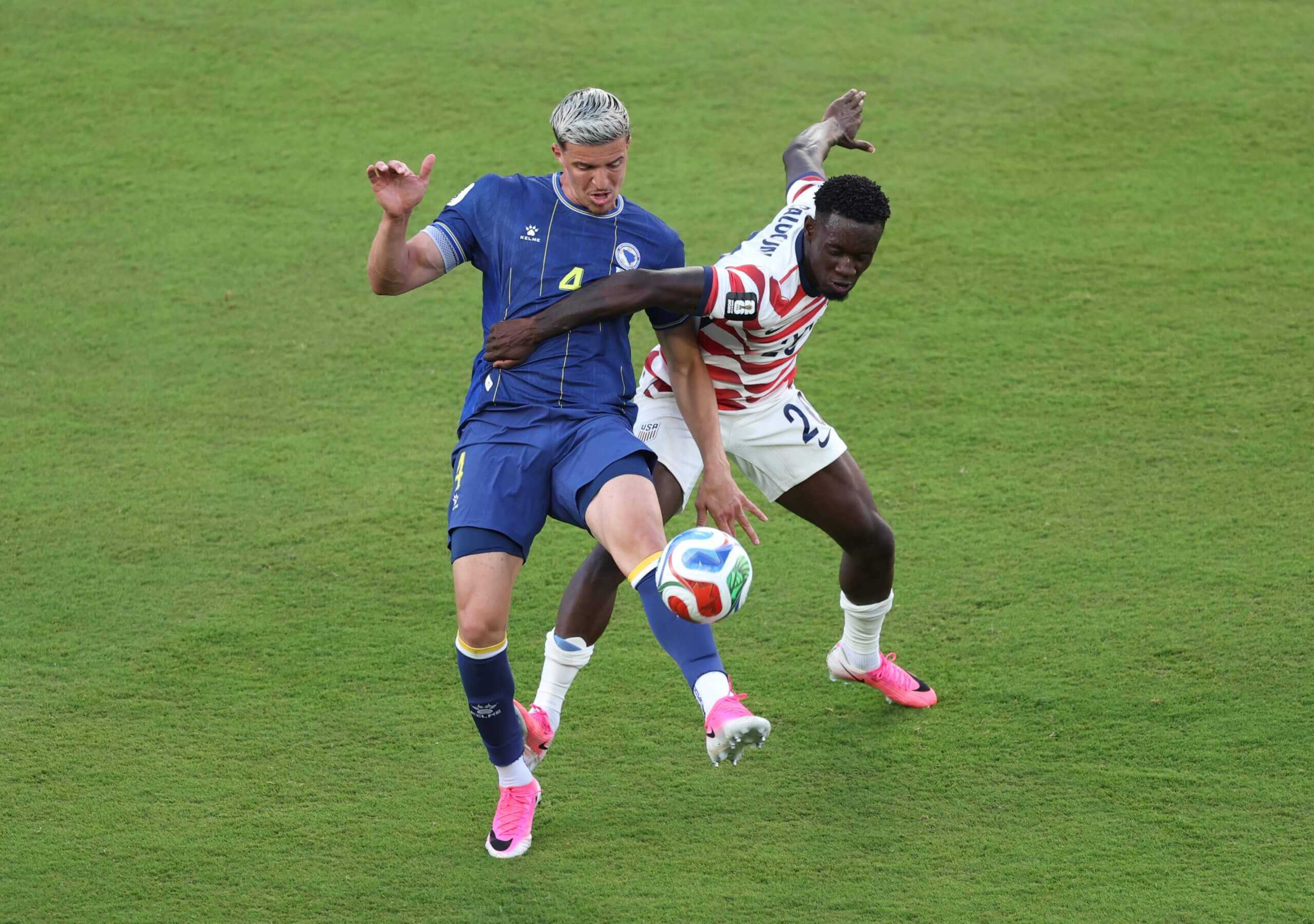
Folarin Balogun was shown a red card for this foul on Tarik Muharemovic (Michael Steele/Getty Images)
Andrew Giuliani, the executive director of the White House Task Force for the World Cup, was actively engaged in the process, working with the lawyers and seeking updates from FIFA and U.S. Soccer.
For FIFA and its president, it is the latest instance of questions being raised over his relationship with Trump. According to FIFA’s statutes, its participants must abide by political neutrality and political interference is not permitted in its processes.
Most famously, Infantino personally invented a FIFA Peace Prize to award to Trump at the World Cup group-stage draw in December, after he had been overlooked after campaigning to win the Nobel Peace Prize.
FIFA opened an office in Trump Tower in Manhattan, New York City, meaning that the organization is paying rent on premises owned by the Trump family.
World soccer’s governing body even altered its plans to host that World Cup draw in Las Vegas, after Trump suggested to Infantino that the event be held at the Kennedy Center in Washington, D.C., a performing arts venue that he and his allies took over following his return to power in January 2025.
At the draw, Infantino presented the U.S. president with a large trophy, a medal and a certificate for the Peace Prize, as well as organising the Village People to sing YMCA, which has become Trump’s personal anthem, at the end of the draw. All of this will combine to raise suspicions, even if it is unknown at this stage how much consideration or weighting FIFA may have given to the U.S. president’s intervention.
Some have raised concerns previously. An official complaint was submitted in December to FIFA’s ethics committee by FairSquare, a non-profit organisation and advocacy group which focuses mainly on global labour migration rights, political repression and sport. Fifty members of the European Parliament (MEPs) wrote to FIFA last week to demand that the organization address the complaint, which has been supported by the Norwegian Football Federation.
Ultimately, per multiple sources familiar with the process, a body of work was submitted by U.S. Soccer to FIFA, which would culminate in the remarkable decision to suspend Balogun’s ban.
Flo Balogun’s red card is being suspended. Here’s why that’s controversial.
Henry Bushnell and Jayne Orenstein
No sooner had the final whistle blown against Bosnia and Herzegovina than U.S. Soccer’s lawyers were searching for ways to ensure Balogun, who has three goals and as many assists at this World Cup, would be available to play in the round of 16.
As is standard practice for sports teams and organisations, they called on their own access to external lawyers to help them ascertain whether they had a case.
The issue staring them in the face, however, was that, as per FIFA’s rulebook, a red card is an automatic one-game suspension and there are no avenues to appeal it, even if Pochettino, the head coach, was adamant it was “never a red card” and Tyler Adams, the midfielder, described there being no way to appeal as being “typical FIFA”.
As U.S. Soccer explored its legal options, arguments started to form in the media, including from former match officials, who claimed the VAR (video assistant referee) system had not been implemented correctly, with an emphasis on the use of slow-motion and freeze-frame of the incident being at the centre of these claims.
The morning after the match, FIFA formally notified U.S. Soccer of the red card via a communication from its disciplinary committee. It was then that U.S. Soccer responded with its view that the decision to send Balogun off was incorrect and the suspension unfair.
Over the following days, it provided submissions which included a view that the VAR presentation to the on-field referee relied excessively on freeze-frames and slow-motion images. The eventual decision did not entirely match up to the U.S. Soccer request, which was to overturn the decision entirely, but, without a formal appeals process, FIFA found perhaps the only way that Balogun could get on the field against Belgium within their regulations, which was to suspend the ban.
The U.S. federation, not wanting to inflame the situation, took the approach that it would be better served keeping its counsel and remaining magnanimous in public at the same time as working tirelessly behind the scenes to have Balogun available.
So, when Balogun himself spoke to the media from the USMNT’s open training session on Friday, rather than vent his anger, he instead spoke of being conscious of “inspiring little kids, boys and girls who are watching” and wanting to “show them the correct way to handle things”.
In the days after the 25-year-old was sent off, including on Friday, Pochettino’s training sessions centred on his star player not being available. He wanted to be kept abreast of the developments throughout the disciplinary process, and he would have had a game plan in reserve in case Balogun was ruled eligible to play.
Such was the surprise at the ban being suspended, Chris Richards, the USMNT centre-back, said on Sunday that the squad initially wondered whether the news they were reading was AI-generated, noting they “weren’t quite sure if it was true or not”, before describing Balogun’s reaction to the news as “lit”.
“I saw a big smile on his face,” team-mate Christian Pulisic added. “I got to see him and dap him up. It’s great for us. We’re excited to have a really good player for us.”
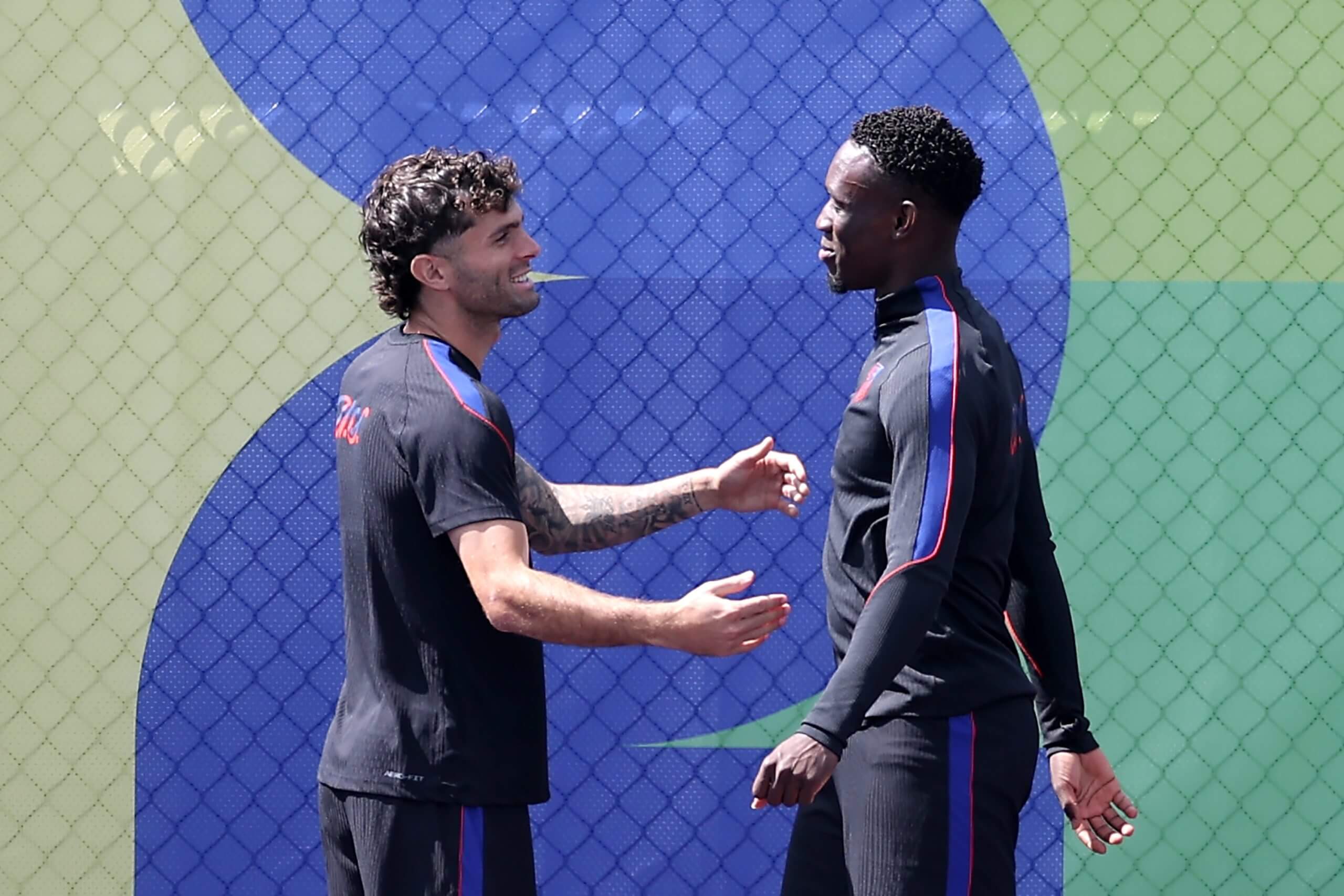
Balogun is welcomed back by Christian Pulisic at USMNT training (Sarah Stier – FIFA/FIFA via Getty Images)
Unsurprisingly, the positive reaction was not echoed by the USMNT’s opposition.
The Royal Belgian Football Association (RBFA) released a statement on Sunday, saying it was “astonished by FIFA’s decision” and also outlined that it was “investigating all potential options”. It has been granted the right to appeal FIFA’s decision.
Speaking in his pre-match press conference, Rudi Garcia, Belgium’s head coach, was equally critical.
“I didn’t know that July 5 was equal to April 1 (April Fools’ Day) at FIFA,” Garcia said. “I think we should refer to the (statement) of my federation, the Belgian federation. A lot of things are in it. The federation does not defend itself, it does not defend the national team — it defends football in general. It defends its integrity. It defends its ethics.”
Pochettino, speaking after Garcia, defended the controversial move to suspend Balogun’s one-game ban.
“For me, there isn’t much debate here, though I do understand Belgium’s perspective and Rudi’s point of view,” he told reporters.
Early Monday morning, The Athletic revealed Belgium has requested a formal explanation of why Balogun has had his one-game suspension for a red card overturned.
Although FIFA has long maintained the disciplinary committee is independent and that it has no influence over any outcome the panel may arrive at, this is not the first time the organisation has been met with fierce criticism in relation to flexibility around how its rules can be implemented.
The same Article 27 of its disciplinary code cited for Balogun was also used earlier in the year, when Cristiano Ronaldo saw two matches of a three-game suspension for a red card against the Republic of Ireland suspended, resulting in him being available for Portugal’s opening two World Cup group matches.
Last summer, FIFA was met with similar criticism when it appeared to alter the entry criteria for the inaugural expanded version of the Club World Cup to include MLS team Inter Miami, whose star player is Argentine superstar Lionel Messi.
It is the latest in a developing pattern where FIFA stands accused of finding ways to get the sport’s biggest stars on the field, ahead of the conventional implementation of its widely understood regulations.
“I have to be honest, it was a big mistake by FIFA. This is not a great conclusion to what happened,” Stale Solbakken, Norway’s head coach, said after his team knocked out Brazil in the round of 16 on Sunday.
“He got a red card. The VAR concluded it was a red, and he was sent off. That means you are meant to be suspended for one game. It’s a bad, bad, bad, bad decision. I feel sorry for the USA. If they win, this decision will be in the background. It’s not good for the sport.”
Wayne Rooney, the former Manchester United and England captain, speaking in his role as a pundit on the BBC, described it as an “absolute disgrace”.
“But to suspend it for a year? It’s an absolute disgrace. Infantino should be ashamed of this. The sportsmanship of this game is in question here,” Rooney added.
As well as Infantino, criticism has been directed at Pierluigi Collina, FIFA’s chief refereeing officer, for his apparent role in the decision, although he does not play any part in the disciplinary proceedings.
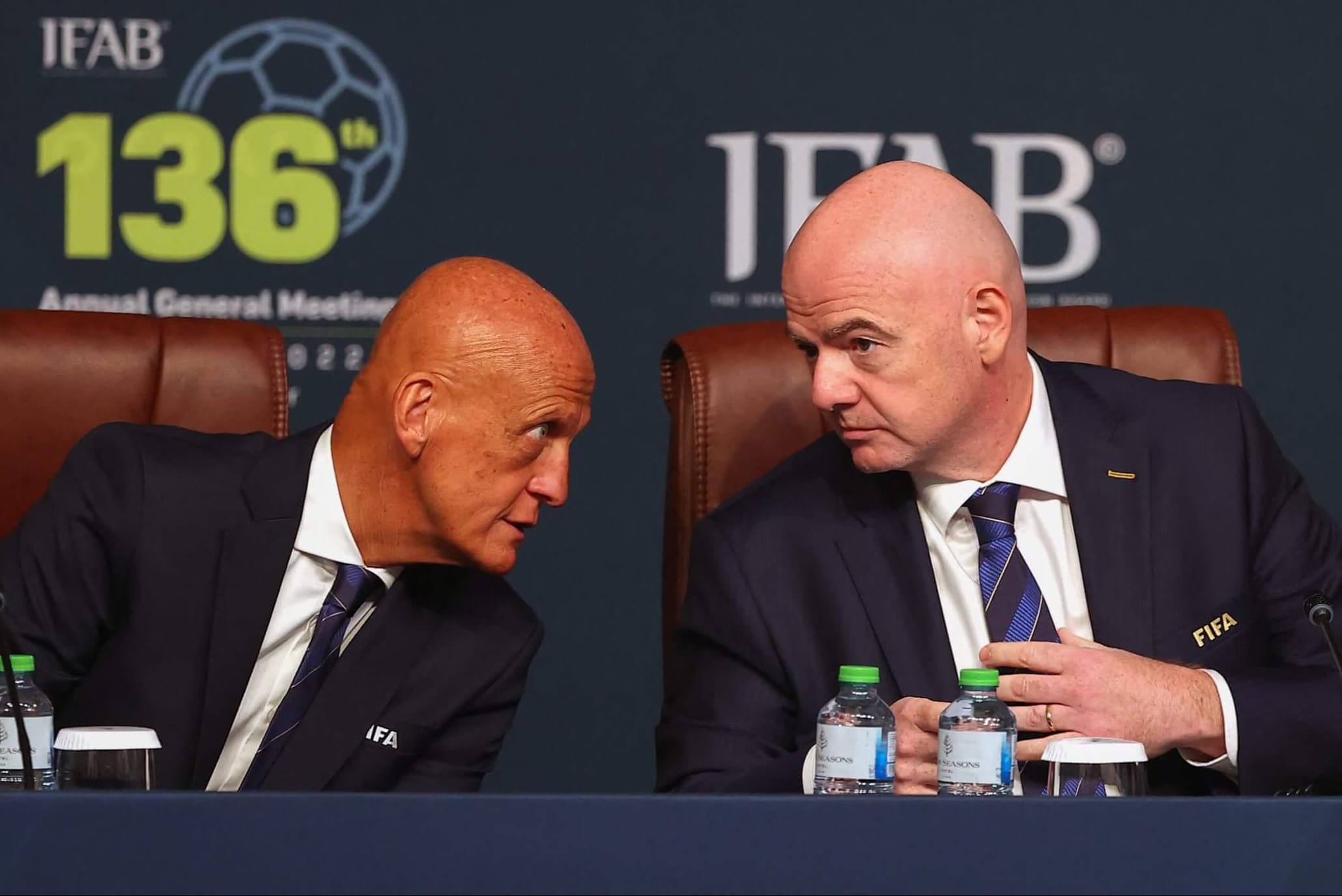
Gianni Infantino with FIFA referees committee chairman Pierluigi Collina in 2022 (Karim Jaafar/AFP via Getty Images)
Gary Neville, another ex-England international, speaking on UK broadcaster ITV, said the decision “absolutely stinks”, before going on to say he would be “absolutely raging” if he was involved with Belgium “or any other team in the tournament”.
Ian Wright, Neville’s former team-mate with England, also working for ITV, questioned the ethics of the outcome.
“We’re talking about integrity,” he said. “People talk about transparency, but… some of the things that’s happened in this World Cup have been shameful.”
How FIFA’s independent disciplinary committee made this decision is yet to be made public.
For that to happen, one of the parties involved — the USMNT or Belgium — would need to request the grounds for the outcome. As of Sunday night, Belgium had not done this and, even if they do, the disciplinary committee can decide against sharing its rationale.
But in the absence of any formal comment from FIFA, nor anything beyond the announcement from that panel, questions are being raised as to whether Trump may have finally found his moment to influence this World Cup.
Additional reporting: Henry Bushnell, Paul Tenorio and Tom Bogert