
Get free access to the most comprehensive World Cup coverage in The Athletic app.
The on-field story of the World Cup is as rich and evocative as any in sport and the tournament has been the stage on which the likes of Pele, Just Fontaine, Gerd Muller, Diego Maradona and Lionel Messi have achieved footballing immortality.
It is arguably the biggest and most famous competition on the planet and, rightly or wrongly, performances and feats in it tend to be career-defining — with players, teams, goals and so much more reverberating through the years.
Here, The Athletic charts the history of the competition by numbers — exploring and analysing how it has evolved since its inception in 1930, as well as looking at some notable, and less notable, records.
Here are the number of teams that have played at each previous World Cup, with the figure increasing from 32 to 48 for this summer’s competition in North America. The 1930, 1938 and 1950 editions were all meant to have 16 participants but late withdrawals resulted in fewer sides competing than had been planned.
And here is the number of games that have been played at each World Cup. There will be 104 at the 2026 edition, more than there were at the first five tournaments combined.
There have been 964 matches overall, with Brazil, who have won the World Cup a record five times and are the only side to participate in every edition, playing in more of them than anyone else with 114 — two more than Germany/West Germany. At the other end of the scale are the Dutch East Indies (now Indonesia), whose first-round loss to Hungary in the straight-knockout tournament of 1938 is their only game in the competition.
The format of the tournament varied far more frequently in its earlier years — hence several editions with the same number of teams having a different number of games.
A notable anomaly in the structure came in 1950, where late withdrawals resulted in Uruguay and Bolivia contesting a two-team, one-match group and the other 11 sides being split into two groups of four and one of three before the pre-planned ‘final round’, in which the winners of those four groups played a round-robin tournament to determine the world champion.
Advertisement
Uruguay beat hosts and heavy favourites Brazil in the deciding match to win the World Cup for a second time, having played two fewer games in the competition than their opponent. This remains the only World Cup not to have had a final.
Another anomaly came in 1954, when the first round featured four groups of four but with each side only scheduled to play two of the three teams in their section. A tie on points for second place (the top two qualified for the knockout stage) was to be determined by a play-off.
So as a result, in Group 2 (World Cup first group stages were titled numerically before 1986), West Germany and Turkey played each other twice but the West Germans did not face South Korea and Turkey did not meet Hungary. In Group 4, Switzerland and Italy played twice but the former did not face Belgium and the latter did not meet England. Oh, and drawn group-stage matches — uniquely — went to extra time at that tournament in Switzerland.
The first six World Cups all had a goals-per-game average of 3.6 or higher but the number has been below three at each of the 16 tournaments since then, with the low of 2.21 in 1990 playing a big part in the introduction of the backpass rule.
Curiously, the average was identical at the 1962 and 1966 World Cups, with Geoff Hurst’s 120th-minute strike in the final for England at the second of those tournaments meaning both had 89 goals in 32 games.
Now, here is the number of goals scored at each tournament — with a notable standout being the fact that there were 25 more in 1954 than 1990, despite there being half the number of games. West Germany won both World Cups.
None of the 147 goals at the 2006 edition were scored against Switzerland, who, after keeping three clean sheets in the group stage, were knocked out in the round of 16 after losing a penalty shootout to Ukraine following a 0-0 draw. This is the only instance in the history of the World Cup of a team not conceding a goal at a tournament.
Advertisement
Hungary scored 27 of the 140 goals in 1954 (19.3 per cent), which is the most any team has found the net in at a single edition and two more than Scotland (who have played 23 games across eight tournaments) have ever scored at the World Cup.
West Germany in 1954, Brazil in 1970 and again in 2002 and Germany in 2014 are the only sides above who won the World Cup in the year in question.
Brazil’s 22 goals in 1950 make them the highest-scoring host nation in the tournament’s history.
Nine of Hungary’s goals in 1954 came in one game against South Korea in the groups, with Sandor Kocsis scoring three of them before netting four times against West Germany three days later, becoming the first player to score a hat-trick in consecutive matches at the World Cup. Muller (for West Germany in 1970) is the only man to have matched this feat.
That victory over South Korea is the joint-biggest in the tournament’s history, with two other games won by nine goals and a further three by eight.
Of the victorious teams on this list, only Uruguay went on to win the tournament in question. Hungary lost in the final in 1954 to West Germany, despite beating them 8-3 in the groups, which — coupled with their defeat in the 1938 showpiece to Italy — makes them one of three teams to have played in the final more than once but never won the tournament.
Sweden in 1958 and Croatia in 2018 are the two other teams to have played in the World Cup final but never won the competition. Croatia, which today has a population of under four million people, have competed in six World Cups since gaining independence from Yugoslavia and have finished in the top three in half of them.
As for the highest-scoring matches in World Cup history, five games have reached double figures for goals.
The Austria 7-5 Switzerland and Brazil 6-5 Poland matches in the above table are the only World Cup games in which a player from both teams has scored a hat-trick — Theodor Wagner for Austria and Josef Hugi for Switzerland in the 1954 game and Leonidas for Brazil and Ernst Wilimowski (four goals) for Poland in 1938.
Advertisement
They were the only World Cup goals Wagner and Wilimowski ever scored, with the latter the first to register four in a match at the tournament (Oleg Salenko’s five for Russia against Cameroon in 1994 is the most a player has scored in a game).
France’s 7-3 victory over Paraguay on the opening day of the 1958 World Cup in Sweden also contained a hat-trick, scored by the 24-year-old Fontaine.
The Frenchman netted a further 10 goals at the tournament, finishing with a remarkable 13 from just six matches (France came third). This is the most any player has scored at one World Cup, with Fontaine breaking Kocsis’ record of 11 from the previous edition.
Surprisingly, of the players in the table above, only Brazil’s Ronaldo represented the winning team.
Guillermo Stabile’s four games at the inaugural tournament were the only matches he ever played for Argentina, meaning he finished his international career averaging two goals per game. Stabile did return to the World Cup as a manager, though, taking charge of his home country at the 1958 edition.
The 13 goals Fontaine scored in 1958 also made him the competition’s overall top scorer, a record he held until 1974 when Muller’s strike in the final against Netherlands not only won the World Cup for West Germany but also saw him move outright top of the goalscoring charts with 14 (10 in 1970 and four in 1974).
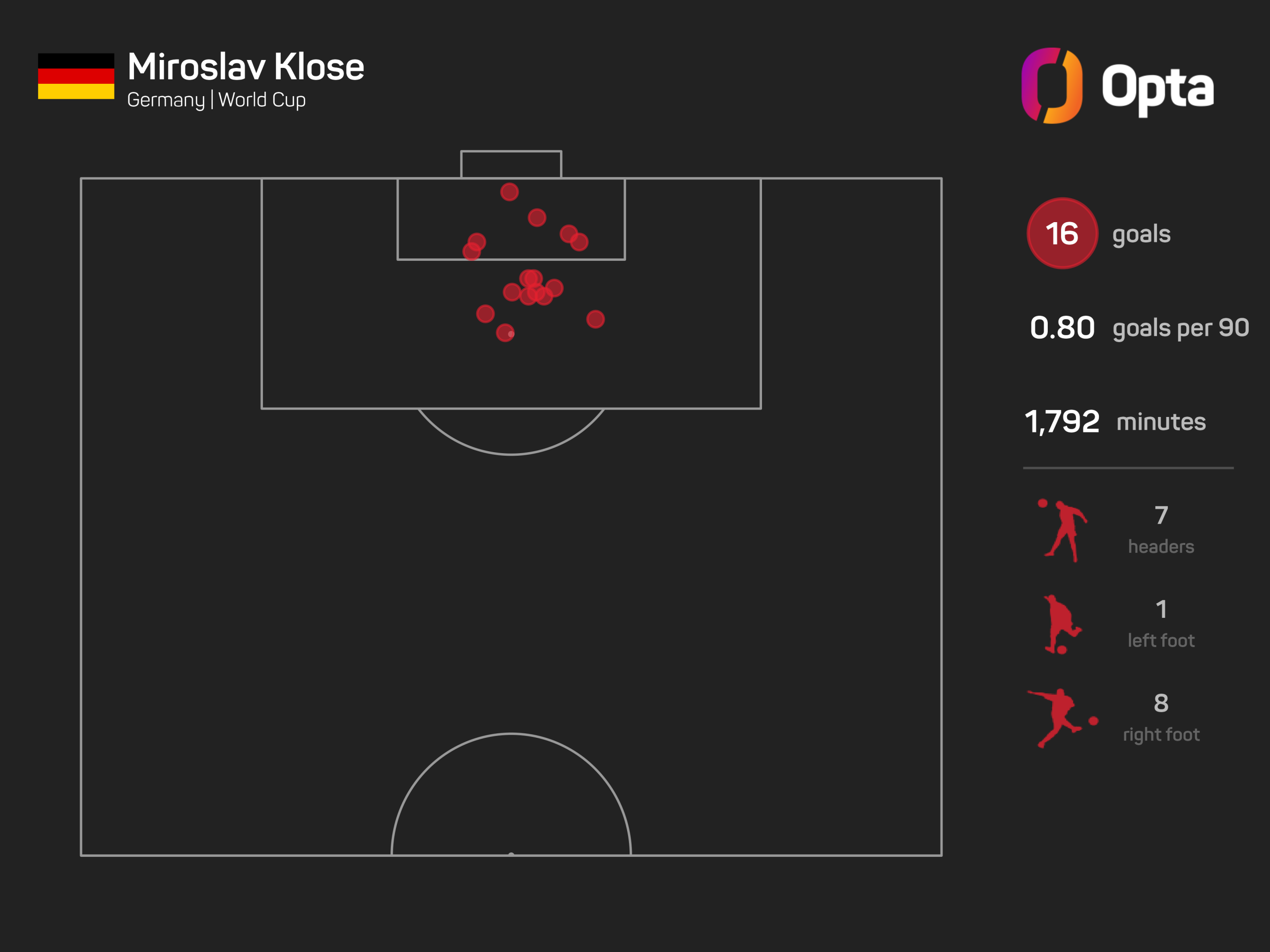
Muller has since been surpassed by both the Brazilian Ronaldo (15 goals) and the German Miroslav Klose (16). Argentina’s Messi, who has scored 13 times at the tournament, is set to play at the 2026 World Cup and the same is true of Frenchman Kylian Mbappe, who has 12 World Cup goals to his name.
This is how the record for scoring the most overall goals at the World Cup has progressed over time, starting with the end of the inaugural 1930 edition and taking the record-holder’s goals at the completion of the relevant tournament (rather than mid-competition when they went past the previous mark).
All 16 of Klose’s goals came from inside the penalty box, with six inside the six-yard box.

Klose played 24 games overall at the World Cup, with only Messi (26) and Lothar Matthaus (25) for West Germany/Germany appearing in more matches in the tournament’s history. Portugal’s Cristiano Ronaldo (22 games), Klose’s former World Cup-winning team-mate Manuel Neuer (19) and Croatian duo Luka Modric (19) and Ivan Perisic (17) could all hit 25+ matches in the coming weeks.
Advertisement
Messi, Ronaldo and Modric all played in the 2006 tournament, where the oldest player was 40-year-old Tunisia goalkeeper Ali Boumnijel. He was born in April 1966 — before England won the World Cup. The trio will be sharing this tournament with Mexico’s Gilberto Mora, who was born in October 2008.
The earliest-born player to have ever been in a World Cup squad is the Belgian Jean De Bie at the 1930 tournament. The goalkeeper travelled to Uruguay, by boat, at the age of 38, having been born in 1892. De Bie was older than eight of the 14 managers involved (Argentina had two head coaches).
This includes Uruguay’s Alberto Suppici who, aged 31 in 1930, is the youngest manager to win the World Cup. Suppici had nine players from Montevideo side Nacional in his roster for that tournament, the joint most a club has been represented in a winning World Cup squad (the table below is sortable).
Spanish clubs Sevilla and Atletico Madrid providing the joint-highest number of players for Argentina in 2022 is the only instance of a foreign side supplying the most men to a World Cup-winning squad.
On that theme, the first man to win the World Cup while playing his club football outside his homeland was West Germany’s Gunter Netzer in 1974 — the midfielder had joined Spanish side Real Madrid from Borussia Monchengladbach the previous summer. Netzer featured in just one match at the tournament though — the 1-0 loss to East Germany in the first group stage, which was the only time the two Germanys ever played each other.
Meanwhile, Maradona was the first captain to win the tournament while playing overseas — he was at Napoli of Italy when Argentina triumphed in 1986. Since then, the winning captain has played at a foreign club in six of the nine World Cups staged, with West German Matthaus — who was at Italian side Inter when he got his hands on the World Cup in 1990 — the first to join Maradona.
Matthaus went on to become the first outfielder to play in five different World Cups, with his fifth and final tournament coming in 1998. Only Mexican goalkeeper Antonio Carbajal had played in more than four editions before Matthaus. Overall (before 2026), six players have appeared in five World Cups — with three of them from Mexico. Before the 2018 edition, only two men had played at five different tournaments.
Messi and Ronaldo appear certain to shortly become the first men to play at six World Cups, while Modric, Germany’s Neuer and Japan’s Yuto Nagatomo — who have also all been selected for this tournament — have each played in four editions and will therefore join the above list if they get on the pitch.
Advertisement
Modric’s previous appearances came in 2006, 2014, 2018 and 2022 (Croatia didn’t qualify in 2010), so the 40-year-old midfielder would become the first to play in five World Cups with the editions not coming in consecutive order.
Carbajal played just 11 games across the five editions he appeared in, three fewer appearances than France’s Mbappe has made in just two World Cups — seven in both 2018 and 2022.
Mbappe scored in the final of both of those tournaments, becoming the fifth player to find the net in more than one World Cup final after Brazilian duo Vava (1958 and 1962) and Pele (1958 and 1970), West Germany’s Paul Breitner (1974 and 1982) and fellow countryman Zinedine Zidane (1998 and 2006). Only Vava and Pele won both of the finals they scored in.
Pele, arguably the individual most associated with the World Cup, is the only player to win the competition more than twice as, along with those triumphs in 1958 and 1970, Brazil also won in 1962. Pele was injured in the group stage of that competition in Chile but he still scored, putting the ball past Mexico goalkeeper Carbajal in the two sides’ first game.
That Brazil victory in 1962 is the last time a team retained the World Cup, with Italy’s back-to-back triumphs in 1934 and 1938 the only other time it has happened.
Over to you, Lionel.