
The Athletic has live coverage of Argentina vs Cape Verde in the Round of 32 at the 2026 FIFA World Cup.
SANTA CLARA, Calif. — We wear the same jersey. One size fits all, for a change, with clashing accents that we make match.
We paint our faces and drape the flag across our shoulders, some like a cape, others like a shawl. We show up, loud and unashamed, suddenly immune to the rage baiters and social media bots. We find, for a moment, something better than ourselves. And then we act bigger than ourselves.
A woman wears a bald eagle costume and flaps red, white and blue wings from the upper deck at San Francisco Bay Area Stadium. A man perches a toddler on his shoulders, the boy’s striped face an American canvas of potential. A girl holds a handcrafted “We Believe” sign on a poster half her size.
In downtown San Jose, Patricia Vo cheers in bustling San Pedro Square, standing in the middle of a kind of joy that she envisioned to get through three surgeries and eight rounds of chemotherapy. Naseem Farooqi bounds out of the stadium after a 2-0 win over Bosnia and Herzegovina, draped in an American flag, cowboy hat and boots. He lights a cigar as soon as he clears the exit. Dressed in a USA crop top and flag-colored socks to her knees, Robin Roettger completes her look by sporting the shell of a soccer ball across her stomach, making it seem like she is with child. She stands with her mother, who is bedecked as the Statue of Liberty.
These people look silly.
These people look fabulous.
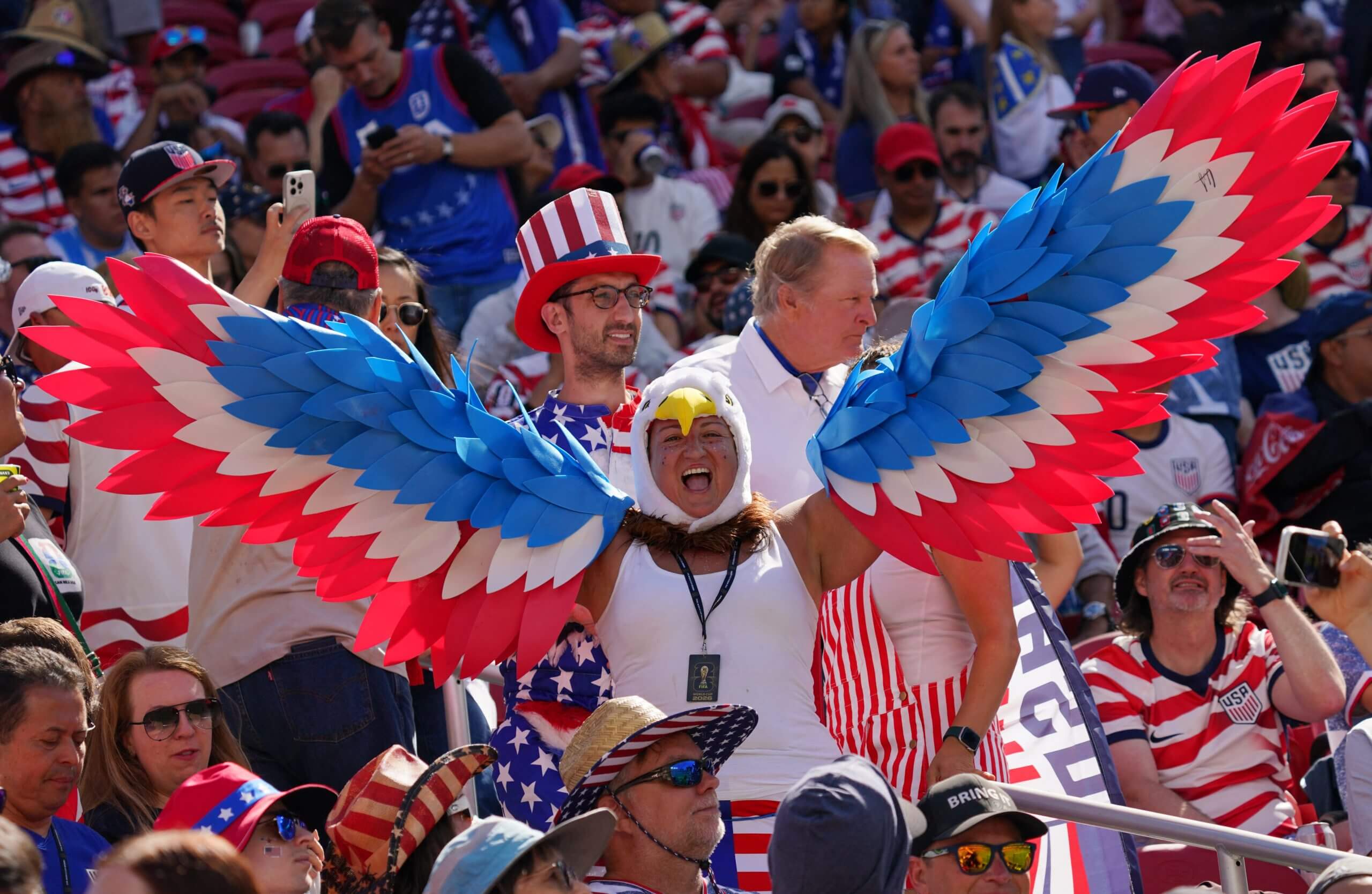
This United States fan is flying high at San Francisco Bay Area Stadium (David Gonzales / Imagn Images)
These are images of America, at 250 years old, hosting the world’s grandest sporting event and partying like it’s 1776. But the jersey has never been just a jersey. It is a visual manifesto of a complicated country, and in the upkeep of long-recited ideals, it becomes a battleground. The politics of exclusion have infiltrated these colors, this flag, narrowing perspectives about who counts as a real American and who does not. In response, the politics of inclusion have turned to elitist derision, partly as a shield, but that only makes it easier to exile the faction from national pride.
This World Cup has become a bridge. It is not ideal to host a world reunion during a family feud, but it has been beneficial. The event has created a reprieve, delivering us from division and reminding us that patriotism can be inviting. Before large crowds that contain multitudes, the U.S. men’s national team takes the field, striving the way we are supposed to strive. And for a 90-minute respite, the arguing stops.
This is not a constraining pride, either. A warm welcome has not been universal, but it has been prevalent. Some nations — such as Iran, whose team captain called this “a disaster World Cup” — and their fans could not escape the political shadows. But most have observed the difference between the government and the people. Most have witnessed an America that wants to wrap its arms around the globe.
In a viral social media video, a Scotland supporter traveling with the Tartan Army cried on a Boston sidewalk, expressing what many visitors have felt the past few weeks. When she arrived, she expected hostility from a nation with a presidential administration that antagonizes the world. She found joy.
May her tears irrigate the feeling.
A powerful force
Just a couple hundred yards from a parking lot asking for $200, the men danced in front of a vendor. One was Latino, the other White. Both wore USA overalls, stars on top, stripes on the bottom. They made up a bop: “Hot dogs! (clap, clap) Hot dogs! (clap, clap) Hot dogs!” Their steps were a hilariously poor approximation of the way Kid ‘n Play moved in the 1980s. The song “Whoomp! (There It Is),” a classic from 33 summers ago, blasted in the distance.
Maybe that’s how we ought to picture freedom: warm in addition to weighty, a serious human right that shouldn’t have to take itself seriously.
Sports have always been a powerful social force. At their best, these games give a multicultural invitation to a monocultural experience. The shared language requires no translation, no common background, no political agreement. A goal is a goal. A comeback makes every heart in the building lurch. The electricity of 70,000 people rising and screaming in unison jolts everyone. In a fracturing nation, in a fracturing world, this is no small accomplishment. It is among the few remaining gateways to human connection.
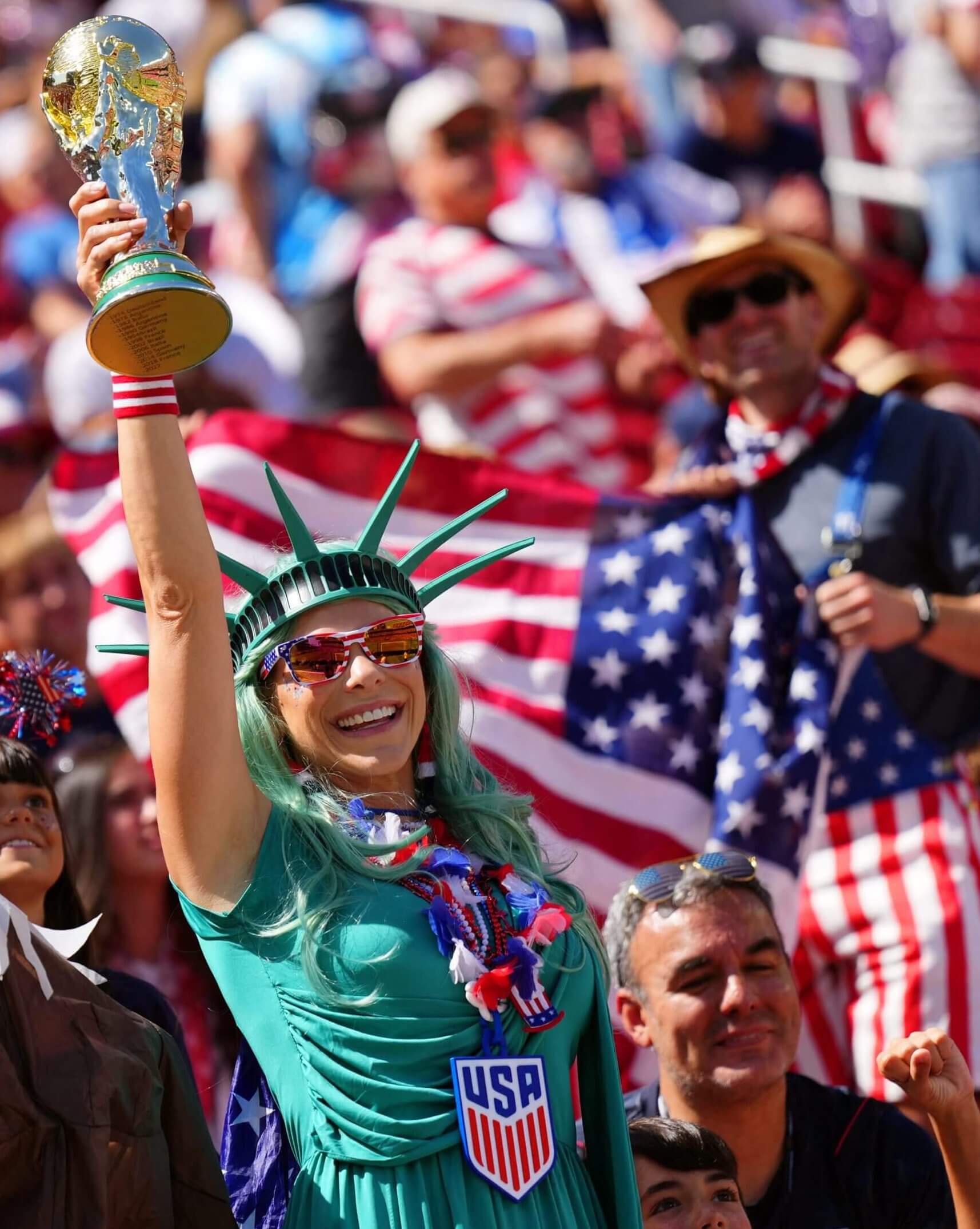
The World Cup has spread unity and a human connection across North America (Darren Yamashita / Imagn Images)
But the unity does not happen by accident, and no one should assume it is protected by default. Those unifying elements — passion, tribalism, a deep and generational emotional investment — can be redirected. The stadium is not immune to society. It houses a sliver of it for a few excitable hours.
Over the past decade in American sports, we have experienced an unsettling amount of conflict. When Colin Kaepernick started kneeling during the national anthem in 2016, he continued an old American tradition, leveraging his visibility to demand the country meet the high standards of its stated values. It was a demonstration as quiet as it was provocative. The reaction was loud and lasting. Early in his first term, Donald Trump seized on Kaepernick’s protest and made it into a quarrel about respecting the flag, a reframing from which sports have yet to fully recover.
The toxic environment has mangled a nuanced idea: Sport can promote belonging and hold dissent at the same time. It is possible to love the jersey and question what it sometimes represents. That criticism is not apostasy. Dissent and devotion are not adversaries. At their best, they are complementary.
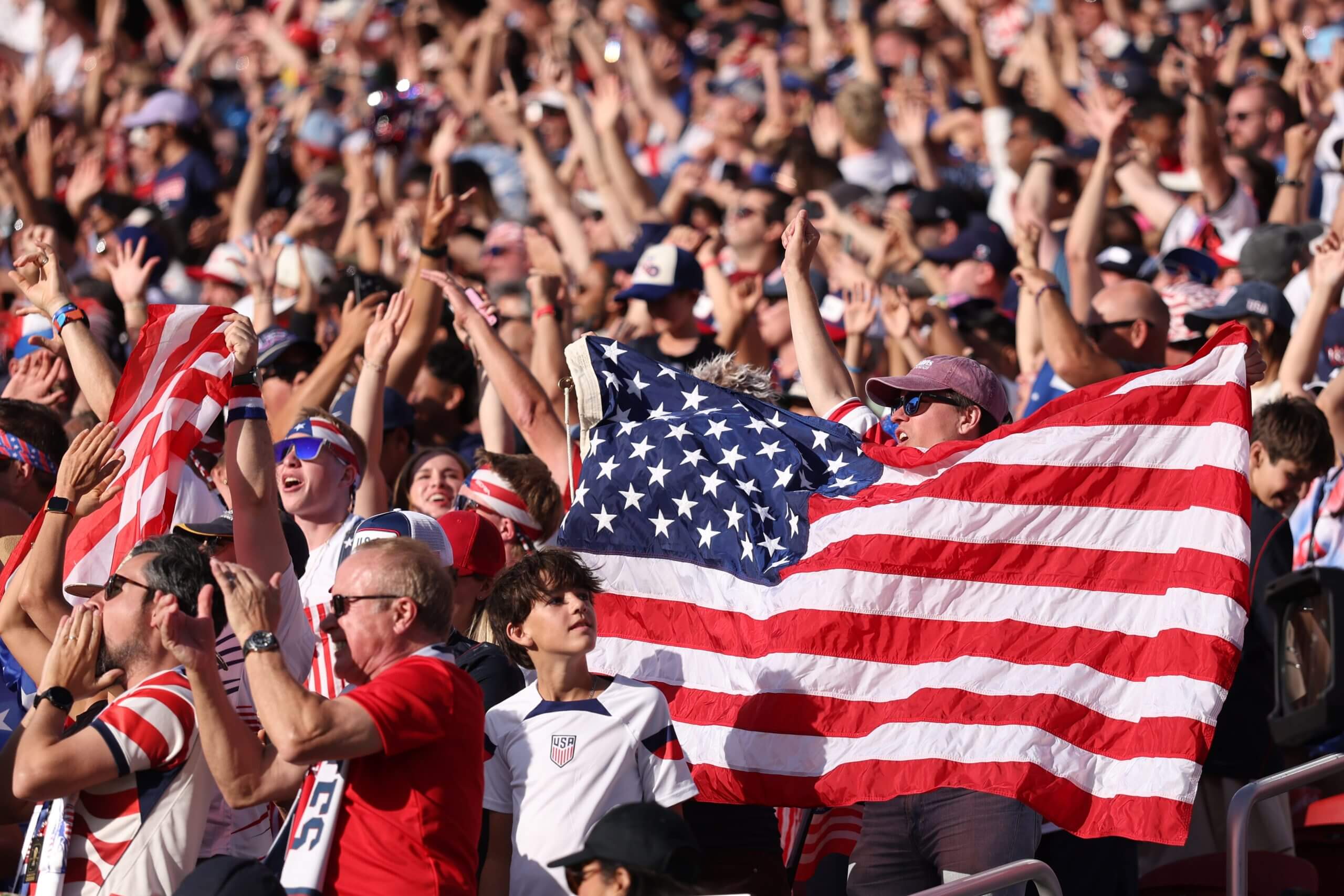
U.S. fans show their colors during Wednesday night’s victory against Bosnia and Herzegovina (Catherine Ivill / AMA / Getty Images)
In the last 10 years, the American flag has been co-opted in a way that makes the stadium feel more like a contested territory than sacred, common ground. The danger is that it hardens from a revolutionary symbol into one of submission.
In this climate, the games cannot simply profit off obsession and call it a social good. The diverse audience it cultivates deserves more than empty ceremony and strategic neutrality. This is not a demand to take political positions or a call for athletes to become activists. The ask is simpler yet harder: Refuse to let these shared spaces get overtaken by those who wish to predetermine who belongs.
Halfway through this World Cup, the people have done what the institutions couldn’t. It’s the triumph of a vast fandom that keeps choosing goodwill at a time when leaders incite a supremacy relapse.
You saw the Tartan Army bringing the good vibes as those supporters romped through Boston and Miami; and the Kansas marching band learning the Algerian national anthem; and the Mexicans and Brazilians who lifted the weeping Japanese fan out of his disappointment. Staging a World Cup made this possible, but it did not manufacture compassion. People did not look to the sky, see a FIFA banner claiming “Football Unites the World” and consider it a bat signal. They are the inspiration for the slogan.
Marketing is not a moral position. It is a well-researched enticement. People want to gather. They want to connect. And America still values hospitality.
“It’s been great to embrace other countries, and it’s been great to see that other countries really embrace America for who we are,” said Amanda Ryan, a fan from Carlsbad N.M., who has traveled to matches in several cities. “We’re not what they see on the media or on social media.
“We are more.”
It’s not a boast. It’s a standard, one that necessitates intention and accountability.
Sport did not create all these inequities, but the enterprise must decide whether to acknowledge them or look away. That choice does not make any political insinuation. It transforms a game into an institution, a pastime into a benevolent force.
Patriotism and sports
A hundred years ago, America also threw itself a 150th party. The word sesquicentennial taunts the tongue in the way that semiquincentennial does right now. In 1926, the birthday bash featured boxing and Philadelphia, the city where the founding fathers declared independence.
Governors and dignitaries attended the spectacle. Charlie Chaplin came, too. At the center of the celebration, before 120,000 who ignored the pouring rain, the most famous athlete in the country was being booed.
During the infancy of American sports stardom, there was Jack Dempsey. He was among the first athletes to see the flag turned against him. The debate about sports figures and their place in a patriotic society is not new. It is at least a century old. If Dempsey were still alive, he would recognize this conflict.
He sprouted from nothing, a kid from Manassa, Colo., one of 13 children, who dropped out of school and became a vagabond. He rode freight trains, strutted into mining camp saloons and challenged the patrons. He slept in spittoons and boxed under the name Kid Blackie.
Then — on July 4th, of course — he won the heavyweight championship in 1919.
The next day, America’s most celebrated sportswriter called him a slacker.
During World War I, Dempsey had received a dependency exemption from the draft board because multiple members of his family needed support. Still, he was ridiculed as unpatriotic. Fans mocked him. Grantland Rice also wrote in The New York Tribune: “It would be an insult to every young American who sleeps today from Flanders to Lorraine, and from the Somme to the Argonne, to crown Dempsey with the laurels of fighting courage.”
He was a famous athlete and an infamous American. It was not about love of country. It seldom is. Dempsey was guilty of free will.
The jingoism was loud. It also lacked stamina.
During that anniversary fight in September 1926, Gene Tunney ended Dempsey’s seven-year reign as heavyweight champion. Tunney, a veteran and reader of Shakespeare, was nicknamed the Fighting Marine. After 10 rounds, Dempsey lost by unanimous decision and exited with his left eye swollen shut.
In a rematch the next year, Dempsey knocked down Tunney for the first time in his career. Tunney wound up winning the fight, but America favored Dempsey afterward. People thought he had been robbed. The contempt evaporated. After all that, he walked away a beloved prizefighter.
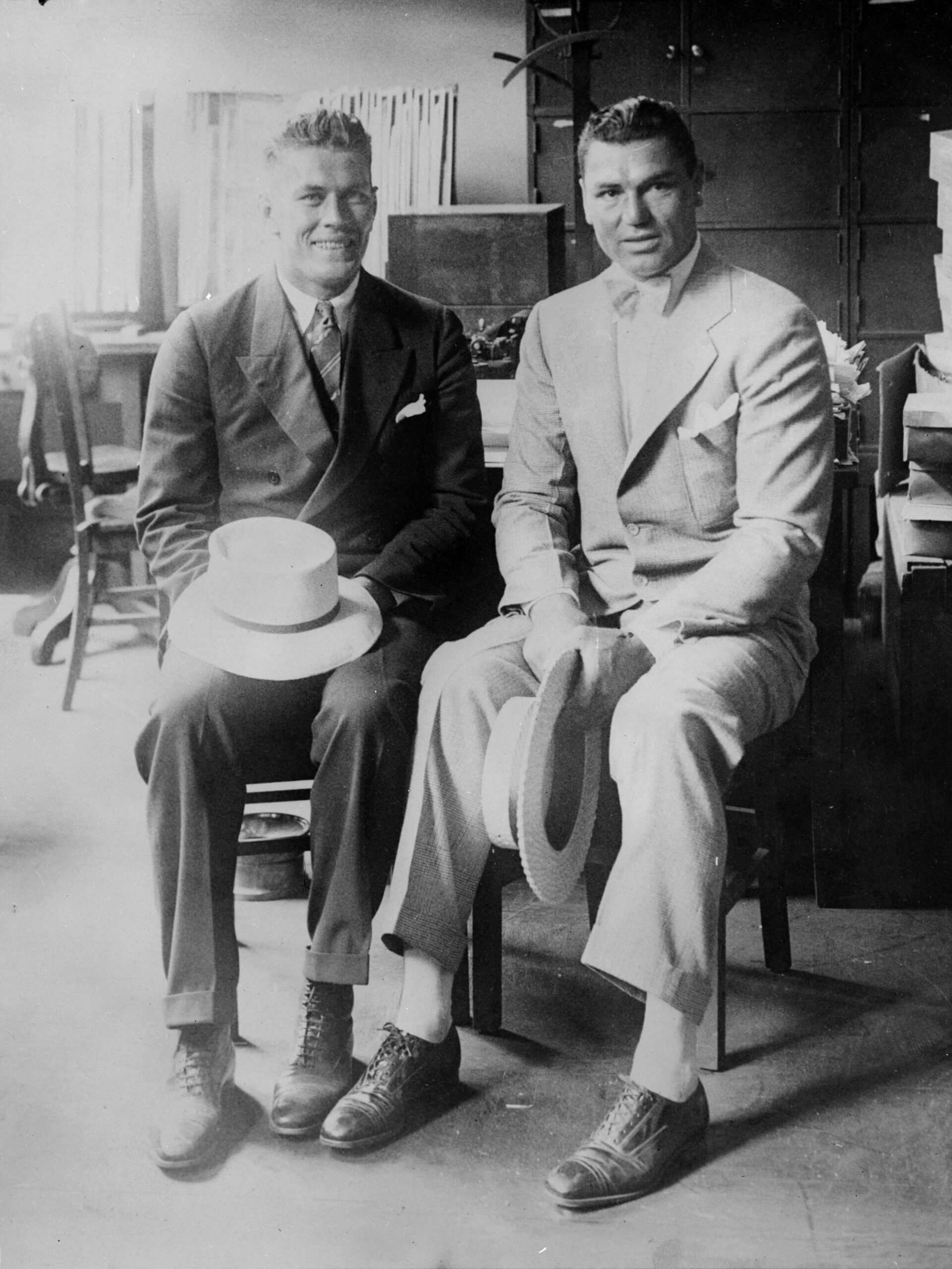
American heavyweight boxers Gene Tunney, left, and Jack Dempsey pose before their bout in 1926 (Topical Press Agency / Getty Images)
After the Pearl Harbor attack in 1941, Dempsey joined the Coast Guard. He enlisted at age 47 and rose to commander. In 1945, he boarded a transport bound for Okinawa.
An officer told him to stay behind. They couldn’t afford to lose him.
“I go where they go,” Dempsey replied, according to biographer Roger Kahn.
Kahn captured the boxer’s thoughts on his capricious fame: “They branded me a draft dodger in World War I and a hero in World War II. They got it wrong both times.”
Neither verdict was solely about him. Society changes. The jersey doesn’t. A century later, the friction persists.
‘Something bigger’
Mauricio Pochettino, the USMNT coach who insists he is still “200 percent Argentine,” jogged toward the stands, arms outstretched. Fans leaned over the railing. Pochettino stood on the tips of his toes. At last, they slapped hands. Elvis crooned “Can’t Help Falling In Love” over the stadium sound system.
Pochettino could not help it, either.
“You feel part of something bigger,” he said.
In short bursts of English, the coach expresses American pride better than most. Sports fandom would make an ideal mentor for patriotism. The essential characteristics are there: commitment, unity, aspiration, hope, accountability.
There is little blind devotion. It is a more demanding form of love, one that expects to outlast terrible seasons and decisions and owners. You feel part of something bigger.
In every country, the flag should hold similar symbolism. It is an inspiration for relentless striving — Gave proof through the night that our flag was still there — not an endorsement of leadership.
Pride is non-partisan.
Division is a choice. So is unity.
Look across these democratic vistas. Eleven American cities, hosting the world, each one its own argument for what this country can be when it decides to shine.
What song describes the USMNT’s World Cup so far?
Lia Griffin
As “Take Me Home, Country Roads” filled the stadium Wednesday night, more than 68,000 lingered and harmonized. Weston McKennie whipped his arms through the air, conducting the crowd. As other U.S. players took laps, the crowd shifted from singing to roaring and back to singing.
And there was Pochettino again, 200 percent Argentine but so very American in celebration.
“It’s impossible not to sing,” he said.
We wish this feeling could last forever. We know it’s fleeting joy, but we water it still.