
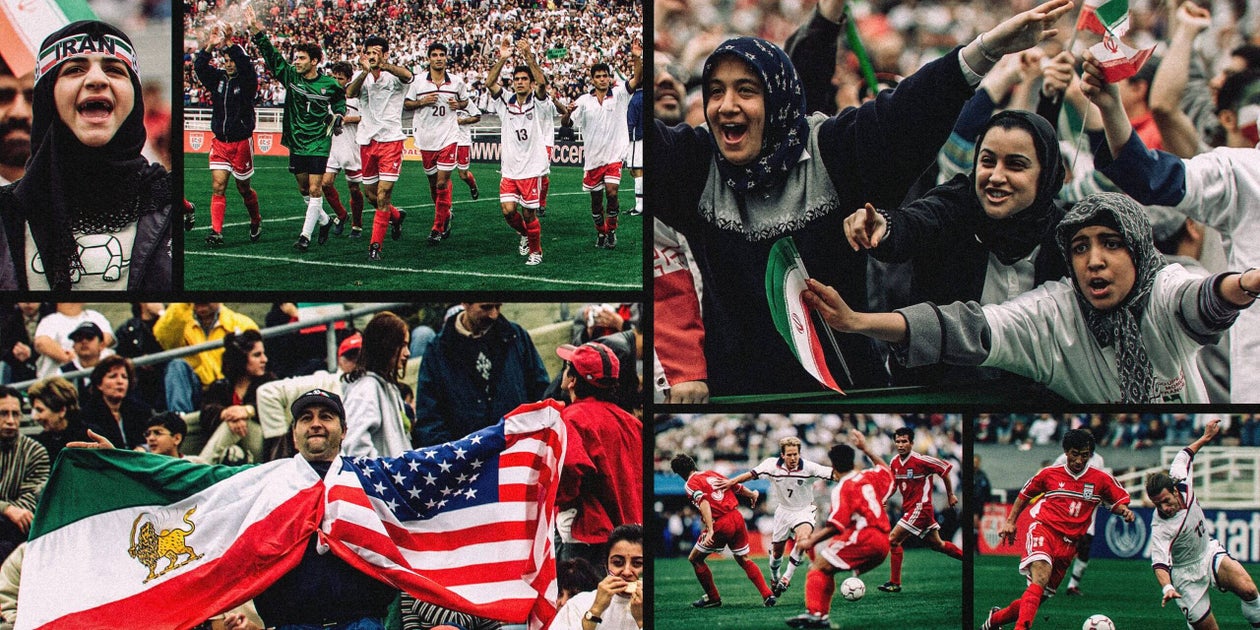
The once-outlandish idea went from private meetings to the highest levels of government, from Chicago to Washington, D.C., from France to Tehran. It began as a speculative proposal for a soccer match — Iran vs. the United States. It became a logistical behemoth, drawing scrutiny from the U.S. State Department and Islamic hardliners alike.
After weeks of worry, though, on Jan. 5, 2000, for the first (and, so far, only) time, the Iranian national soccer team boarded a plane bound for the United States.
A few weeks from now, it will do so again. The Iranians will come for the 2026 World Cup despite geopolitical friction and travel bans. They’ll compete in the shadow of war. Their participation — and the scene at SoFi Stadium in Southern California, site of their first two games — will feel unprecedented, perhaps surreal.
But there is precedent. Some 26 years earlier, Iran’s squad flew to California for a 12-day tour and friendlies against Mexico, Ecuador and the U.S. They secured exemptions from a U.S. government policy that required the fingerprinting and photographing of Iranian nationals upon arrival. They played despite a death threat, allegedly sent by Islamists who objected to the Budweiser ads ringing the field.
“Both sides, U.S. Soccer and the Iranian federation, had to fight tooth and nail with their own authorities to get the game going,” says Mehrdad Masoudi, an Iranian-born soccer official who served as intermediary between the two sides.
And both won. On Jan. 16, 2000, at the Rose Bowl in Pasadena, Calif., they produced more than a 1-1 draw in front of 50,000 fans, many of them joyously chanting “Iran! Iran!” They produced a diplomatic spectacle that reminded all involved how powerful soccer can be when politics step aside.
For two decades, the two countries had been antagonists. After the 1979 Islamic Revolution, which toppled the U.S.-friendly Shah, and the taking of American hostages at the U.S. embassy in Tehran, the two governments severed relations. The breakdown obstructed cultural exchanges and prevented some Iranian-Americans from seeing relatives back home.
The 2000 tour, in that light, felt momentous. And it sent a message that 2026 could reprise.
Advertisement
”I’m very happy that after 21 years, the sport of football — or soccer as you call it here — brought us here to the United States,” Iran captain Javad Zarinche said through an interpreter as the tour began. ”I’m hoping sports can be a bond to bring people of the world together.”
A World Cup origin story
The little-known story of Iranian soccer’s stateside voyage begins at France ’98. The night before “the mother of all games,” perhaps the most politically charged match in World Cup history — and the first-ever between America and Iran — officials from both sides and FIFA settled in for a tense coordination meeting. They discussed security arrangements and operational details. The thorniest subject, however, was a seemingly inconsequential bit of pre-match protocol.
Iranian players were supposed to walk toward U.S. players for handshakes. But Iran’s supreme leader, Ali Khamenei, had allegedly forbidden them from doing so.
Hank Steinbrecher, U.S. Soccer’s general secretary, worked with Iranian counterparts and Masoudi, FIFA’s media officer for the match, to offer a solution: “We’ll walk to you. No problem.”
And almost instantly, according to those in the room, tension evaporated.
The two sides agreed to exchange gifts and pose for a joint photo. “Both delegations,” U.S. Soccer administrative director Tom King would later say, also “said that we really must make tomorrow’s match the beginning of a relationship between U.S. Soccer and the Iranian Football Federation.”
Three weeks later, on the eve of the 1998 World Cup final in Paris, at a U.S. Soccer function on the Champs-Élysées, Masoudi says he made the first informal pitch. Steinbrecher shook his hand. They agreed to arrange subsequent friendlies between the Iranian and U.S. teams — or, at least, to try.
Over the coming 18 months, Masoudi, who left Iran in 1986 and worked soccer media jobs in Canada and London, brokered negotiations. He initially called Mohsen Safaei Farahani, the president of the Iranian football federation; Farahani “was very receptive to the idea,” Masoudi recalls. On the U.S. side, he worked with Steinbrecher and King, and eventually with U.S. Soccer lawyers to sort through the complexities of signing a contract with a country under stringent U.S. sanctions.
“It was probably the most complicated thing I’ve ever been involved in,” Masoudi says.
Advertisement
And it was historic. The only Iranian athletes to visit the U.S. since the 1979 revolution had been wrestlers and a handful of others for the 1996 Atlanta Olympics. Iran’s soccer team, meanwhile, had gone 18 years without playing a friendly outside Asia.
In 1997, though, Masoudi brought them to Toronto. His next proposal, after 1998, was another trip to Canada in June of 1999 for a four-team tournament, then two friendlies in Washington, D.C., one against the U.S.
The U.S. leg of that trip, though, never happened. The two sides instead zeroed in on January 2000.
And then they confronted one of their biggest obstacles: fingerprinting.
Circumventing the sticking point
After relations between the two countries collapsed, the U.S. government began requiring fingerprints and photographs of Iranian citizens who visited. Many who did, including wrestlers and scholars, found the practice insulting, humiliating, degrading. “I was with my mother when she went through this process, and she was treated like a criminal,” Masoudi recalls. Others described it as intrusive, protracted and painful.
So, Iranian soccer officials agreed to come on one condition: that the requirements be waived.
They even wrote it into the contract. Throughout the fall of 1999, therefore, King and Thom Meredith, U.S. Soccer’s director of events, went in pursuit of a waiver.
Meredith remembers working through Ron Acker, who worked in the State Department’s visa office as a liaison for international sporting events. Acker escalated the exemption request up the chain of command. Multiple people briefed on the process at the time say that it went all the way to the Secretary of State, Madeleine Albright. They also say that other agencies within the Department of Justice were involved.
And for weeks, U.S. Soccer awaited a decision.
Around Christmas, Masoudi recalls, he and the Iranian federation were both informed that a waiver wouldn’t be possible. He says the Iranian federation called him and fumed: “You told us this will not happen! We are not going.”
Advertisement
But with less than two weeks to spare, according to those involved, the U.S. government acceded. Meredith doesn’t know why or how. All he knew was that he now had a letter, signed by a top government official, assuring him and U.S. Soccer’s Iranian guests that they would not be fingerprinted or photographed.
On or around Jan. 4, he jetted off to Frankfurt, Germany, with multiple copies of the letter in tow. He stayed overnight, sorting through documents, telling himself: “Don’t screw this up, Meredith.” Years later, he recalls: “I checked everything like 600 times.”
The following morning, as Iranian players and coaches boarded a plane in Tehran, Meredith went to Frankfurt Airport to meet them. He waited in a transit lounge, nervously checking his watch every few minutes. When they arrived, after handshakes, he gathered their passports, hurried to the nearby U.S. embassy, and got them approved to travel. Amid the rush, a woman at the embassy told him: “You know how hard this was to get done?”
Then, when he returned to the airport, a Lufthansa agent called him over to a check-in table. Several of the Iranian tickets, the agent said, had not been paid for. Meredith, flustered, realized that his U.S. Soccer credit card had a $5,000 limit, so he pulled out his personal card and fronted roughly $13,000.
That, he thought, was surely the final hurdle. When their plane lifted into the air, many exhaled. Some nine hours later, they landed in Chicago, trudged toward customs, through a special lane, toward an immigration officer who … pulled out his inkpad and asked for fingerprints.
Farahani, Meredith recalls, raged: “You lied to me! You lied to us!”
Meredith whipped out a copy of the waiver letter and defused the crisis.
So on they went to California. Despite the novelty and geopolitical backdrop, “they never showed any kind of discomfort,” Meredith recalls. And when they deplaned at Oakland Airport, The New York Times reported, “Iranians joyously greeted the players.” All the supposed stress and tension ceded to love.
Advertisement
“It was like following the Rolling Stones,” says Paul Mendes, who organized and directed the Oakland leg of the tour, including Iran’s match against Mexico. From airport to hotel to stadium, fans flocked toward players they’d only ever admired from afar. “They were all trying to see that team like an entourage trying to see Messi,” Mendes adds. “It was that type of joy.”
Claudio Reyna attempts a free kick against Iran in the 2000 friendly at the Rose Bowl. (Vince Bucci / AFP / Getty Images)
Extreme security needs — and a death threat
Mendes, a longtime soccer promoter and event manager, had been apprised of the team’s popularity. He knew security would be necessary. Around a week before Iran arrived, he settled in for a safety meeting at the Oakland Coliseum, expecting to hear from stadium officials and the Oakland Police Department, as he had countless times previously.
As they went around the room making introductions, though, one inspired a double-take. “One guy,” Mendes recalls, “goes, ‘I’m so and so from the FBI field office in San Francisco.’”
“Oh,” Mendes remembers thinking, “this is a little different.”
There was talk, he says, of setting up sniper nests. There were police escorts and freeway off-ramps shut down as a coach bus carried the team from the airport to Oakland Marriott. Some of the security — such as officers controlling reverent fans seeking photos with players at the hotel — was standard fare for a touring soccer team and always discreet. But other aspects were tailored to this geopolitically delicate, and perhaps perilous, endeavor. Parking lots were blocked off, and a decoy bus paved the way to the Rose Bowl, as players snuck out a back door to an undercover vehicle that would carry them to the U.S. match.
“Even up to the day of the game, there were a lot of things happening,” Masoudi says. “The FBI was involved, making phone calls. It was unreal.”
The first week of the tour had proceeded problem-free. Iran lost to Mexico in Oakland, then beat Ecuador at the Los Angeles Memorial Coliseum, both by a score of 2-1. In between, players explored California, visiting Universal Studios, taking in the Golden Gate Bridge, typically in their tracksuits. They trained on relatively public fields and spoke with the media. “Our American hosts have treated us very well,” Iranian forward Khodadad Azizi said through an interpreter. “They’ve done everything possible to make us feel at home.”
Advertisement
In the background, though, there was concern. Islamists, either in Iran or with ties to the Islamic Republic, were allegedly plotting to intervene and prevent Team Melli — as the national soccer team is known — from playing the Americans. Days before the match, U.S. Soccer representatives had to inform Farahani that someone was threatening to kill him or down the team’s plane if the match went forward with Budweiser as a sponsor. (Alcohol is largely forbidden in Islam.)
Farahani, a reformist politician who years later would be jailed by Iranian authorities, was unfazed.
“That guy was so brave,” Meredith says. “He just kept on waving his hand — ‘don’t worry, I will handle this.’”
U.S. Soccer did offer to pull the Budweiser advertising boards, witnesses say, but Farahani remained calm and adamant: “The boards stay up.”
U.S. Soccer’s president, Bob Contiguglia, was in awe. The day before the match, he hosted Farahani and others for afternoon tea, and told his Iranian counterpart, according to Masoudi: “I can only commend your bravery. If I were in your shoes … I don’t know if I would’ve done the same thing, with my family being threatened.”
At one point, Contigugulia got up from his seat, walked around a table and gave Farahani a hug.
“It was quite an emotional moment for me,” Masoudi says. “Because for so long, Iran had been labeled as this and that and the other. But in that moment, I felt that this person represented the ordinary people of Iran, and not their rules. And this is what the ordinary people of Iran are — accommodating, hospitable and warm.”
After swapping kits with U.S. players, the Iranians celebrate with their fans at the Rose Bowl. (Vince Bucci / AFP / Getty Images)
‘I thought we were in Tehran’
The players, too, represented the Iranian people. Unlike the current team, which sparks conflicting emotions due to its perceived alignment with the Iranian regime, the team at the turn of the century was beloved. When it beat the U.S. in 1998, millions of euphoric Iranians flooded the streets of Tehran and other major cities. When the 2000 friendly was announced, thousands of expats in Southern California saw it as a chance to express their Persian pride in a similar way.
Advertisement
“The game is being talked about everywhere, in homes and among families,” Iranian American journalist Homa Sarshar told the Los Angeles Times.
“No American sporting event has ever made me this excited,” one local with Iranian heritage told the Times. “I’m American but I still love my mother country.”
In Westwood and other Iranian hotbeds throughout greater L.A., T-shirts were printed; face paint was readied; half-and-half flags — stars and stripes on one side, the pre-revolution Iranian flag on the other — were distributed to commemorate the occasion.
And as tens of thousands of fans pulled into the Rose Bowl grounds on matchday, they saw a typical American tailgating scene but smelled the wafting, comforting scent of kabobs.
U.S. Soccer, Meredith remembers, spent relatively little money promoting the game. Nonetheless, around 50,000 people showed up. They came with drums and horns and handmade signs. They danced and chanted, and when Mehdi Mahdavikia scored in the 7th minute, the vast majority of them erupted.
“I could smell my homeland,” Mahdavikia said postgame. “I thought we were in Tehran.”
On the other side, U.S. players were accustomed to feeling like a road team at home. They had played Mexico and other regional rivals in Southern California. They’d been pelted with boos and objects.
“But this was different,” U.S. forward Brian McBride said that day. “I could feel some love.”
The atmosphere, all involved say, was never hostile. It was festive. There were also cheers, albeit not quite an eruption, when Chris Armas scored to level the match at 1-1.
And that’s how it ended, without incident, with players swapping shirts and embracing, with tens of thousands of smiles.
Gifts — flowers, pennants, a traditional rug — were exchanged.
Antonee Robinson consoles Abolfazl Jalali after the U.S. beats Iran at the 2022 World Cup (Claudio Villa / Getty Images)
The game, of course, did little to mend geopolitical relations between the two countries, who remained at odds and are now at war. The friction reared itself when they met at the 2022 World Cup, and almost certainly would if they meet again this summer — which they could in the round of 32 if both finish second in their groups.
Advertisement
The 2022 match, though, ended with compassion; with American players consoling teary Iranians after a 1-0 U.S. victory; and with the same essence that filled the Rose Bowl 22 years earlier: shared humanity.
“I just wanted to show that we are all human beings and we all love each other,” U.S. winger Tim Weah said in 2022. “I just wanted to spread peace and love.”
After the 2000 friendly, U.S. defender Frankie Hejduk sent a similar message: “When you can bring two countries, two cultures, with different political philosophies, together in one stadium and everybody has a good time, it’s an incredible feeling. It was a joyous occasion.”