
LAGUNA NIGUEL, Calif. — Mauricio Pochettino has built his life around the belief that to dream big is the only way to give yourself a chance to do something important.
How else could it be explained that a kid from a tiny farming town in Argentina finds himself coaching the U.S. men’s national team at a home World Cup — a team that, after a resounding 4-1 win over Paraguay last week to open the tournament, has a chance to capture the imagination of an entire nation with a win Friday afternoon against Australia.
“We should dream without limits,” Pochettino said in his native Spanish in an exclusive sit-down interview with The Athletic three days after that inspiring opening result. “Don’t put limits on them. If I dream of touching the moon, of being up on the moon, maybe I can get close to the moon. If I only dream of getting close to it, I’ll stay on Earth.
“It’s so powerful, isn’t it? Believing that you can do it. Realizing that thoughts formed in your mind first, eventually manifest in reality.”
To understand the man who helped inspire this U.S. team, and now a nation, you must start with a lifelong philosophy anchored by the simple idea that anything is possible if you’re willing to dream it — and give yourself over to it completely.
It’s the same credo he’s asked of his players and of the country going into this summer: To believe this team is capable of doing something great.
“That’s where we truly dream great dreams, then we add heart, emotion and work,” he said. “That’s what brings reality closer to our dreams. In some ways, reality is built first in our minds.”
How Pochettino transformed the USMNT
Pochettino grew up in Murphy, Argentina, a town of 4,000 nearly five hours west of Buenos Aires and two hours south of Rosario, named after a 19th-century Irish landowner who emigrated to the area and donated lands for its foundational railway line. He studied agriculture at a school 13 miles from his house until his ability on a pitch pulled him out of that tiny town and eventually onto the game’s biggest stages, first to a World Cup as a player with Argentina, and now as one of the sport’s most famous coaches.
The game had given him so much and surpassed so many expectations; it fulfilled so many of the fantasies of that young boy in Murphy. And while it might be easy to point to the lemons he keeps in his office to ward off bad energy, or team-building activities like walking across coals, and reduce it to superstition and motivational tricks, for Pochettino it’s all layers built into his ideas about positive energy and manifestation. About envisioning where you could go and then aiming one step beyond that.
He has always been able to find his way via that outlook. He took Tottenham Hotspur to a Champions League final and coached a trio of the very biggest names in the sport — Lionel Messi, Neymar and Kylian Mbappé — at Paris Saint-Germain. And it’s why, even as the U.S. toiled with difficult results, outside skeptics and even internal doubt over the past two years, he remained steadfast when asked what he believed the team might accomplish this summer.
The American team should aim to lift the trophy at the end of the tournament, he insisted.
“Why not us?” he asked the day his World Cup roster was announced last month. “I think it’s important to believe.”
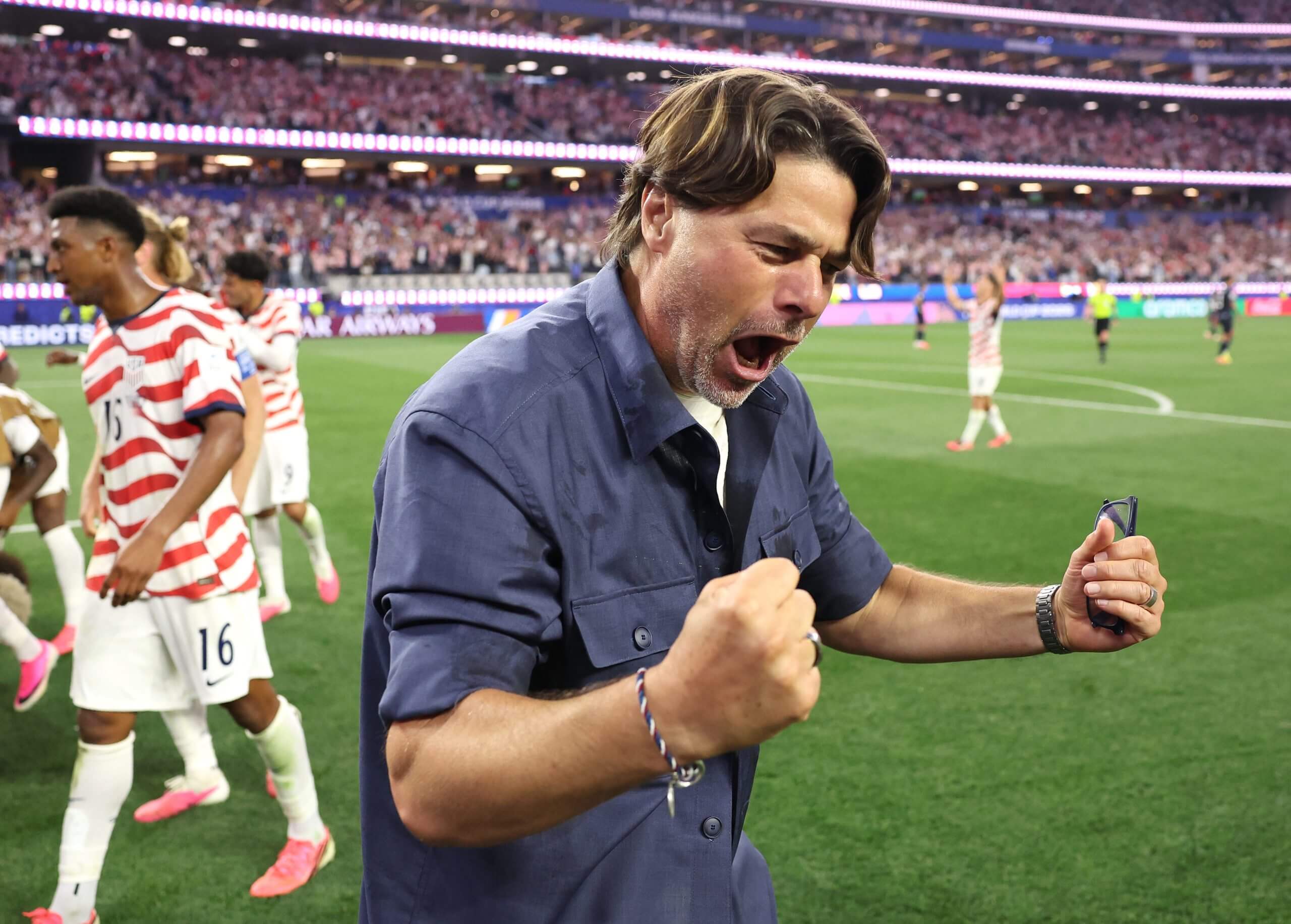
Mauricio Pochettino after the USMNT’s win over Paraguay (Alex Livesey / FIFA / Getty Images)
‘Constant evolution and growth’
The lemons are mentioned just once in “Brave New World,” a book told in Pochettino’s own words about his success at Tottenham Hotspur. An Argentinian friend told Pochettino that the fruit can “absorb negative energy and cleanse the air, which is why I have a tray of them in my office,” he says in the book.
The lemon anecdote has stuck with Pochettino, but it is the few paragraphs later in the chapter that reveal more about who Pochettino is as a person and as a coach. He talks about his ability to perceive “the energy that surrounds objects and people,” and how that “ability to see if the right energy is flowing” can influence his decisions.
“Ever since I was a boy, I’ve been convinced that the universe conspires to help you fulfil your dreams,” Pochettino said in the book. “That’s the energy source that I feel is with me. Decisions, personal relationships and absolutely everything else are a matter of energy. Good or bad, small or large. … I can foresee things that are going to happen and the associated consequences, or which path each player is going to take. I can see it in their auras.”
It is why, perhaps, Pochettino was so quick to diagnose the route he needed to take after being named coach of the U.S. team in September 2024.
The 54-year-old manager took over a program with massive expectations, but one that was coming off a huge disappointment at the 2024 Copa América, where it was eliminated in the group stage. The energy at the time was, frankly, not good.
Pochettino found ways to inspire winners at underdogs Espanyol and Southampton, then famously built up Tottenham and led the club to its first Champions League final appearance and first major European final in 35 years. He managed a star-studded group in Paris and then seemed to have untangled Chelsea before surprisingly stepping away from the London club. U.S. Soccer used contributions from hedge fund billionaire Ken Griffin and donor Scott Goodwin to afford the record contract for one of the sport’s biggest names.
The U.S. program he now led, once so optimistic about its golden generation, was searching for a way through the pressure and disappointment. Pochettino was brought in to reestablish that confidence, and then to build it beyond even any previous expectations.
It took Pochettino very little time to recognize that he needed to tear down some of the structure in order to rebuild a winner. The change started behind the scenes. Pochettino aimed to remake the culture within the entire federation, not just the group of players.
In order to perform their best on the pitch, Pochettino said, players needed “to feel free of responsibilities that don’t belong to them.” Some players believed too much had been put onto their plate by the federation, he said. They had been kept in the loop on coaching hires. They were empowered in everything, like determining time off during camps, to, as what publicly spilt into view with Christian Pulisic during the 2025 Gold Cup, what role they wanted to play when called up.
Pochettino pushed to refocus power, and the burdens that come with it, away from the team.
“In the end that leadership, that power, starts to fall into the areas where it needs to be,” Pochettino said. “On the decision-makers.”
Pochettino brought trusted assistants with him that he regards as a family. Some of them are. Son Sebastiano is part of the mix, while right-hand man Jesús Pérez has been with him nearly two decades and his opinion is valued unquestioningly.
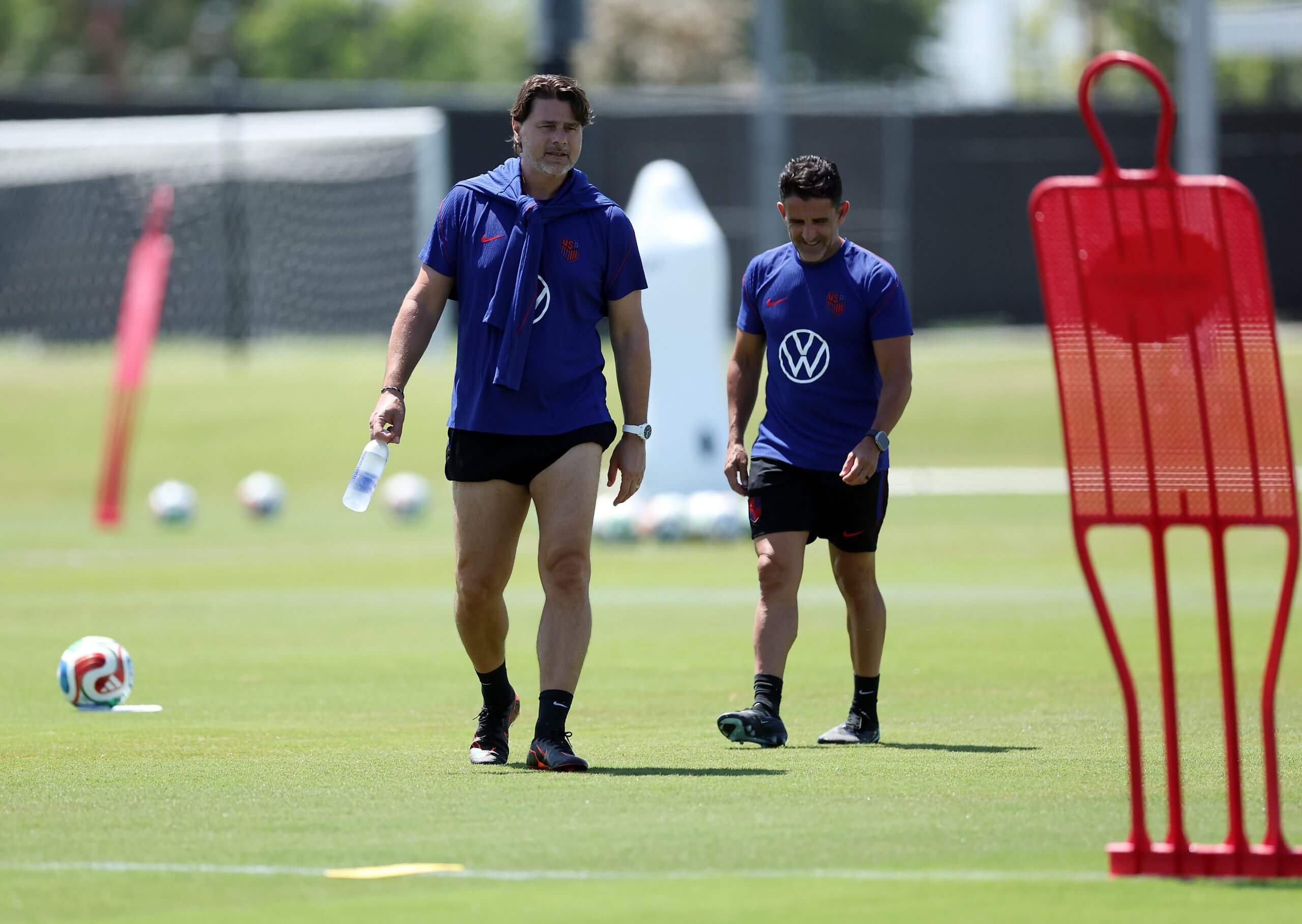
Pochettino with longtime assistant Jesús Pérez (Jamie Squire / Getty Images)
The process is detailed and deeply rooted in matters of mindset as much as in tactical priorities. The belief is that principles and practices don’t work unless everyone is fully committed, which led to an awakening of sorts for some members of the pool in Pochettino’s early days with the U.S.
Within the squad, he manufactured competition within a group that was over-leveraged around a core group of established stars. Some around the set-up felt that there was a group whose status would never change. That caused a trickle-down effect with those on the outer fringe of the pool, some of whom believed they wouldn’t have a chance to win a job.
Pochettino not only introduced new players, but he also empowered them to feel as if a World Cup role was possible. It was hardly the easy road forward. It introduced tension, but in the name of strengthening the overall mentality within the pool. Some of those players — Matt Freese, Alex Freeman and Sebastian Berhalter — were on the field Friday night against Paraguay.
“I’m not criticizing what came before or saying it was right or wrong; there are different ways of doing things, but we found a group of players living in their comfort zone,” Pochettino said. “Some assumed that because they were certain players, they were guaranteed to be here regardless of performance. For us, coming from highly competitive environments, that’s unfair. Because your evolution depends on the demands you put on yourself, as well as on the competition around you.
“If there is no competition, if you believe you’re the best and that you’ll play no matter what, or you’ll be called up, or you’ll be on the roster for the World Cup, it becomes difficult to evolve and grow.
“Ultimately, soccer is about constant evolution and growth.
“Our challenge was to foster that competitiveness, especially by bringing in players like the ones we have now. … We brought them in and those players, with motivation, ambition, hunger and something to prove, those players became a threat to the ones who may have felt too comfortable. I think that benefited our soccer.”
A culture built around respect
The benefits were on display last Friday against Paraguay.
The lost team Pochettino took over now looked as confident as ever. They played free-flowing, fun, attacking soccer. They overwhelmed La Albirroja. It felt like validation of Pochettino’s approach, one that may have left some bruises, but also clearly coaxed the best from this team.
It’s part of the reason why, after Gio Reyna’s trivela goal in the final minutes sealed the outcome, Pochettino, dressed in a suave blue suit and with his longer hair earning him comparisons to actor Russell Crowe, took off running down the sideline to join in on the celebration.
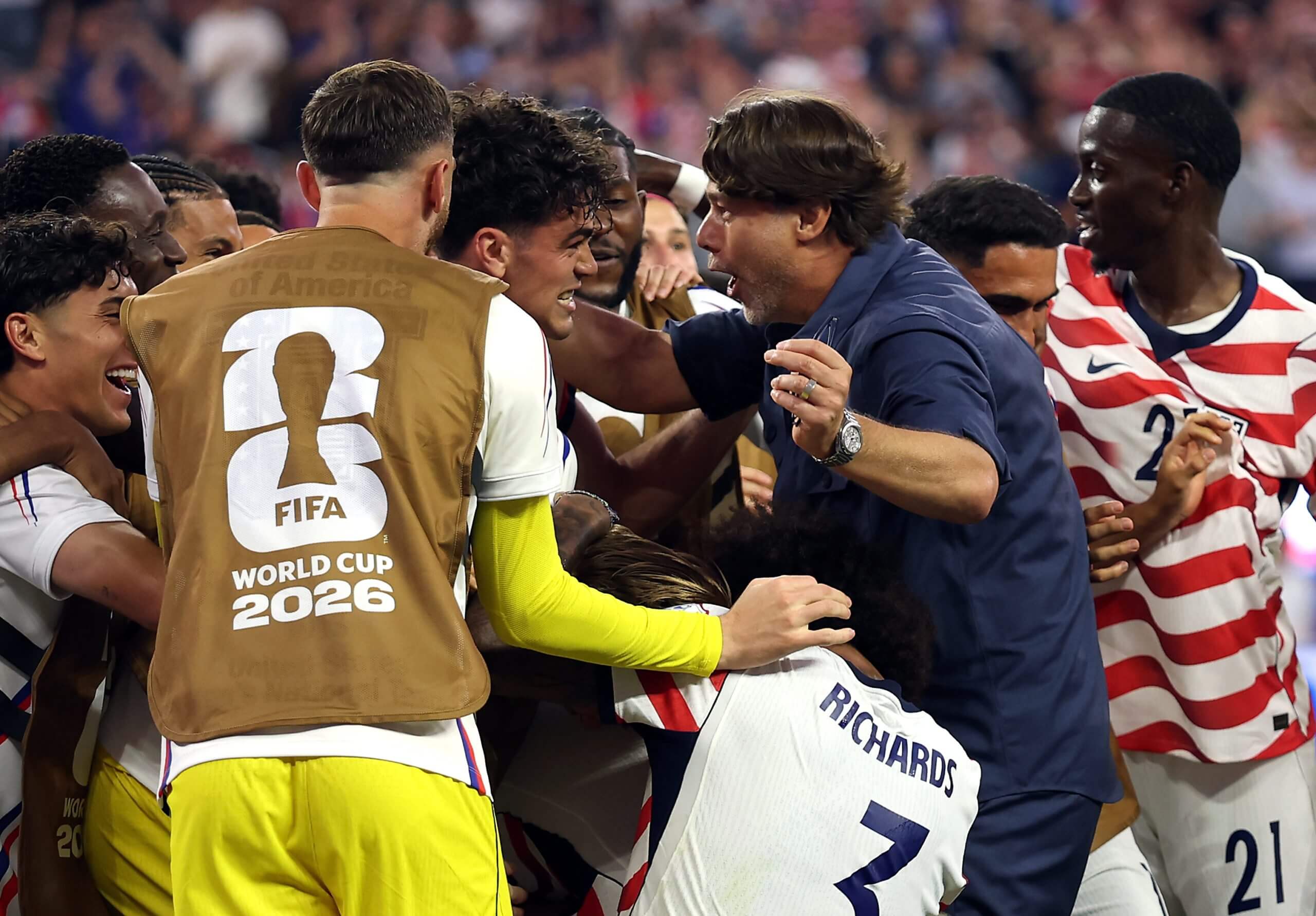
Pochettino joins the USMNT’s celebration of Gio Reyna’s goal vs. Paraguay (Jamie Squire / Getty Images)
“I think it’s a huge credit to the players,” Pochettino said. “We simply showed them the path. What makes us happiest is seeing them perform at that level, because ultimately our objective was always to help them reach their maximum level, to find a way for them to be free, happy and able to perform without carrying the burden of external pressures — pressures that simply didn’t need to be there.”
For Pochettino, it goes back to those early decisions to challenge the mindset around the group and to challenge the federation’s overall approach.
“The Paraguay game showed that the talent exists,” Pochettino said. “And when resources are distributed and the balance of power is leveled out — in a country this big, with an organization as significant as U.S. Soccer — when everyone operates at their best within their respective area, we are a very strong force. That was proven.”
It was never about undercutting the star players or trying to diminish previous accomplishments. In fact, Pochettino says it was the opposite. Each action was purposeful, its byproduct considered and weighed. Encouraging more competition forced players to confront what the national team meant to them, and how important it was to be a part of this team. The communication, or lack thereof, was about fairness and erasing any sense of hierarchy.
Pochettino saw it all as a matter of respect — for the badge, for the team and for the players themselves.
“Whenever you arrive at a new team, a new country, a new club, you must adapt and understand the culture,” he said. “It’s grounded in respect for what already exists. Respect for the history. Respect for the symbols. Respect for what was achieved before. And, of course, respecting every person in the organization on a human level. Respect for players is a given. But that concept, respect, isn’t always easy to put into practice. People always talk about the need for respect, but you have to be consistent with it.”
But Pochettino said people often “confuse the human side of respect with the professional side.”
“The human aspect has to be impeccable,” he insisted. “Professionally, respect means constantly pushing the player, really working with them so they improve, improve, improve. Not making life easy for them, but pushing them.
“Often, the coaching staff and I find ourselves in delicate situations; for instance, the way to show respect to a player who perhaps isn’t getting playing time is to make sure they train hard. Some might say, ‘Well, the player who didn’t play is upset, so let’s not push them to train.’ But that would actually be disrespectful. Respecting him means training him hard so that when the opportunity comes, he can perform and challenge the starter. That is vital for us.”
On Monday, as the team began its work week after the win, the task for Pochettino had changed again. Whereas he spent years trying to challenge the team so that they could rebuild confidence and belief, now he had to manage that optimism against the task ahead of them: an Australia team that was also coming off of a tournament-opening win.
The U.S. can build support around the country with another win. They can also lose it with a bad result.
The task is to harness the positive energy around them, as Pochettino always has believed he can. To lean into the aura the win over Paraguay created. To dream of stepping on the moon, even if they only get close.
“Certain factors have to come together to win a World Cup, yes, but we believe,” he said. “Today we talked about three words: Believe. Work. Compete.
“Believe. Work. Compete. Believe. Work. Compete. It’s a circle. Combined with the talent that we know is there, we can get close to glory. We can get close to doing important things.”