
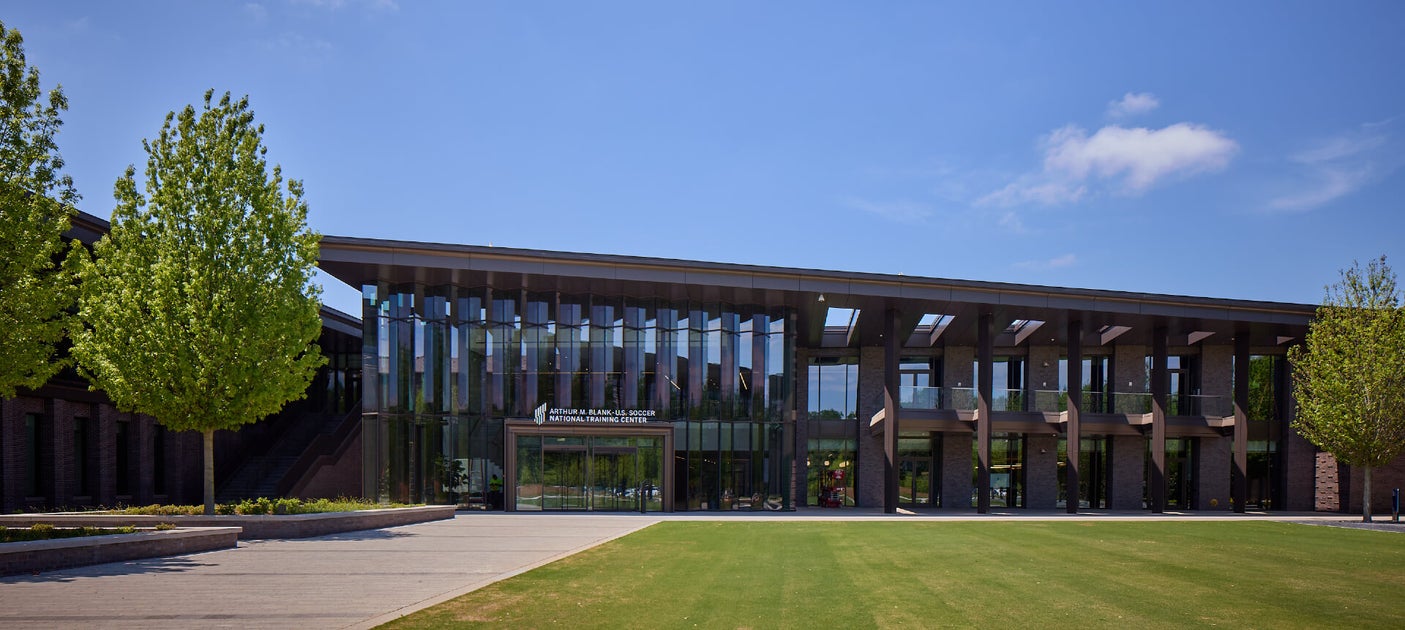
Cindy Parlow Cone touched down in Atlanta on Aug. 11, 2022, with a vision for the future of U.S. Soccer and a playbook for her high-stakes meeting with the billionaire who could bring it to life.
Parlow Cone, the U.S. Soccer Federation’s president, wanted to build a first-of-its-kind national training center. But so had her predecessors. The dream dated back decades and, to many, felt unaffordable or far-fetched.
Parlow Cone, though, was determined. After several months of strategizing, she’d landed a meeting with Arthur Blank. U.S. Soccer had neither a CEO nor COO at the time, so she asked chief strategy officer Tim Vernon to accompany her. They came with a presentation and a pitch that they hoped would convince Blank, the Home Depot co-founder and Atlanta sports owner, to put tens of millions of dollars toward a world-class facility. They arrived early and waited in the foyer of Blank’s palatial family offices.
And there, minutes before the meeting that could make or break the dream, Parlow Cone spilled tea all over her white blouse.
“And I didn’t bring an extra,” she recalls.
Oh my god, she instantly thought. I can’t believe this.
But then she flipped a mental switch, and adopted an attitude that has defined her leadership. She was neither an experienced executive nor a trained politician, but she’d led U.S. Soccer out of crisis, at times bucking convention or recommendations, by being her authentic self. “And you know what?” she thought that afternoon. “This is me. … I sometimes come with a tea stain on my blouse.”
So she strode into Blank’s intimate conference room. And in the meeting, she went off-script. Multiple rounds of role play with her team at U.S. Soccer had equipped her with carefully-crafted rhetoric. But “I threw our strategy out the window,” Parlow Cone recalls; instead, she spoke from her heart. She outlined her vision for a new HQ in metro Atlanta that would change the trajectory of American soccer. Within 10 minutes, Blank would later say, he was sold.
He ultimately committed $50 million toward the project. He also rallied other corporate executives and philanthropists. Together with U.S. Soccer and countless others, they funded and built the $250 million “Arthur M. Blank U.S. Soccer National Training Center,” which will open Thursday in Fayette County, Ga.
And in doing so, they converted fanciful dreams into reality.
Advertisement
For years, the thought of a national training center felt distant to many at U.S. Soccer. Equivalent hubs existed in dozens of countries around the world, but in a nation this big, with a soccer landscape this fragmented, with annual revenues insufficient, building a state-of-the-art complex for everybody seemed neither feasible nor sensible. When Parlow Cone became president in 2020, the federation was still operating out of two refurbished 19th-century mansions in Chicago’s South Loop. Its 27 national teams, from senior to disability to youth, were effectively traveling circuses, hopping from field to field, facility to facility, none of which U.S. Soccer owned.
That, once and for all, will change. The new NTC will house everything from youth tournaments to commercial operations to the U.S. men’s national team’s pre-World Cup camp. “It’s a physical manifestation of our ambition for U.S. Soccer and soccer in America,” USSF CEO JT Batson tells The Athletic.
And to those who came before him, the ones who built this sport at earlier stages, the ones who dreamed but conceded the dreams were distant, it’s emotional and “mind-boggling.”
“What the federation has done in a very short period of time,” former U.S. Soccer president Sunil Gulati tells The Athletic, “is absolutely extraordinary.”
U.S. Soccer’s long search for a home
Talk of a national training center, Gulati says, dates to at least the late 1990s. Nearly a decade after U.S. Soccer relocated from Colorado Springs to the Chicago mansions, Bob Contiguglia, its president at the time, tasked longtime soccer administrator Marty Mankamyer with formulating plans for potential facilities. But the more elaborate ideas, Gulati says, were “beyond anything we could do or think about.”
In 2002, they did break ground on what they called “a state-of-the-art U.S. Soccer National Training Center” in Carson, Calif., alongside the LA Galaxy’s new soccer-specific stadium. They raised funds, and spoke about “the NTC” as “a facility that can provide a world-class environment for the continued development of our players.” It would be an “icon for the sport,” Contiguglia said in a statement, and would “benefit every part of the U.S. Soccer family.”
Advertisement
But it was never home. It was a joint venture with Anschutz Entertainment Group (AEG), which owned the Galaxy and largely controlled the facility. “We couldn’t be home at the LA Galaxy’s training center,” Gulati says. Over the years, U.S. national teams would practice and play there, and some U.S. Soccer staffers worked there, but most remained in Chicago. Camps and games were still dispersed across the country. “We wanted, at some point, to have our own home,” Gulati says.
Talk of a true NTC and HQ picked back up in the 2010s. Dan Flynn, U.S. Soccer’s CEO from 2000-2019, was a staunch proponent. After board-level discussions in or around 2016, Flynn asked Brian Remedi, the federation’s chief administrative officer, to lead something of a feasibility study. The elemental questions, Remedi recalls, were: “How do we do this? How do we pay for it? And if we’re gonna leave [Chicago], where would we go?”
But they were always more exploratory than actionable. A study of national centers in the Netherlands and England, among others, helped inform the Kansas City facility that opened in 2018 and has housed U.S. Soccer’s coaching education efforts. But that, like the Southern California hub, was a joint venture with Major League Soccer’s Sporting KC, not an all-encompassing home.
By 2019, the federation was outgrowing its mansions, dubbed Soccer House. “It’s a lovely old house,” then-president Carlos Cordeiro said, “but it’s not the most conducive to meeting. We don’t have meeting rooms. We’re taking offices and cutting them into four, and putting dividers up, because we’re running out of space. Don’t tell the fire people that. But we’re probably on the edge of a violation.”
They focused, though, on stopgap solutions. They hired a real estate brokerage firm to lead a search for leased Chicago office space. An NTC remained a long-term goal, but, speaking that December, Cordeiro seemed hung up on a question that had stalled plans for years: “Do we have one training center? Or do we have multiple training centers?” he mused. “Don’t assume that everything is going to be in one location.”
COVID-19 then forced the world to freeze. A gender discrimination lawsuit also sapped the federation’s attention. When Parlow Cone succeeded Cordeiro in March of 2020, long-term plans had given way to crisis management.
But it was in those months, as she interacted with staff, that Parlow Cone’s appetite for an all-purpose HQ grew.
Advertisement
“There was a disconnect [between] the business and the sport,” she says. “There were a lot of people who worked at U.S. Soccer day in and day out who never actually saw the sport, except for on TV.” And as a former USWNT player, she also knew: “You’re often in your own bubble with the team.”
She felt a need to align all of those groups and functions. “And for me, the best way to do that was a national training center,” she says. While celebrating the USMNT’s Gold Cup title in August 2021, she mentioned the idea to Deloitte’s Tom Zipprich. And then, after stewing on it for months, she picked up her phone.
U.S. Soccer president Cindy Cone, right, CEO JT Batson, left, and Arthur Blank at the groundbreaking of the federation’s new headquarters and national training center (Adam Hagy / ISI Photos / USSF / Getty Images)
Landing on Atlanta
Zipprich, who leads Deloitte’s partnership with U.S. Soccer, had all but shut down for the holidays in December 2021 when his phone began buzzing. He glanced at it, hesitated, then answered. And for the next two hours, he mostly listened as Parlow Cone unleashed a string of restless thoughts. They agreed to convene a team of experts in January to, in Parlow Cone’s words, “start figuring out what this could and should look like.”
Her vision, though, “was quite clear from the beginning,” Vernon says. She wanted “a big, sprawling campus” that would house all of U.S. Soccer’s operations, sporting and otherwise.
And for that, USSF executives and Deloitte’s consultants decided, they needed to find 200-plus acres of land that satisfied a few key criteria:
Weather — soccer had to be playable outdoors nearly year round.
Airports — the campus had to be within 30-45 minutes of a major international airport, so that all sorts of stakeholders could access it.
Proximity to Europe — with most USMNT players now based overseas, the facility almost certainly had to be in the eastern half of the U.S. (The southeast also offered more connectivity with Concacaf nations in the Caribbean and Central America, and, generally, with most of the soccer world.)
Major cities — “it needed to be a city we could recruit staff to,” Parlow Cone says, and “we wanted a city that had an educated, diverse workforce as well.”
They quickly narrowed the search to five or six states and 8-10 cities. After site visits, analysis of aerial images and conversations with local officials, they cut it to three, then two. Texas and Florida summers were too hot; Washington, D.C., winters were too cold. South Carolina and southern Virginia were considered, but neither had prospective sites near a big enough airport. North Carolina and Georgia became the finalists.
But even in the former’s biggest city, Charlotte, “there wasn’t the amount of land that we needed within 30-45 minutes,” Parlow Cone explains. “We even went an hour out, and still didn’t have it.”
Advertisement
So they dove deep into two options. They could leverage existing infrastructure at WakeMed Soccer Park in Cary, N.C., near the Raleigh-Durham “Triangle.” Or, they could acquire land and build from scratch in metro Atlanta.
The Cary option, Parlow Cone says, was around $100 million cheaper, and close to her home in Chapel Hill. But the potential Georgia sites would give her and U.S. Soccer full control and a blank slate on which to bring their vision to fruition.
They prioritized the latter, then confronted the most daunting question: “How in the world are we gonna pay for it?”
The many training fields at U.S. Soccer’s new national training center (Courtesy of U.S. Soccer)
Cindy goes off script
In the summer of 2022, Don Garber, the MLS commissioner who sits on U.S. Soccer’s board, connected Parlow Cone with Blank, who owns Atlanta United. They scheduled a meeting, and as it approached, Parlow Cone’s team at U.S. Soccer urged her to play up the “real” competition between the two cities. Blank, they reasoned, would feel compelled to donate if he felt his millions could lure U.S. Soccer to Atlanta rather than elsewhere.
But when Parlow Cone stepped into the conference room, heart beating beneath the tea-stained blouse,” the inauthenticity of that message gnawed at her. “It just doesn’t feel right,” she thought.
So she sat down next to Blank and, according to her own recollection, said: “Arthur, my team told me to tell you this. And I’m from North Carolina, I would love the national training center to be in my backyard. But as U.S. Soccer president, I know that the right place is Atlanta.
“But there’s a $100 million delta between building in the two cities. Can you help me close that gap?”
Blank didn’t say yes on the spot. But he began extolling Atlanta, what it could do for soccer and what soccer could do for the city. He and Parlow Cone went back and forth, “speaking the same language,” Vernon recalls, well past the meeting’s allotted time.
On their drive back to the airport, Parlow Cone phoned U.S. Soccer executives to debrief. “How’d it go?” they’d ask. Horrendous, she began. We were completely unprepared. He poked a ton of holes in everything we pitched.
Advertisement
Then she broke out laughing, ended the prank, glowed about Blank’s enthusiasm and spoke about next steps.
Blank, meanwhile, did more than commit to writing a check. He directed Steve Cannon, then-CEO of his sports and entertainment company, to help execute U.S. Soccer’s vision. “His team became our team,” Parlow Cone says. Cannon “was out there advocating for U.S. Soccer as if he was one of our employees.” After one of many meetings, on May 2, 2023, Cannon personally drove Parlow Cone, Batson and Vernon down to the rolling cow pasture in Fayette County that, three years later, has become the NTC.
Blank also arranged multiple dinners that brought together U.S. Soccer and “a who’s who of big corporations, big philanthropists in town,” Batson recalls. Companies such as Coca-Cola and Home Depot, plus people like Chick-fil-A chairman Dan Cathy, became integral parts of the answer to the funding question.
But even after those dinners, Batson had doubts. After one, he called Parlow Cone with an update full of honesty. “People were really excited,” Batson reported, “but I still have no idea how we’re gonna pull this off. Like, no earthly idea.”
Arthur Blank speaks at the groundbreaking of the U.S. Soccer national training center he helped fund (Adam Hagy / ISI Photos / USSF / Getty Images)
From ‘dream crusher’ to executor
From Day 1 back in 2021, Parlow Cone never wavered. “She called the shots,” Zipprich recalls. She wanted a full-blown NTC, “and she said, ‘I want this operational before the men’s World Cup.’”
Batson, on the other hand, became CEO in the fall of 2022 and brought what multiple people describe as “healthy skepticism.”
Parlow Cone had another descriptor. “I may or may not have called him a dream crusher,” she says with a smile and chuckle. “I told him: ‘Do not crush my dream.’”
Over the months and years that followed, Batson “sweat every single dollar, every detail,” Vernon says. He had to wrap his head around the finances and logistics of a project the likes of which no one involved had ever led. There were “all sorts of practical, operational questions,” Batson explains, and then he rattles off nine: “How would you use it? How often would people use it? What does programming look like, and how much space do you need, and how many fields do you need, and should your headquarters also be there? And are you gonna have to pay for the land? And how much does the construction cost? And do you have to pay taxes?
“And, and, and, and, and.”
Advertisement
Some who visited potential sites also struggled to envision how cow pastures or hilly woods — which the sites invariably were — could become a gleaming corporate headquarters and a pristine soccer complex.
But throughout 2023, the finances began to fall in line. Sponsors and donors joined Blank. Cathy — who’d built out Trillith Studios, the largest movie production facility outside Hollywood, just down the road in Fayette County — agreed to gift the land. The county’s development authority ultimately issued $200 million in tax-exempt bonds to help U.S. Soccer fund the construction. There were also property-tax abatements and other incentives. Utility companies, Parlow Cone says, offered to serve the facility for free or at a reduced cost.
Batson and others at U.S. Soccer, meanwhile, tallied up the money they’d save by having their own home for training camps and other events, plus the money they could make from naming rights and other sources. And they began to realize: “Oh! Hey! This works!”
In fact, Batson says, “this is gonna turn out to be an economic benefit for U.S. Soccer — despite it being the largest investment in our history.”
And over the two years that followed, he and his team — most notably chief financial officer Chelle Adams — willed it to life.
U.S. Soccer president Cindy Parlow Cone speaks at the National Soccer Hall of Fame induction ceremony this past weekend (Sam Hodde / Getty Images)
‘Ah, I’m home’
When they announced their plans in late 2023, then broke ground in April 2024, there was more healthy skepticism that the pre-World Cup timeline was realistic.
They had worked with architects; consulted experts and national team alums; visited other training centers across the country and world. They’d designed a campus that would feature more than a dozen locker rooms and pitches, a court and a gym, conference rooms and hospitality areas, workspaces for 400 people and nearly every amenity imaginable. Could all of that really rise from a cow pasture in two years?
Advertisement
Before any of it could, construction workers spent six months blasting into rock, grading the land for soccer.
And for another six months, truck after truck rolled in with stone and sand — around 7,000 truckloads in total.
Four ponds were “created,” and a massive water mane was built, to keep the many acres of grass alive.
Some 1,600 or 1,700 people touched the project in total, with up to 500 at once sculpting the site into flawless fields on a few different levels.
The lowest ones, farthest away from the multi-story headquarters, are for youth teams. The “superpitch” on higher ground is for the USMNT and WNT — and designed, intentionally, to inspire teens to work their way up.
All of it, remarkably, has been completed on time and on budget. Batson, like others, is “amazed.”
“Now,” Parlow Cone says, “we have to make it everyone’s home.”
With the May 7 grand opening set, they began opening the NTC’s doors to members of the soccer community. Some guests are blown away by details or the sheer expanse. Others feel something more. The U.S. Power Soccer national team got “super emotional,” Parlow Cone says, upon seeing their new home court for the first time. Beach soccer players kicked off their shoes, ran onto their new home sand, FaceTimed teammates and teared up.
And then there are the alums. The builders. The fellow dreamers. Batson and Parlow Cone gave Gulati and another past president, Alan Rothenberg, a personal tour in February. “On an emotional level,” Gulati says, “it was great.”
A group of former USMNT players also recently visited, and Cobi Jones, the most-capped player in program history, plopped down on a bench at the NTC. “Ah,” he said with an exhale, “I’m home.”
Batson, too, has taken time to reflect. As CEO, he insists that this is just “the start” of “big things.” But as a soccer lifer from nearby Augusta, Ga., his mind also races back in time. He thinks about the fields he graced as a boy, and “the kid in me,” he says — but then his voice gets weak, and he has to pause.
Then he collects himself. “Like, it’s incredible,” he says. “To think about how far the sport has come.” And, of course, “to think about what’s gonna be possible going forward.”