
Get free access to the most comprehensive World Cup coverage in The Athletic app.
In December of 2022, Joe Connor wished he was halfway around the world. Instead, he was stuck at home in San Diego watching a sport he’d never really liked.
For years, Connor had traveled across the United States and the globe, to hundreds of stadiums and arenas, for hundreds of sporting events spanning all 50 U.S. states and six continents. His curiosity had driven him to baseball games everywhere from Cuba to Kenya to Korea. But the world’s game?
“I wasn’t a soccer fan,” Connor admits, much less a man intent on seeing the sport in 144 different countries.
So, he says, in 2022, when he planned to circumnavigate the globe, he scoped out rugby in New Zealand and hockey elsewhere. A blood clot in his leg, however, forced him to cancel the adventure. While resting at home, he clicked on his TV, sampled the 2022 World Cup, “and that,” he says, “is when the lightbulb went off in my head.”
Soccer, he realized, could be a vehicle for education, his gateway to a deeper understanding of the world.
And over the next three-plus years, he chased it just about everywhere.
From January 2023 through April 2026, Connor says, he visited more than 200 countries or territories and saw soccer in a majority of them. He saw it at hallowed stadiums and on dirt surrounded by goats. He saw it played by superstars and schoolchildren, in spotlights or barefoot in streets, for money and for pride.
He reveled in the pulsating passion of, say, the Clásico Vallecaucano in Cali, Colombia. He also sat in empty concrete bleachers far off football’s mainstream grid. He allowed the sport to lead him on an 11-part global expedition, one that touched all 48 nations who’ll participate in the 2026 World Cup. (He actually set foot in 47; war and politics prevented him from entering the 48th.)
And along the way, he learned one overarching lesson about Earth’s 8 billion people, a lesson he hopes to spread to Americans living in bubbles, a lesson that contradicts all of the planet’s conflicts and hate.
“We’re all human,” Connor says.
That was his takeaway from the “dream world tour” that began as a South American pilgrimage and became something more.
“When you get to know people at a personal level, we’re all the same,” Connor says. “And there’s no better place to do that than a sporting event.”
‘Football … it was everywhere’
By now, Connor knows, you probably have some questions, such as: Why? And how?
His story dates back to a childhood in Connecticut blessed with sports and local adventures. He played ice hockey through high school. Like many 20th-century American kids, he also grew obsessed with baseball. In his mid-20s, soon after losing an entry-level job, he planned his first road trip — to 15 Major League Baseball parks in 21 days. He’d call his dad from landline phones with updates on his whereabouts and excitement.
Then, the following year, his dad died at age 57. “His death was a turning point for me,” Connor says. Life, he suddenly thought, is short, precious, finite. And he decided: “I’m not gonna wait on retirement to do things.” He got to his 30th MLB park by the end of the year. Then he looked further afield.
His work as a freelance sportswriter soon took him abroad for baseball. He also began expanding his U.S. repertoire and branding himself “Mr. Sports Travel.” Over the past three decades, he says, he has been to every NFL, NBA, MLB and NHL stadium, plus every Division I college venue for those same four sports. He continued writing but also worked as a career coach and invested in real estate. That, he says, has allowed him to self-fund his voyages.
Soccer, for decades, had hardly been on his radar. When he briefly played it growing up, “it was brutal,” Connor says. “I hated it.” But something about the 2022 World Cup — the drama, the fervor, the nationalism — opened his eyes to what he’d been missing. He “became hooked.”
So off he went to Brazil in January 2023, first to São Paulo, then to Rio de Janeiro. He stood with Vasco de Gama supporters, chanting “dá-lhe Vasco olê olê,” and when their team scored, beer flew. Fathers lifted daughters into the air. The shirtless man next to him, like tens of thousands throughout São Januário stadium, unleashed a guttural roar.
Next, Connor went to Boca Juniors and River Plate in Argentina. He stood in an upper corner of La Bombonera, as the sun set over Buenos Aires, and heard unceasing noise unlike any other he’d sampled. In Uruguay, he stood with hinchas and drummers; they erupted when Defensor Sporting equalized in the ninth minute of stoppage time against Peñarol. In Paraguay, he saw Olimpia and Cerro Porteño, but even at a teen futsal match in Asunción, he found songs, drums and intensity.
Eventually, after a week in Antarctica, he saw flares and flying pyrotechnics in Chile; he saw blue and white smoke, plus fireworks and pandemonium, at Alianza Lima in Peru. In Bolivia, he saw The Strongest upset River Plate in a Copa Libertadores opener; he also saw kids playing 5-v-5 on a concrete court with fading lines, graffiti-lined walls and net-less goals.
“To me, the most interesting aspect of the travel, beyond the games, was the cultural significance of football in the countries,” Connor says. Throughout South America, it was everywhere.
His true indoctrination then came in Colombia. At Independiente Medellín vs. Atlético Nacional, he saw fights spill from stands toward the field. The following night, he donned red for the America de Cali-Deportivo Cali derby, and found himself hugging strangers as goal after goal was scored. They bounced up and down in the stadium’s top row, lifting Connor onto their shoulders, grabbing his wispy hair and rubbing his freckled head.
Some of their words meant nothing to Connor. But, he says, “even though I don’t speak the local language fluently, we share the language and the love of football.”
He returned home, after stops in Panama and Jamaica, wowed by the experience and ready for more.
For his second trip of 2023, he went back to sports he knew. He began with the FIBA men’s basketball World Cup in the Philippines and Indonesia, hopped around South Asia, and concluded with tennis’ Australian Open.
It was after that trip, though, in early 2024, that he altered his mission. If he were going to try to see every country, he thought, “you know what? I want to see as much football in as many places as possible.” And specifically, he wanted to sample it in all 48 countries that would be coming to North America for the 2026 World Cup.
From the Bernabeu to Iraq, then ‘fascinating’ Africa
His problem, of course, was that in early 2024, only three teams had qualified.
Connor, as a soccer novice, initially had no clue how the byzantine qualification process worked. But he studied up, mapped out a plan, and traveled that spring to Europe. He visited the Emirates and the Bernabeu in England and Spain. He took in Der Klassiker at the Allianz Arena in Munich. He checked off Belgium, Italy, Croatia, Serbia, Poland, Denmark, Sweden, Switzerland and Hungary — most of which, he assumed, would qualify — plus Saudi Arabia and Qatar just before departing.
He also stopped in Tunisia, where Club Africain fans taxied him to a stadium entrance and local reporters, struck by the sight of a White dude from America, asked to interview him.
And for a few days, he popped over to Iraq, specifically to Erbil in Kurdistan. He found a contact at the local soccer club who told him: WhatsApp me when you get here, I’ll tell you what gate to go to.
He got to 32 countries and saw soccer in 20 of them on this March-April excursion, according to his own detailed tally, which is supported by photos and videos.
It was his final trip of 2024, though, and his first of 2025, that really stuck with him.
Both were to Africa, and “to me,” Connor says, “the most fascinating place was Africa. Because the friendliest people were there. The most curious people were there. And you see how, despite the challenges that exist in Africa — poverty, crime. … To most Americans who would go there, it’s considered ‘third world,’ but that doesn’t mean they’re less than us or they’re less human.
“The way I was treated there,” he later continues, “I can’t say enough about Africa.” Having been from north to south, from east to center to west, he raves about its cultural diversity. And about the obsession that courses through dozens of countries on the continent.
Connor saw it on choppy fields, on pavement, on beaches, in rundown stadiums and gleaming ones.
“I mean, morning, noon and night,” he says, “these kids, they breathe, eat and sleep football.”
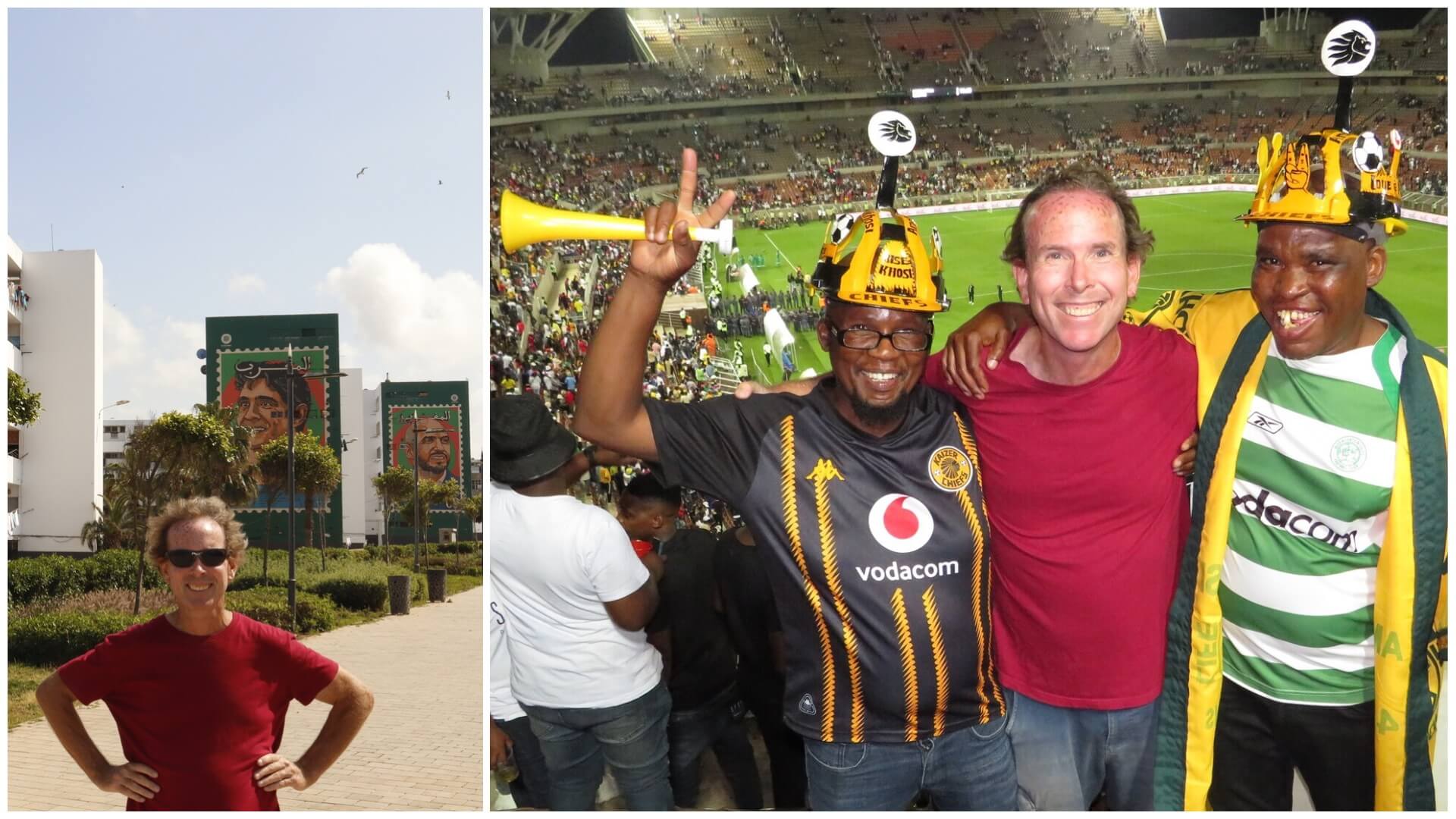
Connor’s travels through Africa took him to World Cup-qualified nations such as Morocco (left) and South Africa (Photos courtesy of Joe Connor)
The one qualifier he couldn’t crack
He saw the obsession in Djibouti and Algeria, in Rwanda and Morocco, in both Congos and Gabon.
He saw World Cup qualifiers in Malawi, South Africa and Mozambique, but also amateur games. In Guinea-Bissau, Connor says, “I stumbled upon a really great rivalry match I didn’t know about.”
Early on, he found a WhatsApp group of African football journalists, who helped guide him to teams and leagues whose schedules weren’t easily Google-able. In three countries, Connor says — Togo, Guinea and Zimbabwe — locals even organized games specifically for him. He would tell them about his mission, and if schedules didn’t align, they’d respond: “We’ll plan a friendly for you.”
“I’m like, ‘for me?!’” Connor says, reproducing his amazement. “I couldn’t believe it!”
And “they didn’t ask for money,” he notes. “They did it because they wanted to share their cultural love of football.”
He ultimately made it to 48 of 54 African countries, and he knows that in some of them, many Westerners would worry about safety. But “I never felt threatened in Africa. Not even once,” Connor says. He did get detained — in the Central African Republic, he says, for accidentally taking a photo of a military installation, without permission due to a translation error — but he largely did his homework. He researched laws. He asked for permission to take photos. He avoided dangerous areas, as you would as a tourist in any country, including America. He worked contacts to help with visas and media or VIP passes — though when he couldn’t get one, he’d buy a ticket.
If necessary, he’d hire a guide or fixer, but he says he mostly stayed in non-chain hotels or rentals and wandered through communities solo. “Because that’s how you get a sense for what daily life is like,” he explains.
He couldn’t get to Niger, Chad or Sudan — and last March, Sudan concerned him. A civil war has ravaged the nation since 2023. Its men’s soccer team, though, surged to three wins and a draw to open qualification. Their unbeaten run, which stretched past the midway point of a 10-match group phase, sent Connor “scrambling” for a route to the country.
But they ultimately faded and failed to qualify. Ukraine, similarly, fell short in a European playoff.
The one qualifier he couldn’t quite crack was Iran.
Connor had previously been denied a visa to the Islamic Republic. This past winter, he told The Athletic he had preliminary approval to travel; but after the U.S. and Israel bombed Iran on Feb. 28, inciting a wider regional conflict and internet blackouts, Connor couldn’t connect with his guide. As the war raged on, he gradually conceded he couldn’t get there.
Last summer, however, after an earlier U.S. military attack on Iranian nuclear sites, Connor thought ahead. He planned a trip to Tajikistan to see Iran’s national team play in a Central Asian tournament. He posed with fans and Iranian flags. It felt like the next best thing.
“Am I disappointed I couldn’t go to Iran? Of course,” Connor says. “But … I’m at peace with the fact that I literally did everything I could to try to go. And one day, I hope to get there.”
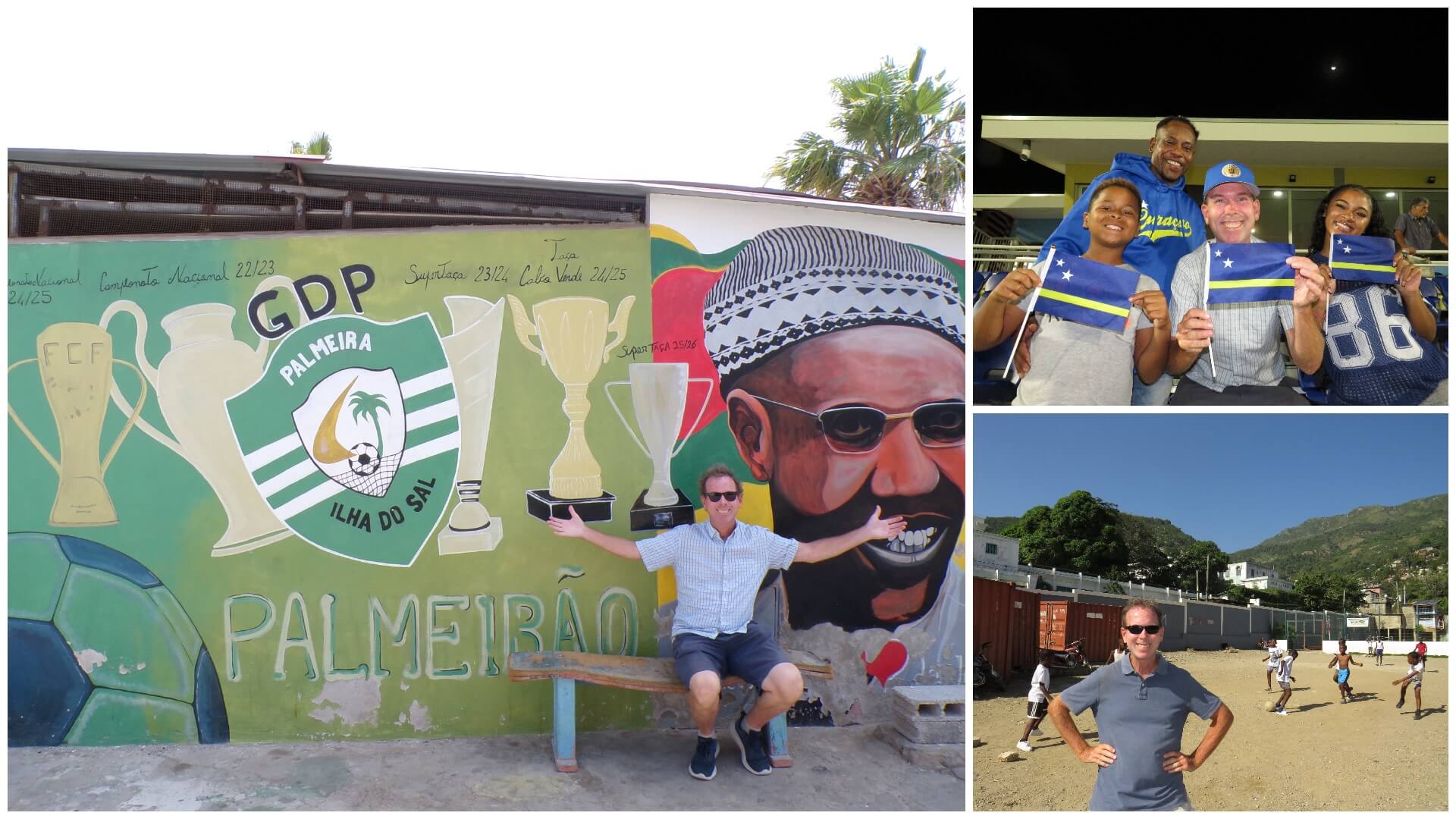
Connor’s trips to three World Cup upstarts: Cape Verde (left), Curaçao (top right) and Haiti (Photos courtesy of Joe Connor)
The ‘greatest sports traveler of all time’
He entered the winter of 2026 with 36 boxes checked, six still to fill and six undetermined.
In February, he went to Curaçao — where he’d been for baseball but not soccer — and Haiti.
In Haiti, he chose to avoid the chaotic capital, Port-au-Prince, but had a blast in Cap-Hatien. He got in touch with a local stadium manager, who informed him that a team of teens, the reigning champs of their scholastic league, would be bringing last year’s trophy to their season opener. “Want to see the trophy?” the manager asked Connor. Connor walked over from his hotel and posed for a picture with the boys in their school uniforms. He later watched them win their opener handily.
His final trip was the most jumbled of all and “particularly challenging,” Connor says. He knew he still had to get to New Zealand, Jordan, Cape Verde and Mexico. But he also had to react to six playoffs. If, say, Italy, Denmark, Sweden and Romania won the European ones, he was set; but he’d never seen soccer in Turkey, the Czech Republic or Bosnia and Herzegovina.
So, in March, anticipating Turkey victories, he flew to Istanbul for the Turks’ playoff semifinal victory over Romania. When Bosnia and the Czechs upset Italy and Denmark, respectively, he planned April trips to Prague and Sarajevo — Nos. 46 and 47. Finally, he jetted to Guadalajara for a Chivas match to complete the mission.
Why Guadalajara?
“I’m the GOAT and they’re the Goats,” Connor says — a reference to himself as the “greatest sports traveler of all time” and to Chivas’ nickname.
During and after the match, he felt a surge of gratification. His only regret: it ended scoreless. “I can’t stand draws,” Connor says. It’s the one rule he wishes soccer would change. “Draws drive me crazy.”
Results of the hundreds of matches he attended, though, will blur together. “The main thing I remember,” Connor says, reflecting on the three-plus-year journey, “is just how kindly I was treated … and those human moments with people.”
It’s the interactions that broke through language barriers. The smiles he elicited in Saudi Arabia and Egypt, in Senegal and South Africa, in Uzbekistan and Iraq, in Belgium and Curaçao.
It’s also the knowledge he gained, and all the football he saw — men and women, boys and girls, pickup games and Champions Leagues of three confederations. “I’ve seen under-21 national teams, under-17 national teams,” Connor says, and then he rattles off a list of other types. “I’ve seen any kind” — but then he cuts himself off.
There is one type of soccer he’s still missing.
“I haven’t been to the World Cup,” he notes. “That’s my next goal.” It will never be closer to home than it is in 2026, but ticket prices are “outrageous,” he says; he’d “love to go,” but he’s not sure he will.
His broader goal, in the meantime, is to educate. To inspire exploration and bridge-building.
“Hopefully people will read this story, and see my videos, and learn more about me,” he says, “and go, ‘You know what? The world’s not as scary as maybe we think it is.’”