
“Even if elimination hurts: what a game,” Chancellor Friedrich Merz wrote on social media, wildly misjudging the mood immediately following Germany’s defeat on penalties to Paraguay.
“With your commitment and team spirit at this World Cup,” Merz continued, “you have thrilled our country. We are proud of you.”
What game did you watch, Herr Merz?
Nobody is thrilled. Nobody is proud. In fact, nobody even seems particularly surprised at what, among stiff modern competition, might be the most humiliating moment in the country’s World Cup history.
Germany were eliminated at the group stage of the 2018 World Cup. It happened again in 2022. They avoided that same embarrassment at this tournament, but have tripped and fallen into a different one, exiting at the round of 32.
Was this actually worse? Arguably so.
Germany may have advanced from their group with victories over Curacao and Ivory Coast, but those wins hardly bred confidence. Rather, the prospect of playing France in the last 16 was seen as an insurmountable obstacle; that’s how fatalistic German football has become in the 12 years since victory at the 2014 World Cup.
In all that time since, they have not won another World Cup knockout match — Tuesday night’s game was the only one they have contested.
“Are you just a second-class international side now?” a ZDF interviewer asked Kai Havertz while he was still on the pitch on Monday, with giddy Paraguayan players celebrating in the background.
“It seems that way. Sure,” Havertz replied. Imagine putting that to some of the German internationals of the past and, what their response might have been.
But why did this happen? That is the question now being asked by a proud footballing nation.
Here, in an article informed by conversations with stakeholders across German football, who each asked to contribute anonymously so they could speak freely, The Athletic explores the immediate fallout of another dramatic World Cup failure for the four-time winners.
Advertisement
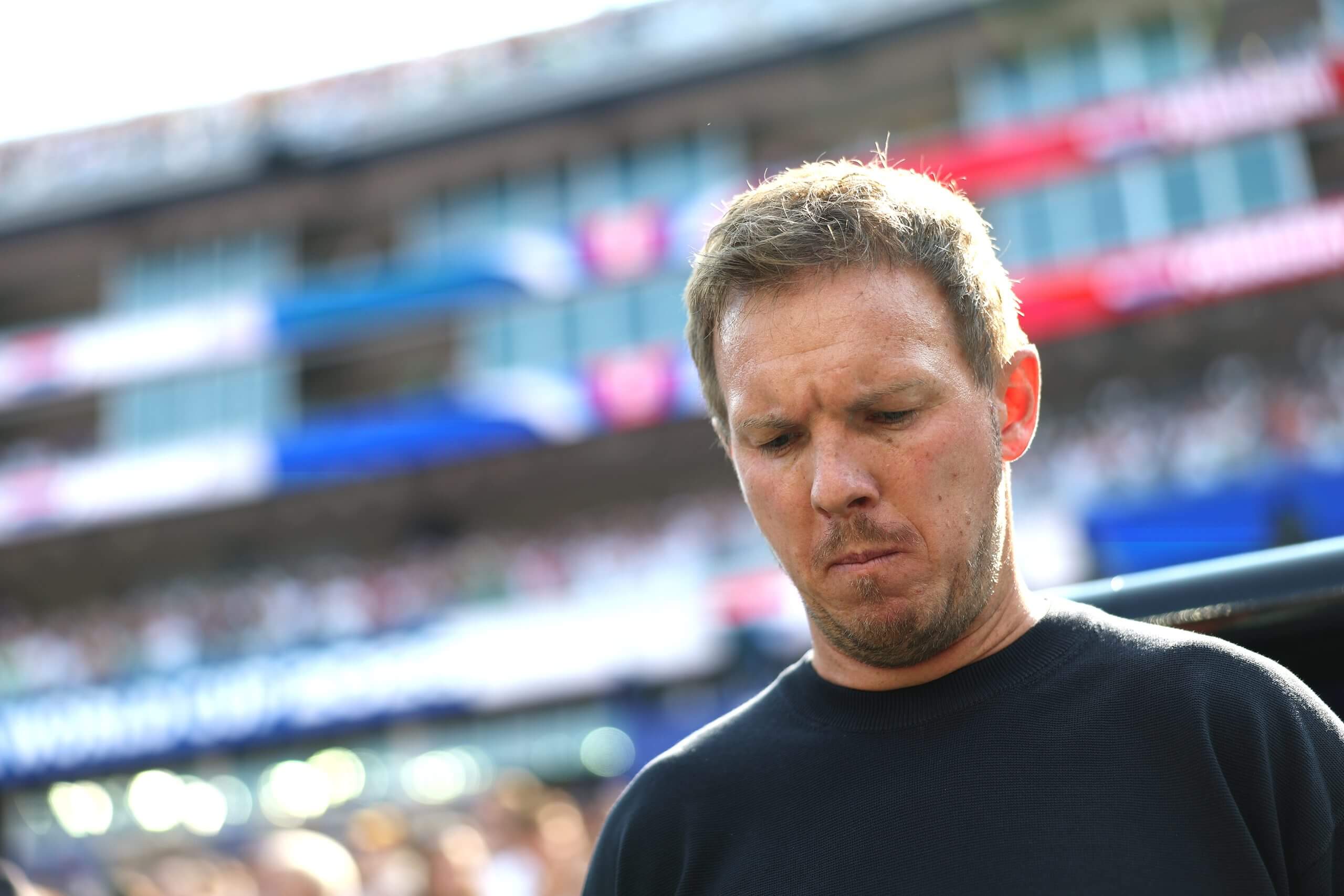
Naturally, manager Julian Nagelsmann is drawing accusing fingers. The absence of a recognisable style in his team was mentioned, even if some of the selections that the public complained about — Leroy Sane, Jamal Musiala, and Joshua Kimmich being used as a right-back instead of in midfield — were defended, not raised at all or otherwise described as issues which, alone, were not enough to explain elimination at such an early stage.

Leadership was raised as an issue. While Aleksandar Pavlovic and Felix Nmecha in midfield drew technical criticisms, their selection was also challenged on account of their relative inexperience. This was a first tournament for both and placing them at the heart of a side which was not playing especially well while carrying star players (Musiala and Wirtz) suffering from confidence problems was a burden. That was part of the argument for moving Kimmich into midfield and the role he plays for Bayern Munich.

It’s a vague argument, but from the squad that reached the quarter-final at Euro 2024, Germany lost Toni Kroos, Thomas Muller and Ilkay Gundogan, three highly respected, highly decorated players capable of anchoring an international group. Robert Andrich and Emre Can, who captain Bayer Leverkusen and Borussia Dortmund respectively, were not part of this squad either — Andrich was not picked, Can was injured — and that helped accentuate the leadership deficit. Go back further and consider the characters that have departed the national team over the past few decades: Philipp Lahm, Bastian Schweinsteiger, Michael Ballack, Oliver Kahn, Mats Hummels, Per Mertesacker, Miroslav Klose; that is a lot of aura lost.
So, Nagelsmann has not had some of the benefits of his predecessors — he also lost Nico Schlotterbeck to injury during the tournament and Serge Gnabry and Lennart Karl before it began — but many have also taken a dim view of his media handling.

Before the tournament began, Jurgen Klopp, working for Magenta TV, drew the two into a controversy. Responding to criticism he had received for suggesting that Musiala should be replaced in the starting line-up by Deniz Undav for the first game, Klopp — slightly facetiously — told the audience at home “not to worry, because Julian Nagelsmann is still picking the team. For now.”
Naturally, everyone focused on the “for now”, and after a slightly confected melodrama, Klopp apologised publicly. But not before Nagelsmann had reacted poorly to questions about Klopp in a press conference and then snapped at an English-language journalist for asking something similar. The journalist in question was not a German speaker and likely did not understand. Nagelsmann was irritated and understandably so, but he still came across as petulant.
As he did in an exchange with veteran presenter Johannes B. Kerner following the 2-1 defeat by Ecuador in Germany’s final group game. Kerner asked a reasonable question about whether Germany’s players were under-motivated, having already secured their qualification — it was standard interview fare — and yet Nagelsmann reacted sharply, telling the moderator to “stop with that nonsense”.
It did not play well with the public. Given that two of Nagelsmann’s players, Undav and Kimmich, then said that Ecuador’s players had “wanted it more” in their own, separate interviews, there was a perception of disconnect.

In addition, during his reign as national team head coach, Nagelsmann developed a habit of contradicting himself — of saying one thing in public but then, with his actions, reversing his position. The most obvious example would be the Manuel Neuer saga, during which the veteran goalkeeper was definitively not reversing his retirement, until three weeks before the World Cup started, when he did.
The use of Undav was another example. Undav, in Nagelsmann’s eyes, was most impactful as a substitute, and that was his role at the tournament. After months spent scrabbling for form after a serious ankle injury, Musiala needed rhythm and continuity in selection, according to Nagelsmann.
Until the Paraguay game, when Musiala was dropped and Undav replaced him, in a newly-designed attack.
Coaches are allowed to change their mind. Of course. But these inconsistencies were sometimes confusing. As was the tactical direction of the side.

During the group stage, Nagelsmann made reference to the team’s “impatience” and how their habit of forcing final balls was creating turnovers and instability. The resulting correction saw their speed of play slow to a crawl against Paraguay, against whom they attempted 55 crosses. According to Opta, that is the most attempted by any team in all World Cup matches dating back to 1966, when that statistical record began.
Advertisement
These details alone are ticky tack; hardly enough to sink a World Cup campaign. But then the lack of a single diagnosis is what makes Germany such a troubling case. Had there been something profound — a fight, an outrageous tactical error, or a PR disaster — then things would be easier to fix.
As it is, that’s not the case. Late on Monday evening, German time, Lothar Matthaus spoke to Bild, claiming that families of players had been too close to the training camp and that there had been an excessive number of “distracting” family days.
The Athletic has not independently verified those claims but, even if it were true, that too would be best described as a minor contributing factor rather than a proper explanation.
It’s why the question of what happens next is complicated.
Much of the conversation will focus on Jurgen Klopp, who has always been assumed to covet the national job; that’s why his “for now” comment before the tournament was so incendiary. But the former Liverpool manager, who is now Red Bull’s global head of soccer, distanced himself from the role before Magenta’s broadcast of the Paraguay game ended.
“I haven’t thought about that yet,” he said. “I understand that when the national coach position is discussed, my name is mentioned in some form, but it’s not the moment to really talk about it. There’s nothing to say. I have a job that I enjoy very much and it’s not part-time.”

Klopp may well make a fine international coach, but nobody The Athletic spoke to after Germany’s elimination believes that the country’s footballing decline will end with a change of coach, even those who don’t particularly like Nagelsmann or want to see him replaced.
Instead, among general points about the squad and the tournament, they pointed to issues with development. Specifically, they reference the absence of particular players. Germany is outstanding at creating multi-positional, multi-role footballers, but no longer produces world class specialists — no goalscorers, no centre-halves.
Advertisement
It’s a credible point. The irony of Undav being held up as Germany’s goalscoring answer before and during this tournament is that he did not have a traditional path through the game. He was rejected by major clubs and worked his way up from amateur football; Undav is not a product of any system, but someone who succeeded in spite of it.
German football must find out why.

There is also tremendous concern about pathways. In late 2025, the German Football League — which operates the Bundesliga divisions — established a working group to combat blockages within youth pipelines. Young players are not getting enough minutes on the pitch at a critical moment in their development. Klopp is part of that task force, so is Markus Krosche, Eintracht Frankfurt’s sporting director, Max Eberl, Bayern Munich’s board member for sport, and Sami Khedira, the former Real Madrid and Germany midfielder.
One of the initial recommendations, given in the spring of 2026, was to establish a new under-21 league. Currently, players between the ages of 18 and 21 who are not ready for the first team have few opportunities to play regular, useful football. Some clubs have second teams, but they are unable to be promoted beyond the third tier of German football and typically dwell in lower divisions. Bayern and Dortmund, for instance, both have second teams at Regionalliga level (fourth tier), where the standard of play does not always help incubate a professional career.
The under-21 league is one of several responses to that; and it will begin next season. Other considerations include allowing clubs’ second teams to be promoted to a higher level, even if that threatens to be a deeply unpopular move with fans.
Regardless, while Germany reinvented its footballing identity in the early 2000s — Raphael Honigstein, formerly of The Athletic, wrote a brilliant book about it — and successfully rebranded itself with sustained investment in youth development and the discarding of tired, defensive football, the country has fallen behind again in different areas. This latest World Cup, the most recent in a succession of failures, prolongs a trend providing further evidence of that.
After their previous tournaments failures, perhaps the mistake was to look too closely at what happened during the games themselves, and not enough at the wider context.
Now, the only consensus that seems to exist is that there are many issues, and all sorts of problems which need correcting.