
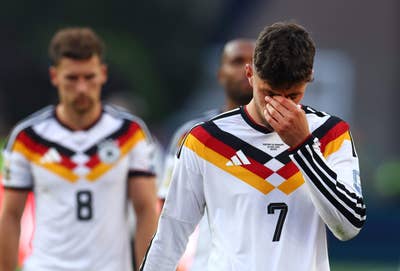
Germany’s early elimination from the World Cup means that we have to be really honest.
We beat Curacao. They played well and were an asset to the competition, but they were not an opponent for us to measure ourselves against.
We lost to Ecuador, and even the win over the Ivory Coast only came through a substitute, against an opponent we had advantages over. Then came defeat by Paraguay on penalties in the round of 32.
Across the whole tournament, there was no stable, structured team performance from Germany. No sense of a path we were actually trying to take towards success. For a country with our footballing history, that is not enough.
The comparison with the best is sobering. Spain have had a clear footballing philosophy for almost two decades and keep winning with it. France produce run after run; the idea of them going out early is close to unthinkable. There is a plan, a style, and authority and leadership from the technical area.

Argentina, for me, is the model. They built a team around a world-class player and his gifts so completely that Lionel Messi, even at 39, is still in a category all of his own in world football. It comes down to using your resources intelligently.
Brazil, under Carlo Ancelotti, provide an example of a coach knowing his nation’s identity and capitalising on it, even without the once-in-a-generation individuals they had in the past.
Right now, we, the Germans, cannot measure ourselves against any of these nations. The deeper difference has a name: continuity.
For the top teams, the way of playing doesn’t keep changing. Brazil have fielded the same core for years. France line up in more or less the same shape, and their wide players don’t cling to the touchline — there is movement. Spain play like Spain: possession, two genuine wingers, the ball worked into one-on-one situations, again and again.
We, by contrast, don’t put our players in the positions where they can shine.

Why did Germany go out against Paraguay?
At the simplest level, because there has been no continuous development. A tournament team grows beyond the qualifiers — it takes on a face, a strength, an identity. Everyone knows the role they fill, and it gets stronger from match to match. That growth was never visible with us. Going out was the logical consequence.
Advertisement
You only move a block like that with movement, by playing right to the byline and becoming dangerous from there, the way that teams with genuinely clear philosophies do it. We were too slow, too predictable. Our football was running on rails.
Leroy Sane was left isolated on the right for long stretches. He got the ball, dribbled, rarely beat his man, came back inside, maybe crossed, but there was no shot at the end of it. If nobody runs beyond him, if nobody breaks into the space created with urgency, such wing play leads nowhere.
And no — this did not come down to the referee. The disallowed goal was a harsh decision, and to my mind a wrong one, but you cannot let the night hang on that. You have to settle the game long before it comes down to a single moment.

This is not our first failure. It happened in 2018, 2022 and now again. Why? The honest answer is uncomfortable.
We keep treating the symptoms. We change the system, the line-up, the players’ positions, far too often. We are in a permanent debate about how Germany actually wants to play. And yet Germany was always at its strongest when it took the individual quality it had, married it to a robust, assertive mentality, put its best players on the pitch and forged them into a real unit. That is exactly what is not happening.
You need a core group to take responsibility. A group of players that always play, and do so in their usual positions. For me, that means Joshua Kimmich in central midfield, Kai Havertz up front and Florian Wirtz behind him in the centre. You stick to that, rather than looking for a new idea during every international break.
We won, in the past, when the profiles were defined, the hierarchy was stable, and the team subordinated itself to an idea. That conviction — this is how we play — is what is missing. Instead, we argue endlessly: one day it should be a possession game, the next it’s a fast, direct game. Until that basic question is answered, we will not be consistently good again.
With Julian Nagelsmann, the idea was to hand a young coach real responsibility. At 38, he was the youngest manager at this tournament. To grow into the role of national team coach is an enormous challenge, and at that point you have to ask yourself honestly: am I the right man for this? Can I carry the responsibility?
My sense is that the fit isn’t there yet. Part of it is the outward demeanour, towards the media in particular. A national coach has to come across with more composure.
The deeper aspect is that he isn’t settled in his own conception of the game. He has a dream of how football should be played and the reality looks different. Possession-based football simply doesn’t work for this team — he has neither the players nor the mindset for it.

You have to start from the options you actually have. How do I win a match with these players? How do I get the ball forward more quickly? That fast game, played into the space with lots of movement, was the signature of German football in the good years. Instead, it is supposed to be possession now, and every part of the game is too slow.
You could see the absence of a clear plan in the smallest details, with almost every substitution. With many of the changes, I simply couldn’t follow what the coach actually wanted. In central midfield, the ball came forward with no urgency and too often only sideways. The German DNA — that quick ball forward, the deep running — was missing entirely.
I would have set up differently. Wirtz through the middle, where he can move freely and play his passes into space, as he did at Bayer Leverkusen, because out on the flank he was lost. Kimmich in midfield, where he belongs, rather than at right-back. And I’d want a genuine defender at the back, someone who is hard to get past.
Advertisement
As for a successor, I won’t put a name to it here. The more important question comes first: German football has to decide how it wants to play.

Are we Spain? Are we Argentina? Are we France? No — we are Germany, and we play our own football. We should return to our own identity, and we should do so with conviction. It is our way, our own culture, and we must not forget it.
Only once that is settled can we address the issue of who embodies this idea, who can build the team around it, day after day. That might be a new figure. But the order matters: first the way we want to play, then the coach who fits it. Reverse those two steps, and you are once again treating the symptom instead of the cause.
There are bigger challenges here, too.
The first is a habit that has quietly disappeared from our game: defending. German defenders used to have a different reputation: genuinely difficult to beat. That is gone, and not only with us. This tournament has produced goals at a rate we rarely see, more than three a game on average. Everyone says the attacking has got better. I see it the other way round: the defenders have got worse.
The defending itself — the duel, the timing of the tackle, throwing yourself into a challenge — is barely being coached any more in Germany or hardly anywhere else, apparently. When you watch how the South American players throw themselves into their duels, you see the difference at once.
The second is one I keep returning to again and again: identity. That is what we have to rebuild: a distinctive idea of how we want to play, cultivated patiently over years, from the Bundesliga clubs right up to the national team. That is not a matter of luck; it is a matter of conviction. Of deciding how we want to act, and then coaching it across the breadth of our game.
First, the idea. Then everything else. That will allow a football we recognise as our own to grow back. Restoring that matters far more than any single appointment.