
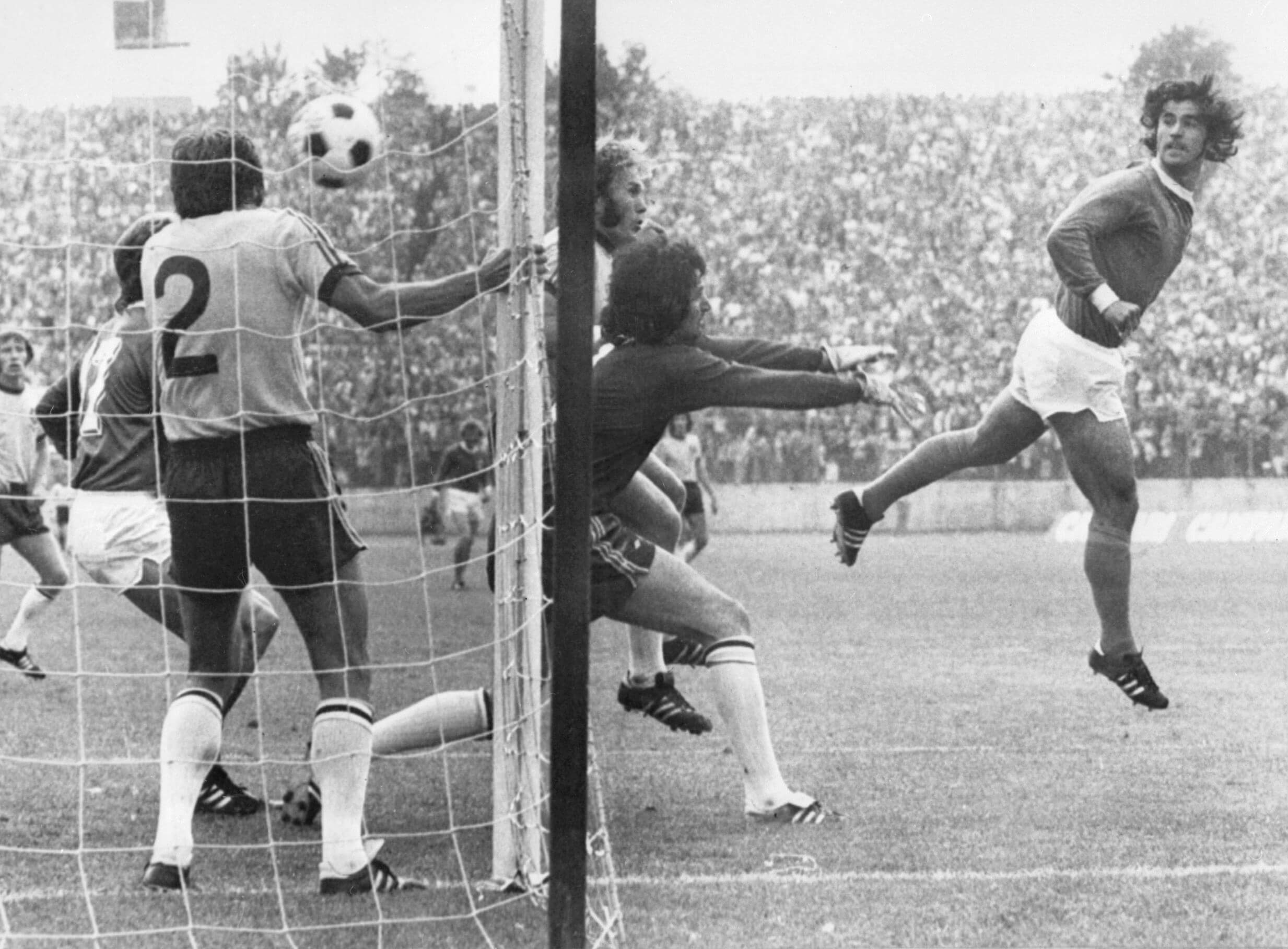
As part of our buildup to the 2026 FIFA men’s World Cup in the United States, Canada and Mexico, we are publishing excerpted chapters from The Soccer 100, The Athletic’s definitive book on the 100 greatest players of all time, courtesy of HarperCollins Publishers.
The 10 players we are featuring are the highest-ranked World Cup winners of our 100. Today, it’s the prolific striker, ranked 13th in our original list, who scored for West Germany in the 1974 final.
There is one thing every footballer in this book has in common.
It’s a bit technical, so apologies for blinding you with jargon here, and please don’t feel too bad if you don’t completely follow, but here it is: They’re all really good at football.
Well, that’s sort of true. It depends on what you mean by “really good at football.” One of them did not boast the same skill or grace or innovation or mystery or fantasy as the others. He wasn’t so much really good at football, but really good at scoring goals. Are those two things different? Maybe not. But Gerd Müller made up for not being stellar at the other stuff, the things we often talk about when we talk about the “greats”, by being maybe the best there ever was at the game’s most fundamental task.
Here are a few statistics.
He scored 365 goals in 427 Bundesliga games.
He scored 40 in one season, a record that stood for five decades.
He scored 85 for club and country in one calendar year.
He scored 68 in 77 European matches.
He scored an astonishing 68 in 62 international appearances for West Germany and would have managed many more had he not retired from the national team in 1974, aged 28, after the German federation banned the players’ wives from attending the post-World Cup victory celebration banquet.
Among those international goals, he scored 14 over 13 games at two World Cups, a record that stood for 32 years until it was broken by Brazil’s Ronaldo in 2006.

He made it into double figures for league goals in each of his 14 full seasons with Bayern.
He can be forgiven for the only time he managed fewer than 10 league goals in a campaign with the club — Müller scored nine in 19 games in the first half of the 1978–79 campaign before moving to Fort Lauderdale Strikers in the United States.
Advertisement
Goals were his obsession, and it was the what rather than the how that consumed him. The method of the conversion did not matter, but the result did.
Müller would score by whatever means necessary: tap-ins, scuffed shots, headers from three yards out, in off the thigh, the shins, the torso, scooped in from the floor, left foot, right foot, head — whatever body part could propel a football over that line.
If you watch clips of Müller’s goals, one of the things you’ll notice is how often he just seems to… emerge. And then score. The ball will disappear into a melee of defenders, only for Müller to suddenly appear, completely free, like a cartoon character calmly stepping out of a cloud of flailing arms and legs. He appeared to have an ability to be in the right position to score, and often you weren’t entirely sure how he arrived there.
It’s pretty hard to explain how he did it. Some attribute it to his short, stocky frame, thus allowing him to have a low centre of gravity to wriggle away from hulking defenders, but also with the strength to muscle his way into advantageous positions. He had thighs like beer barrels and calves like hams, giving him the sort of power you might not expect from a relatively diminutive man.

The most appealing, perhaps romantic, explanation for why he was so good is that it was something intangible. He could, in the traditions of the great goal poachers, smell opportunities. It all just happened. He just… knew. “You can’t learn that,” he said in a documentary produced by the Bundesliga. “You just have to have the instinct to score goals.”
Müller’s single-season Bundesliga scoring record of 40, set in 1971–72, was thought for decades to be insurmountable. In fact, between him setting it and Robert Lewandowski establishing himself as an elite striker in the mid-2010s, the only other players even to break 30 goals, never mind come close to the record, were Jupp Heynckes in 1973–74 and Dieter Müller (no relation) in 1976–77.
When it became clear that Lewandowski was going to break the record, as he did by scoring an extraordinary 41 for Bayern in 2020–21, it felt like there was a move in the German footballing consciousness to preserve Müller’s status as still the greatest striker their league had ever seen.
“Robert’s definitely a great striker, but he didn’t score goals like Gerd, with his shin, his chest, or his knee,” Uli Hoeneß told Bavarian newspaper Münchner Merkur. “Gerd didn’t care less how he got the ball in. It just had to go in any which way it could. Robert hammers it into the back of the net, but, with Gerd, sometimes the ball would just stop an inch over the line.”
That wasn’t just an old friend of Müller trying to protect his legacy. “In terms of efficiency, he’s second among the best-ever strikers of Bayern’s history after Gerd Müller,” Lewandowski’s Bayern team-mate Thomas Müller told newspaper Sport Bild.

It felt like Lewandowski was as keen as anyone to defer to the great man: When he scored his 40th, equaling the record, he lifted up his Bayern jersey to reveal a T-shirt underneath with Müller’s face and the message “4ever Gerd.” There was a poignancy to the fact that, while Müller was alive when the record was broken, he was in a care home, suffering the last few months of the Alzheimer’s disease that would eventually claim his life.
Müller’s record-setting season was part of a record-setting year: In 1972, he registered a whopping 85 goals in 60 games for club and country, a mark that held until no less a man than Lionel Messi managed 91 in 2012. (Kids, if you’re reading this having previously not known much about Müller and take just one thing away from this section of the book, let it be that it took 40 years and the greatest player of all time to eclipse the German.)
He didn’t just score goals in quantity, but also quality — not in terms of them being spectacular strikes that would make golazo compilations for years to come, but crucial goals, high-pressure goals, trophy-winning goals.
He scored four in various German cup finals for Bayern, and three in two different European Cup finals; two in the 1972 European Championship final for West Germany; and, of course, their winner in the 1974 World Cup final. You can also throw in two in the “Game of the Century” — the 1970 World Cup semi-final that West Germany ultimately lost 4-3 to Italy, plus two in the 1972 Euros semi-final against Belgium and four in the two-legged 1967 Cup Winners’ Cup semi-final against Standard Liège of that same country, which Bayern would win and then go on to claim their first European trophy.
Advertisement
Which is to say that his goals didn’t just make for impressive statistics, but made his country continental and then world champions, and his club among the biggest in Europe. Or, as Beckenbauer put it while giving a speech at Müller’s 50th birthday party: “Without Gerd Müller, we’d probably still be in the wooden hut that was once our clubhouse. He’s the most important player in the history of Bayern.”

The noble art of goal-poaching is often treated a little sniffily, but consider the following: Müller scored 14 World Cup goals for West Germany across the 1970 and 1974 tournaments.
Here are short descriptions of all of them: heads in a rebound off the crossbar from two yards out; turns home a low cross from about four yards; a penalty, high into the top corner; a header from a right-sided cross from about 10 yards; brings down a ball from deep on his chest, pokes in from seven yards; converts a low cross from six yards; header from seven yards; hooked in from three yards; bundled over the line from two yards; header from four yards; near-post header from five yards; miscontrol, then scooped in while on the floor from four yards; low finish from 13 yards; miscontrol, then steps back and scores from eight yards.
Obviously, the distances are all rough estimates, but from those descriptions, the average gap between Müller and the goal was about 6.2 yards. He barely needed to leave the six-yard box. Helmut Schön, the manager of West Germany at both those World Cups, famously described him as being “a man of small goals”. Again, that was not intended as an insult.
Take the winner in the 1974 final, which you can look at in a couple of ways: either as a stumble, a piece of opportunism, or a man mopping up his own mistake, having allowed the low cross to skew off the side of his boot. But watch it again with softer eyes and you may instead see a man showing incredibly quick reactions, followed by extraordinary strength to change direction so rapidly, implausible balance to avoid falling on his backside, and then great poise and finishing ability to shoot low into the corner, giving the goalkeeper no chance.
And you could go through plenty of his goals and give them similar treatment.
Just because they were from close in — or were not necessarily from chances created by him, or are not your typical screamers — does not mean they lack beauty or skill.

One thing that has sprung to mind repeatedly while considering all of the incredible names in this book is whether the great players from the past would be superstars today. Talents such as Johan Cruyff, Michel Platini, Pelé, Marco van Basten: It seems inconceivable that if they were born at the right time, with the advantages of modern training, nutrition, and so forth, they wouldn’t have been just as great.
Advertisement
With Müller, though, you’re not so sure. There isn’t much space in the modern game for someone who does not offer a huge amount other than goals, as absurd as that sounds. Maybe he would have adapted, but it feels like he existed in an era suited to him.
Müller makes for a pretty lousy highlights reel. There aren’t many stories about spectators lining up to gasp at his genius, few misty-eyed recollections of the time he made opponents look foolish. He wasn’t a meme-able footballer, nor one for whom a compilation of his best skills will blow up on YouTube.
He didn’t change the game. He didn’t innovate in the way that his contemporaries, Beckenbauer or Cruyff, did. He didn’t have a “move”. There’s a tendency toward over-intellectualising players like that, but not with Müller, which might explain why he often isn’t mentioned in the same breath as some of those other greats.

Yet you could make a strong argument that he was the greatest pure footballer of all time because he was among the best at doing the purest thing the game has. There are so many things to find pleasurable in football: a brilliant piece of skill, a great pass, a crunching tackle, a player effortlessly controlling the game, a dummy, a subtle touch here and there. But ultimately, the point of it all is to score goals. You win games, and thus attain glory, by scoring goals. Gerd Müller scored goals.
In fact, his contribution to the language of football, in Germany at least, was to lend his name to a verb, but it wasn’t something unique to him: to müllern means to score. Which says it all, really: He was so associated with the scoring of goals that his name was not given to a turn or a trick or a position. It was bestowed on the most fundamental element of the sport.
Excerpted from The Soccer 100 by Oliver Kay & James Horncastle with The Athletic Soccer Staff, published by William Morrow. Copyright © 2025 by The Athletic Media Company. Reprinted courtesy of HarperCollins Publishers.