
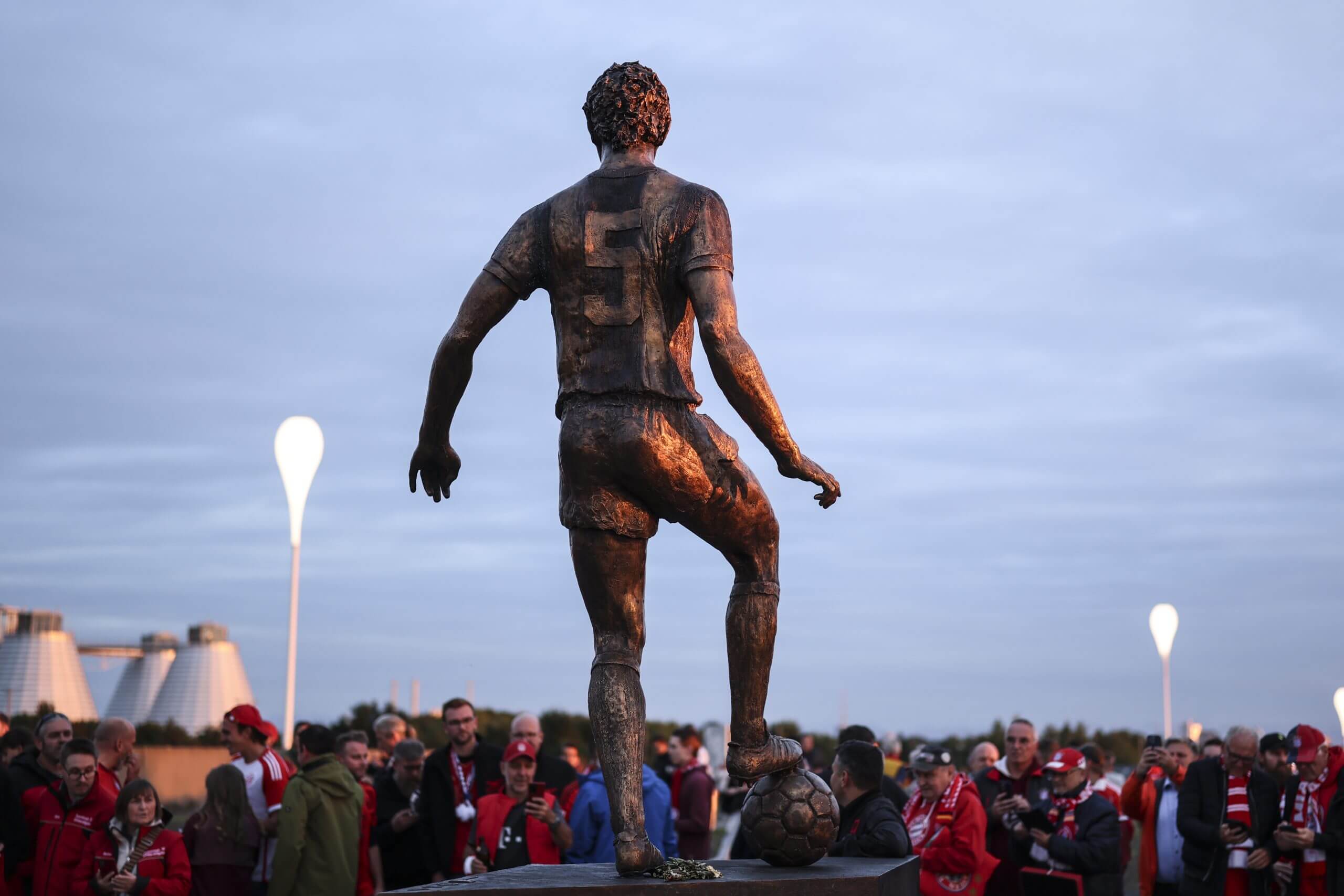
As part of our buildup to the 2026 FIFA men’s World Cup in the United States, Canada and Mexico, we are publishing excerpted chapters from The Soccer 100, The Athletic’s definitive book on the 100 greatest players of all time, courtesy of HarperCollins Publishers.
The 10 players we will feature are the highest ranked World Cup winners of our 100. Today we feature one of the greatest to ever wear the Bayern Munich and West Germany shirts.
If you subscribe to the multiverse theory — the idea that every decision we make splits the world into different universes: one where we turn left, one where we turn right — then somewhere in the infiniteness there is another reality where the biggest club in Munich is not actually Bayern, but 1860.
The split may have occurred during a Bavarian junior football tournament in 1958.
A young striker was playing for his team, SC Munich 1906, but the word was that the club was struggling to find the money and coaches to continue with all their teams the following season. A group of the players thus planned to move to 1860, who were the biggest club in the region at that time and who they just happened to be playing in the final of the tournament.
The game was ill-tempered and the striker in question became embroiled in an altercation with an opponent. The 1860 player ended up giving the forward a slap around the face.
And that, the story goes, is how Franz Beckenbauer decided to snub his local side — the one he grew up supporting and whose forwards, Ludwig Zausinger and Kurt Mondschein, he so idolized — in favor of Bayern.
There is almost certainly a good degree of mythmaking to the tale. It was one Beckenbauer was fond of telling and a few different people have claimed to be the deliverer of the slap over the years. But whether the truth is that neat, or whether there was more nuance, his decision changed the course of German, European, and maybe even world football history.
Is that an exaggeration? Perhaps, but Beckenbauer’s impact on the game shouldn’t be underestimated.

He wasn’t just a brilliant player. There are loads of brilliant players. Another 99 of them in this book, for starters. Very few are brilliant players and invent things that change the game. But Beckenbauer was and did.
Advertisement
Maybe it is also a slight stretch to say that he invented Bayern as we know them today. But when he made his first-team debut for them in 1964, they were the second-most-popular team in Munich and were in the German second tier. They were promoted the following season, won the DFB-Pokal the season after that, claimed the European Cup Winners’ Cup in 1967 and their first Bundesliga title (along with the DFB-Pokal again) in 1969, and were three-time European champions by the mid-1970s.
Beckenbauer was captain for a lot of this, and although coaches like Udo Lattek and Branko Zebec were clearly influential and players like Gerd Müller, Sepp Maier, and Paul Breitner had comparable impacts on the pitch, only one of those men earned the nickname “Der Kaiser”.

Unless something implausible happens between the writing of this book and whenever you are reading it, they will almost certainly remain the biggest club in Germany for some time to come.
And he was always keen to take the credit for it. “Lattek should have been grateful to me,” he wrote in one of his autobiographies, published in 1975, about the success that had been built at Bayern by the early 1970s. If you want an idea of how much he was deferred to at Bayern, regard what Müller, the greatest goalscorer in Bayern and German history, told Bild in 1971. “I will always be in Beckenbauer’s shadow,” he said. “At some other club, I would have the chance to be the number one.”

Beckenbauer also invented a position.
The Italian interpretation of the sweeper, or libero, was purely as a prophylactic; the player who sat behind the defense and swept up any lingering attacking threats, the last, last line of defense after the last line of defense.
His version of the position was rather truer to the literal translation of the word libero, which is Italian for “free” or “independent”. Beckenbauer was initially a slightly flighty forward who was moved back into midfield by a youth coach concerned about how often he was kicked up in the air by ruffian defenders. When he arrived at Bayern, he was moved even farther back in part because of his slightly bratty nature. The theory was to teach him some responsibility and teamwork. And it paid off.
Beckenbauer was initially more of what we would now term a deep-lying midfielder, but back in the 1960s, the role was very much viewed as part of the defense. He realized that with nobody specific to mark, he could have a bit more freedom than most defenders. He took inspiration from the Italian left-back Giacinto Facchetti, who would often storm forward down the flank, but Beckenbauer realized that while Facchetti was limited by the constraints of his position on the flank, from the middle he could essentially go anywhere if he wanted to.
And he did, roaming forward and starting attacks at will; a defender with a forward’s spirit.

The role became so closely associated with him that he starred in an odd 1973 film — called Libero — that was part fiction, part documentary about his life and career up to that stage. Alas, the film wasn’t so much panned as utterly ridiculed when it came out and there were rumors that Beckenbauer tried to buy every copy of it so they could be destroyed. If he did try, he wasn’t successful. You can watch all deeply curious 79 minutes of it on YouTube.
Still, while the film sank without a trace, the position after which it was named very much did not. It never really caught on properly in England, but it took hold in Germany to the extent the national team played with a libero pretty consistently until the early 2000s, with either specialists like Matthias Sammer or aging players who dropped back, like Lothar Matthäus.
And it made him one of the greats. The men’s Ballon d’Or tends to be the preserve of the attacker, the fantasista, the player who gets us out of our seats. That is perfectly logical. The ultimate point of football is to score goals, so why should we heap praise on the nerds trying to stop them? As such, at the time of writing, only four goalkeepers or defenders have been bestowed France Football’s shiny orb since the first in 1956: Lev Yashin, Sammer, Fabio Cannavaro, and Beckenbauer. Der Kaiser is the only one to win it more than once.
This is partly because he was so good, but also partly because he had many of the elements of the attackers that more naturally catch the eye. He wasn’t just some meat-and-potatoes center-back who headed and cleared and tackled. He was elegant and upright, a defender who incorporated the bits of football that we do find fun.

That’s just the stuff he did as a player.
His career ended slightly limply. He moved to the United States in 1977 to join the nascent North American Soccer League, where he took over from Pelé as the jewel in the crown of the defining club of that era, the New York Cosmos. That move was not inspired by the spirit of invention, or to expand into football’s new world, but was largely motivated by a need for money to pay a colossal tax bill.
Advertisement
The negotiations to take him to New York were tough and resulted in Beckenbauer having to give up some of his $2.8 million (£2.1 m) salary to grease the wheels with Bayern, who were stubbornly holding out for a decent transfer fee. That meant his farewell was low-key, as Uli Hesse outlined in his biography of the player, The Three Lives of the Kaiser. “There was not even a lap of honor, let alone plans for a testimonial. Beckenbauer had even declined the offer of a banquet in his honour with a scathing riposte: ‘If you have to part with 350,000 deutsche mark to get away from the club, you can pay for your own dinner.’ ”

He returned to West Germany for an underwhelming spell at Hamburg, but his next significant contribution to the game would come on the international stage.
The failure to make it out of the group stage at the 1984 European Championship had produced mass national handwringing and a nation turned its lonely eyes to Der Kaiser. Coach Beckenbauer duly took West Germany to the final of the 1986 World Cup, where they lost to Argentina. But he went on to become the second man to lift the trophy as both a player and a manager (Mário Zagallo did it in 1970 and Didier Deschamps would join them in 2018) when Andreas Brehme’s penalty won a truly turgid final in 1990 against the same opposition.

National treasure status assured, then? Well, yes. Mostly.
Beckenbauer was, broadly speaking, admired as not just his nation’s greatest-ever player, but as a footballing statesman. The sort of person whose words could make even preeminent figures stop in their tracks. “It feels great he speaks positively about me,” Jürgen Klopp told the media after Beckenbauer praised his work at Liverpool in 2019. “It is just like the king with his sword calling a man ‘sir.’ ”
Yet, oddly, despite being widely admired and adored by the majority of the German public for most of his life, Beckenbauer still carried a minor chip on his shoulder. The sense that he could be loved more.
In his autobiography, Beckenbauer spoke about the affection given to many other German football heroes. “Even the fans in Munich never cheered me the way people in Hamburg cheered their Uwe Seeler … these are men everyone can relate to. People have the impression that this player is one of them. Sadly, this is not the case with me.”
Advertisement
You can read this a few ways. One is that Beckenbauer really did never truly receive the adoration from the broader public. Or that his complaints are just human nature: People always want something they do not have and the different sort of affection the public held for those other players was what he wanted. Another is that this was just a thinly veiled excuse for a humblebrag, that he knew he was an impossible man to relate to because he was so otherworldly. He didn’t exist on the same plane of reality as everyone else.
His nickname was Der Kaiser. How do you relate to an emperor?

He was also the symbol of Bayern, the most loved and the most hated club in Germany until RB Leipzig arrived on the scene to take ownership of the latter crown. Bayern’s combination of arrogance, superiority, and unrelenting success made them a target for ire by the early 1970s and that has continued to this day.
Another, less generous interpretation of why perhaps not everyone loved Beckenbauer was his relationship with money. The tax bill in the 1970s was one thing, but in later years he was implicated in a few different scandals connected to various World Cup bids. In 2016 he was sanctioned by the FIFA Ethics Committee for initially not cooperating with a corruption inquiry. He was questioned over payments linked to South Africa’s bid for the 2010 tournament, which he said were consultancy fees. He denied taking bribes from Qatar and Russia in connection to their World Cups, investigations that were curtailed in 2021 because the statute of limitations had expired.
The thing is, do you really think of those things when you contemplate Beckenbauer? Perhaps we should, but when he died in 2024, most of the obituaries glossed over any question of impropriety, partly because of the “don’t speak ill of the dead” rule, but also because his contribution to the game over previous decades ensured that most people overlooked all of that.
Should that be the case? The pure of heart and soul might suggest not, but it was. It would take more than that to taint the name of Franz Beckenbauer.
Excerpted from The Soccer 100 by Oliver Kay & James Horncastle with The Athletic Soccer Staff, published by William Morrow. Copyright © 2025 by The Athletic Media Company. Reprinted courtesy of HarperCollins Publishers.