
It was Bear’s big chance to make his mark on the World Cup stage. New Zealand goalkeeper Oli Sail held him close and whispered words of reassurance: “Alright, Buddy. Your moment to shine.”
Bear went straight towards the ball, licked it and veered off in the other direction. Sail offered words of encouragement, but they were ignored. Bear looked out of his depth, unsure which way to go.
Then, to the shock and hilarity of those watching on TV at home, it happened.
“Oh, he’s pooing on the floor!” shrieked Tova O’Brien, one of the presenters, bursting into laughter.
“Don’t stand on it!” an embarrassed Sail shouted.
Bear, the goalkeeper’s 12-week-old golden retriever-poodle cross, looked confused. Sail intervened, picked him up and plonked him down in front of the two bowls marked with different flags. Which would he choose?
“He’s going for New Zealand!” shouted Chris Chang, O’Brien’s co-host.
From that, the presenters of New Zealand’s Breakfast show concluded that their national football team would kick off their 2026 World Cup campaign with a win against Iran — but that it would not be straightforward. Perhaps a late winner, Chang mused. Maybe they would have to overcome a red card.
Get free access to the most comprehensive World Cup coverage in The Athletic app
View this post on Instagram
Well, like Bear’s TV debut, it wasn’t plain sailing. New Zealand ended up taking the lead twice but drawing 2-2. Bear had certainly made his mark on the stage, but his career as a World Cup mystic was over before it had begun.
Ritinha, a sandbar shark at an aquarium in Rio de Janeiro, also came up short. She dutifully swam to the Brazilian flag before their opening game of the tournament, only for them to draw 1-1 with Morocco. Ritinha made it second time lucky, backing Brazil to beat Haiti in match two, but by then her credibility was gone.
At the zoo in Guadalajara, Mexico, one of the 2026 tournament’s 16 host cities, a gorilla, a puma and a capybara have all had a go. The best of them was Ashanti, an African elephant who got the locals onside by correctly backing Mexico to win their first four games before letting her heart rule her head before the round-of-16 meeting with England.
Advertisement
But did Ashanti truly capture attention? No. Did she face death threats from fans of those teams whose colours she had dared to overlook? No. Has she been offered a book deal, attracted a six-figure “transfer bid” from a Russian bookmaker or been described by the president of Iran as a symbol of Western decadence and decay? Again, no, no and no.
When it comes to this bizarre World Cup tradition, Paul the Octopus remains unsurpassed.
In the eyes of most, the 2010 World Cup was not a classic edition of football’s biggest competition.
It started with a bang, with Siphiwe Tshabalala scoring a famous goal for hosts South Africa against Mexico in the opening match to a soundtrack of vuvuzelas and Shakira’s tournament anthem Waka Waka, but it soon began to drag.
Goals were at a premium (an average of just 2.1 per game in the group stage) and many of the star players were struggling to make an impression.
Perhaps that is partly why the story of Paul the Octopus gained traction.
A couple of days before the knockout phase began, it emerged that an octopus at an aquarium in Oberhausen, Germany, had been “predicting” the outcome of World Cup matches by choosing to eat mussels from one of two boxes. One was marked with the German flag, the other with their opponents’ flag.
As a publicity stunt, it had been done before. What was different was that Paul kept getting it right.
He had not only backed Germany to beat Australia and Ghana in the group stage but, far more impressively, had predicted their shock defeat by Serbia. Beyond that, staff at the aquarium said he had got five out of seven predictions right during the European Championship two years earlier. Now he was backing a young, inexperienced Germany team to beat England in the World Cup’s round of 16.
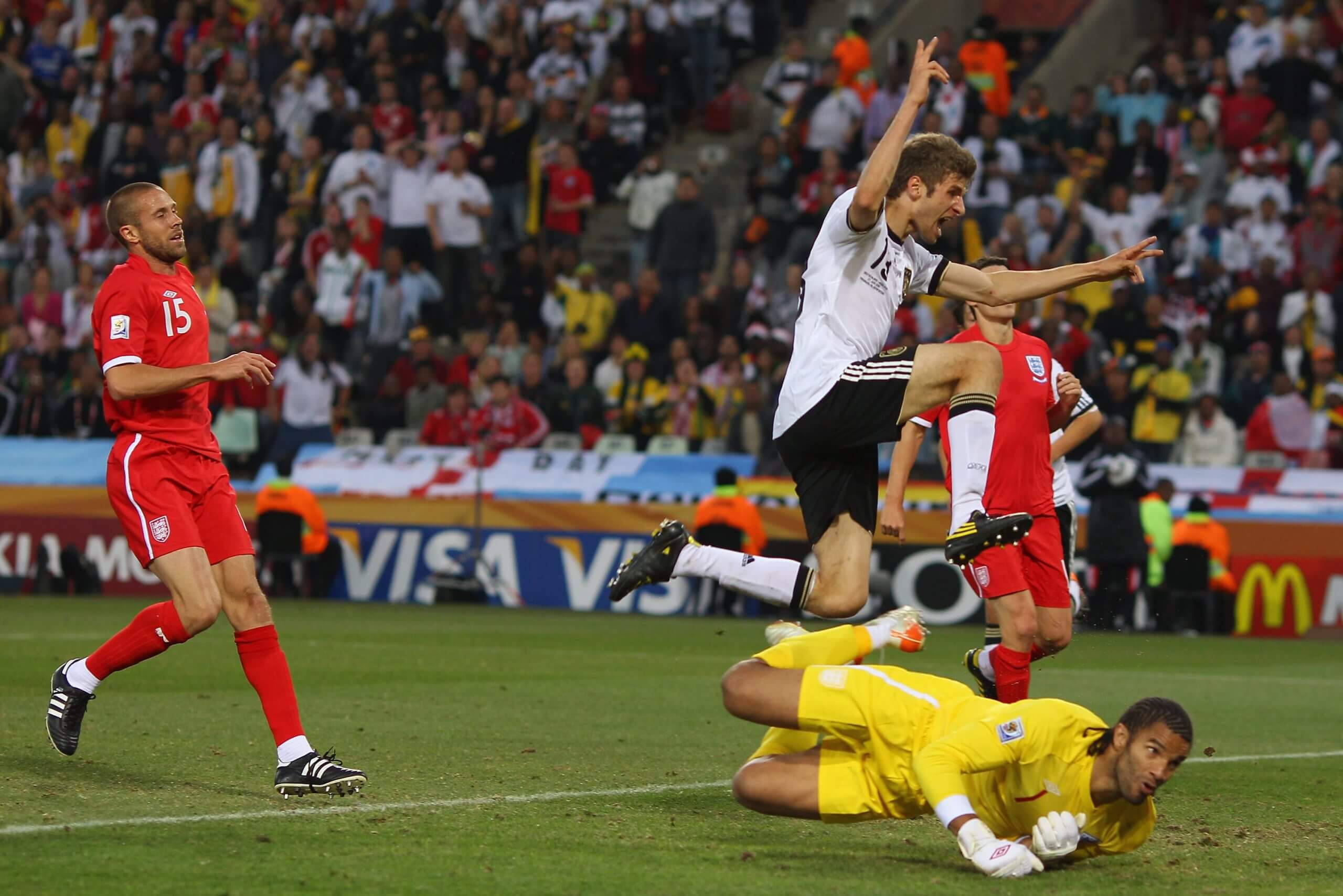
Germany’s biggest-selling newspaper, Bild, picked up the story, as did some of the British tabloids, who called Paul a traitor — the Sea Life aquarium chain said he had been born two years earlier at their site in Weymouth on England’s south coast before being transferred to the Oberhausen branch in 2008. Traitor or not, he was right; Germany thrashed England, 4-1.

“From that moment on, the story took on a life of its own,” Tanja Munzig, who was the aquarium’s marketing manager at the time, tells The Athletic. “A momentum built up that was beyond our control.”
Advertisement
Munzig and a small team in Oberhausen were inundated with media enquiries, all demanding more information about Paul and his next predictions. There was coverage all over the world, even if everyone knew it was just a bit of fun… didn’t they?
“What remained a charming, light-hearted story for us was taken surprisingly seriously by many people,” Munzig says. “That’s what fascinated me most. Nowhere else do joy and disappointment lie so close together as during a World Cup. With every prediction, Paul became a lucky charm for some and a bearer of bad news for others. These emotions are what made the story so extraordinary. It showed the power football can unleash and how deeply it connects people around the world.”
Before the quarter-finals, a crowd of reporters, photographers and video journalists converged on Oberhausen and crowded around his tank to see whether Paul would opt for the mussels in the box with the Germany flag or the Argentina one.
After a nerve-racking 64-minute wait, Paul went for the German box. There were cheers among the assembled media. And there was a backlash from Argentina, where a TV chef proposed “catching him, beating him to make the meat more tender and then putting him in boiling water”. The aquarium found its email inbox bulging with “threats” from Argentina. It responded by increasing its security measures. And Germany won, 4-0.
“By now, it was really exploding,” says Thomas Reinecke, a German public relations adviser who helped Sea Life come up with the idea of a psychic octopus.
“We were thinking, ‘This is really unbelievable’. We started thinking, ‘Is it because of the colour of the flags? Does it depend on which side we are putting which flag?’ We tried all kinds of experiments to see if we could work out what was behind it.”

So there was no manipulation? No way of encouraging Paul to pick Germany more often than not?
“No! It would have been cool as hell if we had known who was going to win the next game and then managed to get him to move in the right direction,” Reinecke says. “But it was just luck.”
Munzig expresses a sense of wonder.
“If he had been wrong at any point, the story would likely have ended quickly,” she says. “But he got prediction after prediction right.”
Dr Jennifer Mather, a comparative psychologist at the University of Lethbridge in Alberta, Canada, remembers the Paul story clearly, recalling how, all of a sudden, more people suddenly wanted to ask her about octopus intelligence, something she has spent more than 40 years studying.
“I found it… somewhere on the intersection of amusing and silly,” she says. “But it’s nice that we have such an interest in the animals we share the planet with. And what I have to say is that octopuses are terrible for people who think they have an understanding of learning theory. If you’ve got an animal that’s as different as an octopus, there’s a pretty good chance you don’t understand what it’s seeing.”
So what does Dr Mather feel was behind Paul’s success?
“There’s a galaxy of possibilities,” she says. “But the first thing to say is that, believe it or not, octopuses do not have any knowledge whatsoever about the World Cup. That I can say categorically. Also, the common octopus can’t distinguish colour, so I don’t believe this octopus was responding to the flags on the boxes.”
She proposes a range of factors that might have guided his “predictions”: 1) he was reacting to different chemical cues, perhaps from the boxes or the live mussels within them; 2) in keeping with the “Clever Hans” theory (relating to a horse in Germany that appeared able to solve basic mathematic problems), Paul was somehow responding to subconscious cues from his handlers, 3) because he felt a sense of “reward” when he found his food, he was often likely to return to the same place the next time, 4) but that, being an octopus, his curious nature (“as what we call a ‘switch’ forager rather than a ‘stay’ forager,” she says) was always likely to lead him to explore different options if indeed he could perceive those differences.
Because Paul was only choosing between two boxes, with no “draw” option, the probability of getting those five results correct was 3.125 per cent (i.e. 1 in 32). It was akin to predicting five coin-tosses correctly, and several statisticians quoted at the time pointed out that, given that there might have been 30-plus animals performing the same stunt unsuccessfully in various zoos and aquariums around the world, it was not altogether improbable that one might go on a winning streak.

But people were hanging on to Paul’s predictions. Some were waiting to see which way he went and then betting on that outcome. Some bookmakers, also not shy of publicity, announced they were adjusting their odds accordingly.
Advertisement
By the time of the semi-finals, Paul-mania was at fever pitch. TV news channels across the world screened his “divination” live as the sense of anticipation built up.
To widespread shock and looks of concern among the German reporters, Paul opted for the mussels from the box with the Spanish flag. And one day and one bullet header from Carles Puyol later, he was proved right — as indeed he was when he backed Germany to beat Uruguay in the third-place play-off and Spain to defeat the Netherlands in the final. Andres Iniesta, scorer of the only goal in that final, even referenced him in a post-match interview.

Paul had done it: eight out of eight.
The probability of such a run was 0.39 per cent (i.e. one in 256). And given that one of those results was a surprise victory for Serbia against Germany, bookmakers suggested that an eight-game accumulator from a $10 bet would have yielded a profit of $1,400.
Paul was a phenomenon. People began to joke that he would need an agent.
“Yes, I was Paul’s agent,” says Chris Davis. “I was doing some work with Merlin Entertainments, which owns Sea Life, and they were getting inundated with requests, so they asked me if I would mind looking after this octopus. Well, what else could I say?
“It totally took over my life for about a month. It was 24/7. There were so many enquiries from so many companies. A newspaper offered €50,000 to use Paul for a full-page advert.
“But the really crazy offer was one we didn’t take. A big Russian bookmaker wanted to buy him. I’m fairly sure the price started at €100,000, and it kept going up and up. Every time, we had to tell them Paul wasn’t for sale. It was so, so peculiar, the whole thing.”
Davis had worked with several show-business clients, including renowned British magician and TV presenter Paul Daniels. So how did Paul the Octopus compare?
Advertisement
“Oh, he was the perfect client,” Davis says with a laugh. “Low-maintenance, well-mannered, didn’t need a car, didn’t need a rider. And he never said no to anything.”
But did Paul the Octopus, like so many overnight sensations, have a slippery past? Was the aquarium hiding something fishy? Did his story have hidden depths? Did the tentacles of…
Oh, on with the story.
On the morning of the 2010 World Cup final, with Paul-mania at its peak, a German newspaper ran a story that cast doubt on some of the aquarium’s claims.
Verena Bartsch, a conservationist, told Bild am Sonntag that Paul was the same octopus she had rescued from a fisherman’s trap off the coast of Italy three months earlier — and that he had arrived in Oberhausen, via an aquarium in Coburg in southern Germany, just before the start of the tournament.
Sea Life dismissed those claims, maintaining that, while they had indeed accepted delivery of an octopus from Coburg, it had since been moved on to another aquarium. They insisted Paul had arrived at Oberhausen from their Weymouth branch in 2008, when he had predicted results in the European Championship.
It is here that the story becomes confusing.
One source who worked in the Oberhausen aquarium at the time, speaking on the condition of anonymity because he still works in the sector, remembers feeling that Bartsch’s claims carried a ring of truth, not least because it is rare for a common octopus to survive in captivity for more than two years.
Reinecke recalls the controversy.
“I remember thinking, ‘What? Paul was born and raised in the UK, so what the hell are they talking about?’” he says. “But then later the client (Sea Life’s owner Merlin) told me that the original Paul had died between the European Championship and the World Cup, and they just bought a new one because they all look somewhat the same, so the story was indeed true.”
Advertisement
So there were two Pauls? One for Euro 2008 and one for the 2010 World Cup? Reinecke is not entirely sure. He says there was a vagueness about Paul’s backstory, that there were conflicting claims internally as well as externally.

Merlin Entertainment did not respond when invited by The Athletic to respond to Bartsch’s claims and the suggestion that the Paul who sprang to global fame in 2010 was not, as they had claimed, the same octopus who had been the subject of regional coverage in Germany during the Euros two years earlier.
The Sea Life aquarium in Oberhausen responded to The Athletic’s questions by saying that “Paul’s story continues to fascinate people, even after so many years”, but adding that “after 16 years, none of the staff members who worked directly with Paul or managed the campaign are still with us. For this reason, we are unfortunately unable to provide any further information for your research”.
Matt Fuller, who was Sea Life’s senior aquarist in Weymouth in the late 2000s, was approached by various media outlets in 2010 and was happy to say how pleasantly surprised he was by Paul’s success story since his transfer to Oberhausen. But he admits he was sceptical about whether it was the same octopus.
“I don’t know for sure — I wouldn’t say it was impossible — but I suspect there was a first one and then there was a second,” he says. “And I could understand that because, whenever any animal dies, you have to be careful and sensitive about relaying that information to the public.”
Munzig says she was not responsible for the transportation of animals or the documentation of their pasts, so she does not know for certain which of these conflicting stories is true.
“But Paul’s origins weren’t what made him special,” she says. “He became special because of what people saw in him and what grew up around him. And our wish was always for Paul to remain what he had been from the start: an extraordinary octopus and a charming story told with a wink.
Advertisement
“What I can say for certain is that Paul became a symbol of a very special summer of soccer for millions of people. That’s exactly how I want to remember him. Not for where he came from, but for the emotions he stirred in people across the globe.”

Not everyone was happy.
As well as that backlash from Argentina, there were reports that the Kazakhstan Association of Bookmakers had issued a statement blaming Paul for their small profits over the course of the 2010 World Cup.
Then came the response of Mahmoud Ahmadinejad, then the president of Iran, who was widely reported to have declared during a speech at a youth festival in Tehran that this octopus — and the fascination with it — was a symbol of Western decadence, superstition and decay.
The media circus began to move on, but the aquarium in Oberhausen continued to draw crowds through the summer holidays, with children particularly excited by the prospect of seeing the world’s most famous octopus.
As much as the aquarium cashed in on this unexpected surge, the marketing spin-offs — which had already been earmarked for charity — were even greater.
“There was a plush (cuddly toy) deal, a book deal, a coin deal, a game, an advert for a German supermarket,” Davis says. “It didn’t worry me ethically because the money was going to a wildlife charity — to look after turtles, I think — and we raised a considerable amount of money in a short period of time, which was nice to be able to do.”
Reinecke recalls a proposal from one of the world’s biggest aerospace companies and an enormous offer from what he thinks was a South Korean telecommunications firm.
Paul was made an “honorary citizen” of O Carballino, a Spanish town famous for its octopus (eating) festival. In recognition of his (reported) origins, he was even named as an ambassador for England’s highly unsuccessful bid to host the 2018 World Cup.
Advertisement
“Almost every day, something happened that left us speechless,” Munzig said. “We would often just look at each other and ask, ‘Is this really happening?’”
And then in the October, barely three months after the World Cup final, Paul was found dead in his tank. There was no mystery — no fingers pointed at vengeful Argentine fans or Kazakh bookmakers. He had passed away suddenly, as octopuses often do. “We were all mortified,” Davis says.
“When Paul died, I realised again just how many people he had touched,” Munzig says. “The outpouring from around the world was overwhelming. People laid flowers, wrote personal messages or came to Sea Life one last time to say goodbye.”
In January 2011, the aquarium unveiled a two-metre (6ft 6in) tall monument honouring Paul. It featured a huge plastic octopus draped over a football showing the flags of many nations, inside which was a golden urn, in the shape of an octopus lifting the World Cup trophy, that contained his ashes.

Next to it, staff set up “Paul’s Ecke” (Paul’s Corner), a display featuring memorabilia and newspaper clippings from all over the world, so that their most celebrated resident’s story and legacy would live on.
The aquarium said it would not seek a new “soccer-psychic”, that Paul was considered irreplaceable.
Looking back, the statements call to mind Pep Guardiola’s tear-stained tributes when Sergio Aguero, Manchester City’s record goalscorer, left the club in 2022. “We cannot replace him,” City manager Guardiola said, voice faltering. “We cannot.”
Staying nearby during the 2024 European Championship in Germany, The Athletic made the trip to Oberhausen with a future article on Paul in mind.
But there was no longer a monument on site, no reference to him whatsoever. Enquiries about Paul met with shrugs from staff members, though one said she believed the monument was now at the German Football Museum, around 25 miles away in Dortmund.
Advertisement
That museum happily confirms that its exhibits include the urn containing Paul’s ashes, along with various newspaper clippings telling his story. “But we don’t have any other object related to Paul,” says Nils Hotze, its head of marketing and communications.
So where is the monument? Britta Pfeiler, a spokesperson for Sea Life in Oberhausen, tells The Athletic, “Unfortunately, I have no information regarding the whereabouts of that memorial. However, the centrepiece was the small golden octopus containing Paul’s ashes, which has now found its place in the museum.”
Looking back, it was huge — not the type of thing you would ideally want in the middle of an aquarium, with crowds passing through. But it must be somewhere.
Regardless, Paul’s legacy lives on — and not just through those unsuccessful attempts to find a worthy successor.
Even last week, a guest on a football show on El Salvador’s Canal 4, while previewing this World Cup’s quarter-finals, could be heard telling the audience that “the only king of predictions is el pulpo Paul”.
«El único rey de predicciones el Pulpo Paul.»
Ya disponible el Episodio 02 de #Equipo49 en el canal de YouTube de Canal 4. @RexonaCam pic.twitter.com/e4lRQqGpQy
— Canal 4. (@Canal4TCS) July 8, 2026
For those who were at the heart of the story, the memories endure.
“I see the many faces gathered in front of his tank and the joy this story sparked,” Munzig says. “Above all, I feel gratitude for having been able to experience that extraordinary, intense time.
“And when I think of Paul today, Waka Waka plays in my mind, and the memory of a summer fairytale lives in my heart. I think of how a little octopus from an aquarium in Oberhausen connected people all over the world, how he thrilled and moved us — sometimes even dividing opinion — and how all of this unfolded at an aquarium that, for a few weeks, became a place where the world came together.”
There really was only one Paul the Octopus.
Or was there?