
When the U.S. men’s national team defeated Paraguay 2-1 last November in Pennsylvania, Mauricio Pochettino’s side was deemed to have turned the corner in its preparation for the 2026 World Cup. The victory was highlighted by a disciplined tactical performance and a bench-clearing scuffle with the typically physical and stingy South Americans. Pochettino was without a number of his stalwart stars, which added to the positive buzz.
For a team that had been criticized for its lack of consistent intensity, the friendly, which was anything but amicable, was used as a rallying cry.
“It shows that guys are in it, willing to protect each other, wanting to get involved,” U.S. captain Tim Ream said after the match. “Make sure we’re not going to be pushed around. It’s a point of pride for both teams.”
As Ream indicated, it also served a purpose for Paraguay ahead of their rematch some seven months later in the World Cup group stage on Friday outside Los Angeles.
Paraguay head coach Gustavo Alfaro, the 63-year-old dapper and well-spoken Argentine, opened his post-match news conference that night with a nearly 10-minute monologue that served as both a warning to his players and a slap of reality to the country.
“Games like these provide us with an opportunity to look at ourselves in the mirror. It’s a reflection of our reputation,” he said sternly. Alfaro praised the U.S. team’s ability to press and he acknowledged that selecting the cohosts as an opponent had provided valuable lessons for his players.
“This U.S. team plays with a lot of intensity,” Alfaro said. “Their physicality can dictate aspects of a match, like ball circulation and the movement of players. When we play teams like this we have to match their intensity.”
After the opening whistle blows Friday night, expect that intensity to be prevalent throughout.
“When we put on the Paraguay jersey and we play for points, I assure you things will be different,” Alfaro said.
La Albirroja, as Paraguay is known, represent a proud footballing nation that is known for its warrior mentality. This summer, Paraguay will return to the World Cup for the first time since 2010, and Alfaro has no doubt that his players will be ready to meet the moment. If U.S. fans and pundits feel that Paraguay is a favorable matchup based on the result of a November friendly, think again.
After Paraguay’s recent send-off exhibition, an emotional Alfaro held back tears as he spoke for the last time before departing for the U.S.
“I know what this country feels. I know what 16 long years of waiting, of frustrations, of heartbreaks, of curses, of watching a World Cup on television feel like,” he said. “I am not going to ask any Paraguayan to be rational. No, quite the contrary. We are prepared to fight. We are prepared to offer our hearts. We are prepared to leave our skin on the pitch. We are prepared to honor the memory of our past.”
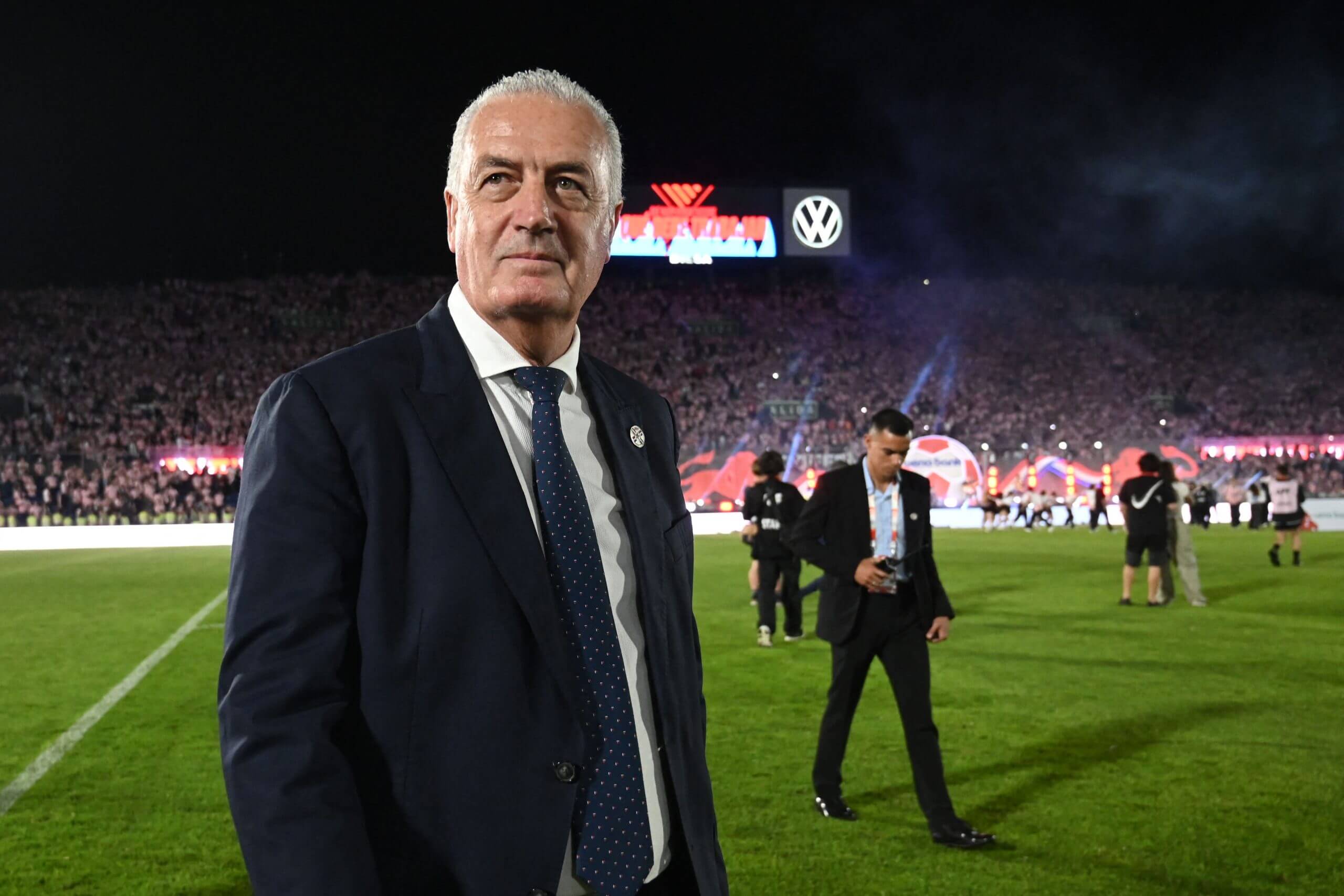
Paraguay manager Gustavo Alfaro leads the South American nation in its return to the World Cup (Daniel Duarte / AFP / Getty Images)
A long road back to the World Cup
For the first time in more than a decade, Paraguay is once again a formidable opponent with a clear focus. After previous coaches played home matches away from the timeless and intimidating Defensores del Chaco national stadium in Asunción, Alfaro restored that hallowed ground as Paraguay’s footballing fortress. Alfaro’s side has re-engaged with the traditional Paraguayan football slogan “Vencer o morir” (win or die) to inspire their countrymen and women.
After 16 years away from the World Cup, there’s a will and a way to rekindle the spirit that sparked the nation’s run to the 2010 quarterfinals in South Africa.
Veteran attacking star Miguel Almirón remembers the joy he felt back then, when he was 16. As he watched his heroes make history, dreams of recreating their milestones danced inside his head.
After watching the team’s gut-wrenching, drama-filled penalty shootout victory over Japan in the round of 16, Almirón joined the celebrations on the streets, a flag draped around his shoulders. When striker Óscar Cardozo calmly scored the winning penalty in Pretoria, the emotions of the victory brought then-national team coach Gerardo “Tata” Martino to tears.
“One of the best World Cups I personally lived through, because we went the furthest — and with Tata Martino, too,” Almirón told The Athletic. “It was something really beautiful, and it was also the last World Cup Paraguay qualified for. So it’s a very fond memory I have, and that the Paraguayan people have too.”
Almirón won an MLS Cup in 2018 with Atlanta United under Martino’s guidance. The two have since reunited in Atlanta for a second go in MLS. But years earlier, Martino became, and still is considered, a coaching legend in Paraguay.
He had won several first-division titles with Paraguayan clubs Cerro Porteño and Libertad before being appointed national team head coach in 2007. His four-year cycle ended in 2011 after leading Paraguay to the Copa América final that year. Paraguay failed to qualify for the 1994 World Cup in the U.S., but then made the tournament field in 1998, 2002, 2006 and 2010.
During those consecutive World Cup berths, Paraguay held firm to its rugged football philosophy that leaned on tough tackling, winning second balls and relentless courage. In South Africa, those traits, along with set pieces and well-worked transition moments, carried Paraguay to a dramatic, tightly contested quarterfinal against eventual champion Spain.
“That World Cup was an extraordinary experience in every way,” Martino told The Athletic. “We had a tight-knit group. A good group can win and the truth is that afterwards it continued with the Copa América. It was a group of great competitors — that’s why it was a career-defining experience.”
After a heroes’ welcome home, that veteran Paraguay side was humbled by Uruguay 3-0 in the 2011 Copa América final. Martino moved on, while the national team stagnated. Paraguay finished last during South America’s 2014 World Cup qualifying campaign, seventh in 2018 and eighth in 2022. The generational changing of the guard was difficult. Fans yearned for a return to 2010, when Paraguay sat among the continent’s elite sides.
“Unfortunately you can’t just replicate it,” Martino said. “When you try to relive the same process, you’re not the same anymore, the players aren’t the same, they have different names, and it doesn’t happen by magic.”
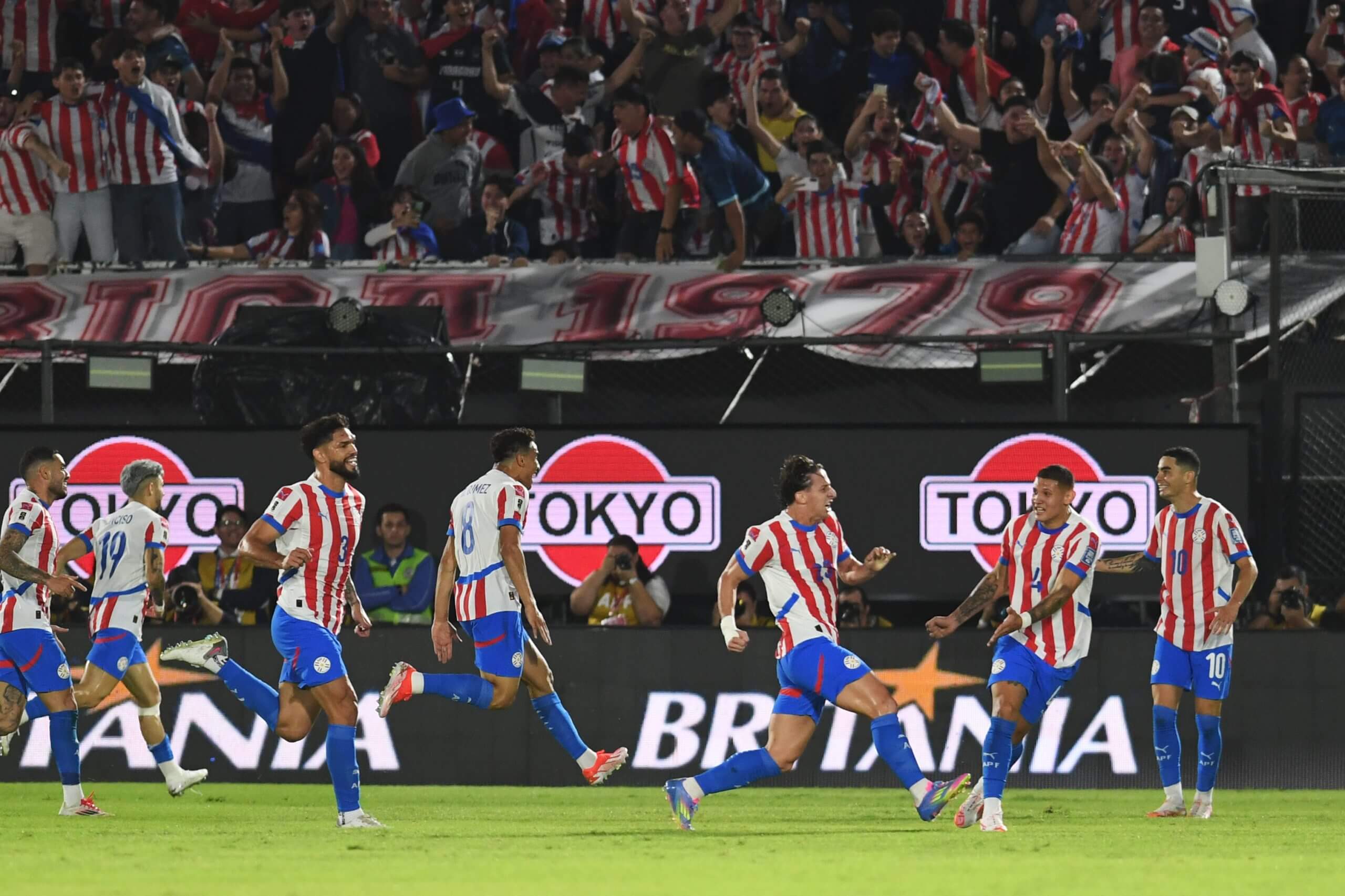
Paraguay players celebrate a World Cup qualifying goal vs Uruguay in Asunción (Christian Alvarenga / Getty Images)
With qualification to the 2022 World Cup hanging by a thread, Paraguay hired former Boca Juniors star Guillermo Barros Schelotto. At the time of his hire, four points separated Paraguay and Uruguay for the final playoff spot with four matches to go. Paraguay did not make any progress, and Schelotto was fired after two matches of the 2026 qualifying cycle.
Another Argentine, Daniel Garnero, took over and promptly led Paraguay to an embarrassing 0-3 record at the 2024 Copa América. In August of that year, the Paraguay Football Federation moved on and hired Alfaro away from Costa Rica, hoping he would inspire Paraguay the way he had with Ecuador prior to the 2022 World Cup.
Ecuador was defensively sound and fearless under Alfaro. That DNA had become a long-lost characteristic of Paraguay. But Alfaro saw potential in this current squad. What was needed was belief and confidence. Alfaro is among international football’s best orators. When he speaks, people listen. And Paraguay’s players were immediately on the same page as their new coach.
Paraguay went unbeaten in Alfaro’s first nine World Cup qualifiers, including a 1-0 win over Brazil on September 10 and a 2-1 win over Argentina on November 14. He has reestablished Paraguay as a capable underdog whose history and passion for football can even the playing field against most opponents. There’s been an evolution in the Paraguayan player, too.
So while a central defensive pairing of Palmeiras captain Gustavo Gómez, 32, and Sunderland’s left-footed center back Omar Alderete, 29, provides the typical veteran leadership of a Paraguay side, there’s more to the group than just steel and work rate.
“We are clearly a different team because of the players that we have,” Almirón said. “We want to maintain Paraguay’s essence by always working hard on the field. But that has also changed a little because we have many young players with a lot of technical quality who can really play.”
Strasbourg attacker Julio Enciso, 22, is chief among them as Paraguay’s dangerman, but his availability for the World Cup is in doubt. On a night of pomp and celebration and remarkable scenes in the Paraguayan capital, he injured his hamstring and was carted off the field 25 minutes into Paraguay’s 4-0 win over Nicaragua on June 5. His absence would be a major blow, and yet, when asked which Paraguayan player fans will remember after the World Cup, Almirón did not hesitate to answer.
“Diego Gómez,” Almirón said of the Brighton midfielder. “I always say it — he’s one of the players with the highest ceiling on the national team. He’s very, very professional. He listens, watches, learns — and that helps him a lot. He’s always been the future of the national team.”
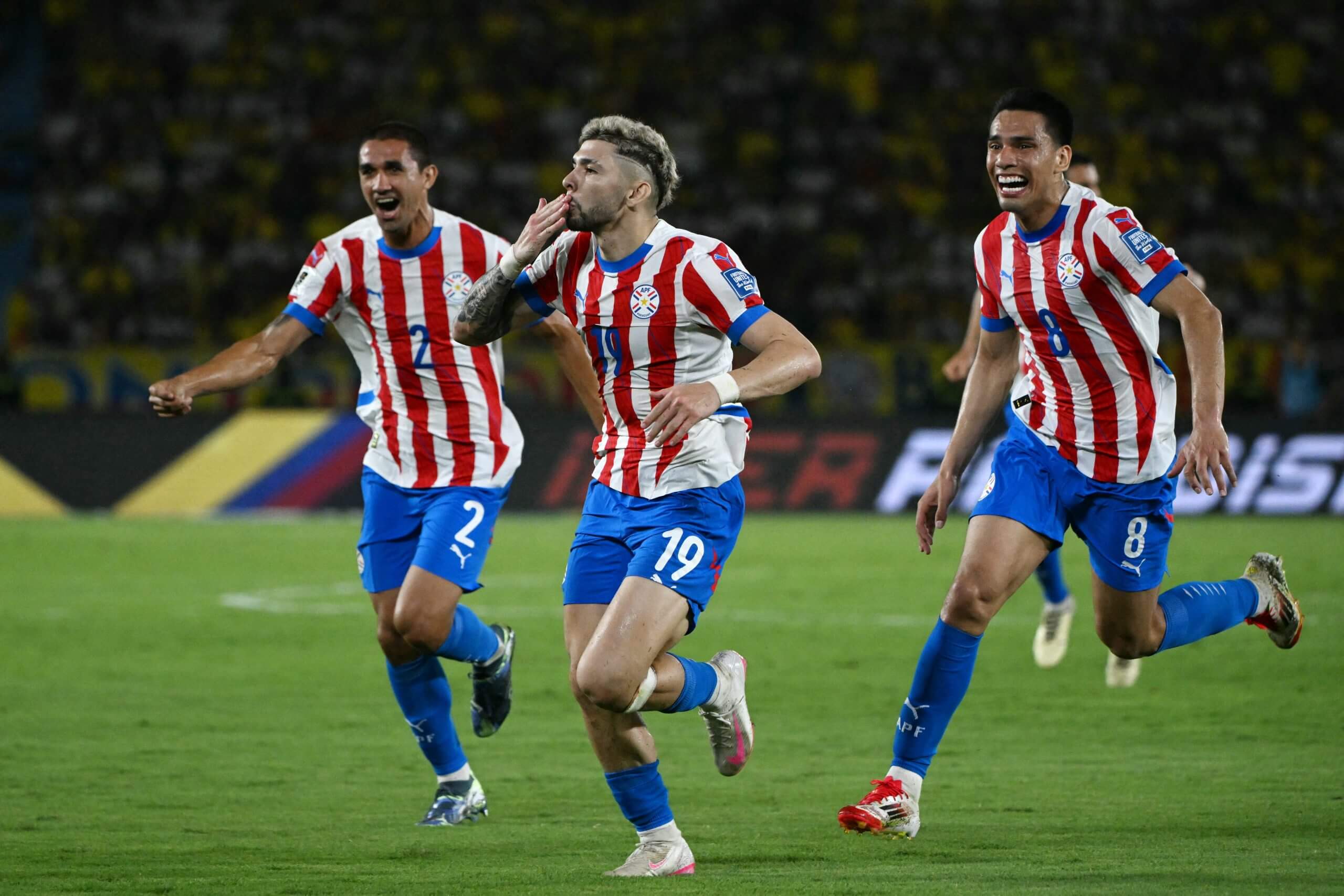
Paraguay is sweating on the health of Julio Enciso (19) just days out from its World Cup opener against the U.S. (Luis Acosta / AFP / Getty Images)
What Paraguay learned from its last match vs. USMNT
The U.S. was viewed by Alfaro and his staff as a likely opponent at the World Cup. That did not dissuade them from signing on for that November friendly. Alfaro studied Pochettino’s side and made note of how compact the U.S. sits in midfield.
“The U.S. were very physical right away,” Almirón said. “But it was also useful to get to know the opponent. Alfaro told us that they could be in our group, so now we already know how they play. The U.S. is a great opponent. Everyone knows they have great players. We have already played a friendly against them, so we also know the quality they have and caliber of coach they have in Pochettino. He’s a great manager.”
Pochettino’s tactics when facing a team like Paraguay that plays against the ball can hinge on reducing the opponent’s space as much as possible. By contrast, Alfaro understood that a player like Blas Riveros, 27, a Cerro Porteño defender who started against the U.S. and was tasked with containing Sergiño Dest, is used to having more time on the ball and more space to work with based on the rhythm and tempo of Paraguay’s first division.
Riveros struggled in the first 20 minutes that night. He was pinned back by the U.S. press and was a step behind Dest, who was running freely at the Paraguay back line. On top of that, a U.S. midfield double pivot of Tanner Tessmann and Cristian Roldan was able to receive the ball in between the lines and progress with ease.
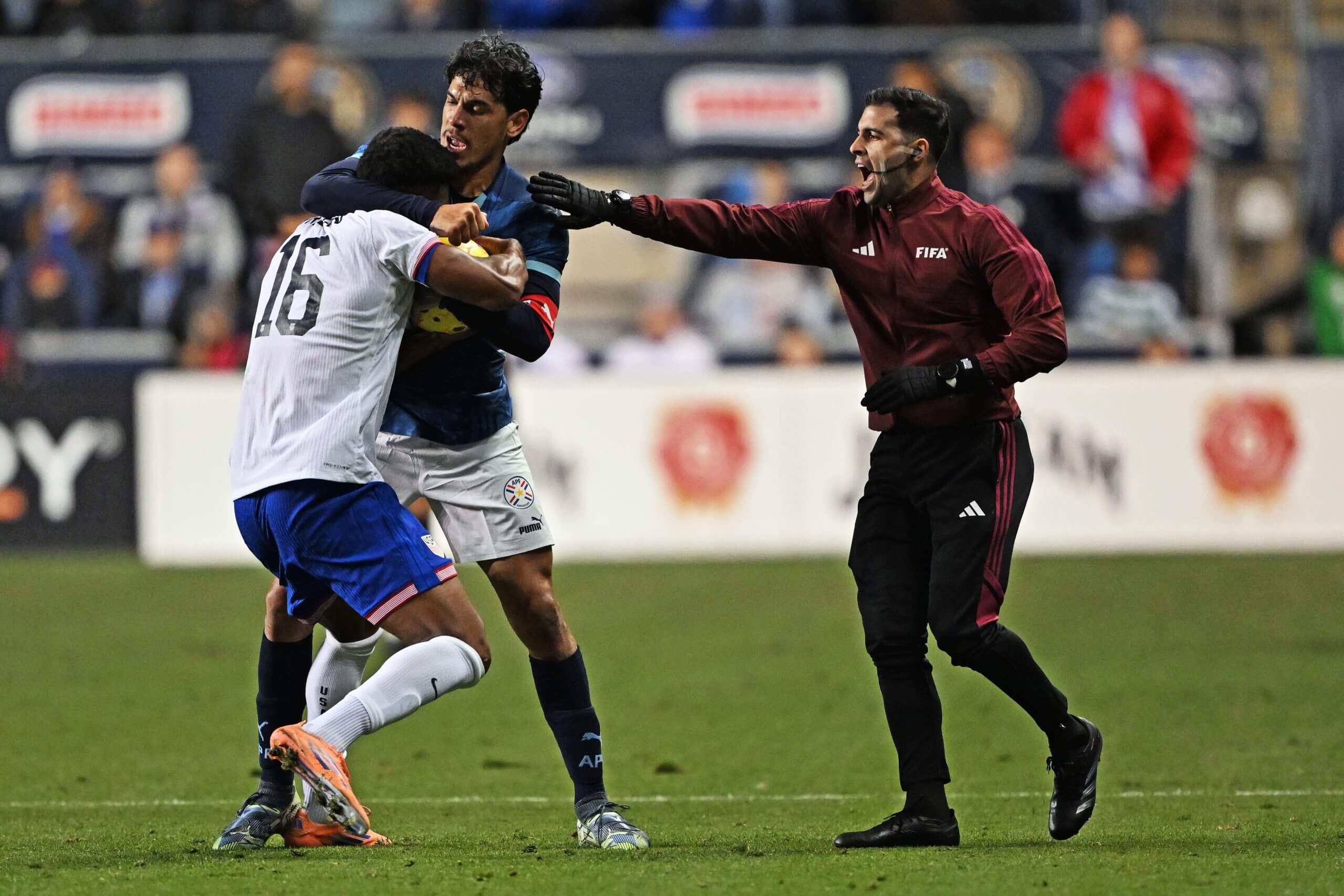
USMNT’s Alex Freeman winds up in a headlock from Paraguay captain Gustavo Gómez at the end of the teams’ November 2025 friendly (Drew Hallowell / Getty Images)
The chess board will look much different Friday, but in the friendly, Alfaro made some mid-game adjustments that could become prescient when the two sides meet again.
Alfaro sent Gómez to track Tessmann, while attackers Enciso, Almirón and Álex Arce formed a line in between the Lyon midfielder and the U.S. back line. Arce, meanwhile, would follow Roldan well into the Paraguayan half. That limited the line-breaking service into Tessmann and Roldan, forcing U.S. defenders Miles Robinson and Ream to have more responsibility on the ball, which forced their build up to go down the flanks.
“Once we corrected our marking assignments and began to hinder the play of their two central midfielders, the U.S.’s possession was concentrated near their stoppers and they couldn’t find their outlets,” Alfaro told reporters after the game.
In possession, Paraguay attacked the U.S.’s wide channels, particularly Dest’s right flank. With Dest pushed upfield, Almirón was in a 1-v-1 battle with U.S. defender Joe Scally. It was a favorable matchup for the 32-year-old Paraguayan, who assisted on Arce’s 10th-minute goal. Dest, meanwhile, was a problem for Paraguay in the first half, but his attacking skill was extinguished as the game went on.
“We overloaded Sergiño Dest (on the right side),” Alfaro said. “After that the U.S. wasn’t as dangerous as they were to start. From there we began to control the ball. I realized that after we broke their first line of pressure we could hurt them. The goal we scored was a beautiful goal.”
Alfaro’s main takeaway, however, kept coming back to intensity and game management. He lauded Paraguay’s ability to rise to the occasion against Argentina, Uruguay and Brazil in high-stakes World Cup qualifiers. But the style of play at a World Cup, he said, is vastly different. He would know, as manager of the Ecuador side that beat host Qatar to open the 2022 World Cup. Paraguay can’t afford to be lulled into a false sense of security.
“We want to go to the World Cup to compete and to play on equal footing against every opponent,” Alfaro said on that November night that’s remembered for the late-game fight but also yielded some instructive points of information. “Because my aspiration isn’t just to have a good World Cup. My aspiration is for this to be sustainable over time.”