
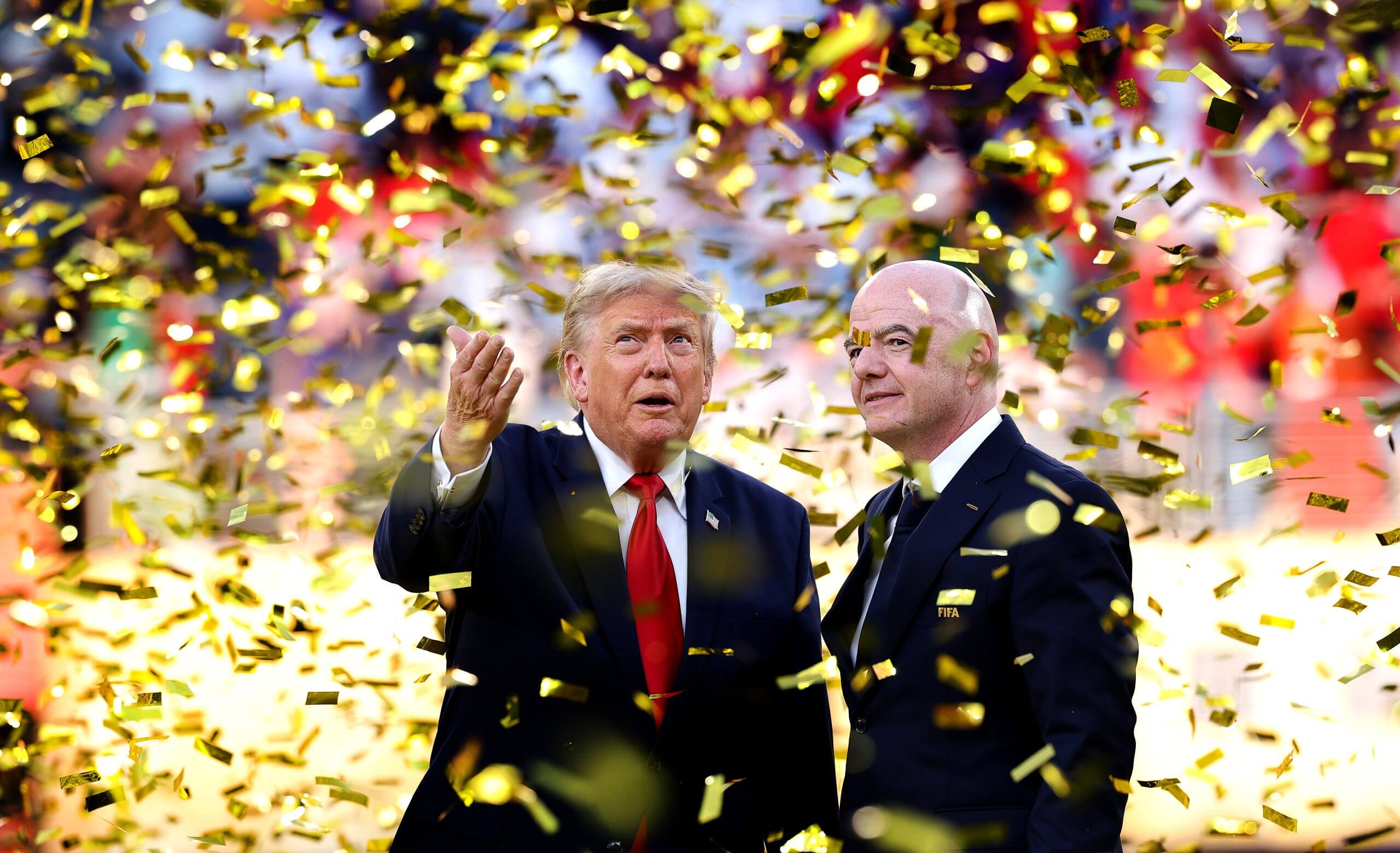
As everyone knows, the best way to let everyone know that you’re absolutely fine and that the haters and the losers definitely haven’t got under your skin is to post an 887-word statement, stretched over 15 slides on Instagram, saying you’re absolutely fine and the haters and the losers definitely haven’t got under your skin.
So from that you can conclude that Gianni Infantino is perfectly content. Tip-top actually. Never been better. Why do you ask?
Four years ago, Infantino delivered his landmark “Today, I feel…” speech before the World Cup in Qatar. This time, his pre-tournament press conference produced his deeply irksome “chill… relax” plea, but it lacked the punch of its predecessor. Now we know why: he was saving the biggest salvo for after the World Cup.
In something that reads like a passive-aggressive Facebook status from circa 2011 to which someone would reply “u ok babe?”, Infantino has hit back at those who had bad things to say about how the last couple of months went.
But what did he say and does it stack up? Here’s a fact-check and sense-check of Infantino’s closing remarks about the 2026 World Cup, hosted in the United States, Canada and Mexico.
Infantino: My message for all those who…
To everyone who missed our beautiful game, the emotions, the celebrations, the laughter, the crying, the deception, and the joy. To all of you who missed watching kids, babies, grandparents, and parents come together for the beautiful game, I say sorry that the matches are now over and sorry that you missed all that joy and togetherness. Sorry that you were so consumed by hate and criticism that you missed it all.
Well, not all kids, babies, grandparents and parents. Cape Verde goalkeeper Vozinha became a poster boy for those who couldn’t travel to the U.S. when his mother missed his breakout performance against Spain, but that situation was minor in comparison to the many thousands who really couldn’t get there.
Four competing countries — Iran, Haiti, Senegal and Ivory Coast — had to contend with travel bans. The BBC reported in June that the visa rejection rate for 11 of the 48 countries that would play at the tournament was north of 40 per cent in the year up to the end of September 2025. For Jordanian citizens, that rate was at 57 per cent. Fans from Algeria, Cape Verde, Tunisia as well as Senegal and Ivory Coast initially had to provide bonds of up to $15,000 to qualify for a visa: that requirement was dropped in May, by which time it was too late for many.
Infantino: To those behind their pens and papers, behind their screens spreading hate and false rumours, I want to say that while you are sitting behind, we at FIFA are on the front lines organising, working hard, and delivering the best show in the world.
While you hide, we are exploring the streets of Canada, Mexico, and the United States, talking with fans, engaging with people, and ensuring everyone’s safety.
While you divide, we unite.
We experienced no violence, no incidents, 100% safety and security, only joy and happiness!
Four people died in incidents following Mexico’s 2-0 win over Ecuador. Even if that tragedy was not directly the fault of FIFA — and there is nothing to suggest it was — to ignore it in order to score some cheap points against some intangible enemy displays a degree of tone-deafness that would be astonishing if it wasn’t exactly the sort of thing we have come to expect from Infantino.
Advertisement
Infantino: Seven million people from over 200 countries enjoyed the tournament across 16 fantastic cities and stadiums: zero incidents, zero hostility, zero violence, just joy, emotions, happiness, unity, and togetherness.
All were safe, secure, and happy.
The tournament did pass off relatively peacefully, though nine buses transporting fans away from Brazil’s group game against Morocco in New Jersey had to be abandoned after they were attacked during New York Knicks celebrations in Manhattan: five of the buses were destroyed, one was set on fire. Algeria and Argentina fans clashed in Times Square before their game in Kansas City. A fight erupted at a FIFA fan zone in Washington DC during the USMNT’s defeat to Belgium.
And that is without getting into the multiple players accused of sexual assault that appeared at the tournament or the anecdotal reports of racism and homophobia from some fans at and around games.
Infantino: Billions worldwide watched the FIFA World Cup from home, sharing moments of love for the game with friends and family, moments filled with joy, emotions, happiness, unity, and togetherness.
Virtually all global celebrities from music, movies, entertainment and sports attended, enjoying the event, spending time with fans and us. They were joyful and happy.
This isn’t so much of a fact-check, more of an interjection to emphasise that the obsession with celebrity wasn’t just an American TV thing, as many of us from outside the U.S. probably quite lazily assumed. When the president of FIFA is essentially saying ‘the World Cup was great because Brad Pitt looked like he was having a good time’, it’s an indication that it isn’t merely some TV directors at Fox Sports that are overly impressed by famous people.

Infantino: All of this was made possible thanks to the governments of the three host countries and their tremendous contributions, thanks to FIFA and its fantastic team working for you, thanks to the host countries and all their people, the police forces and their incredible commitment, and the volunteers — oh, the volunteers, those amazing people who came from all around the world to be part of the greatest event on earth.
A minor point in the scheme of things but, if the volunteers were so impressive and such a crucial part of the whole thing, maybe they shouldn’t be volunteers and you should pay them for their time and effort?
Infantino: Every city was packed with fans from all around the globe. While they celebrated, you were busy planting seeds of hate.
Our world needs love, not hate; tolerance, not division; celebration, not mourning.
It’s worth pointing out here that Markwayne Mullin, the U.S. secretary of homeland security, claimed he did a “happy dance” when Iran were knocked out. Speaking of which…
Infantino: While you spread hatred, we worked tirelessly to unite two countries at war. Iran entered the United States without incident or conflict. When the Iranian team began playing, all the chants against them turned into a single song. The fans became the country, they became the team, and they stood behind Team Melli. This is the power of football. The Iranian team received visas to enter because football is about peace. It’s not about politics. Football is about unity, not division. Football is bigger than hate and discrimination.
The very idea that the way the Iran team were treated at this World Cup is something worthy of bragging about is so offensively and obviously absurd that it almost doesn’t need a rebuttal. But let’s address a couple of things individually anyway.
Advertisement
“The Iranian team received visas” is one of the great pieces of selective language, given the Iran team lodged a complaint about how much their travel was being restricted, not least because they were forced to relocate their training base to Mexico. Several backroom staff were not granted U.S. visas, meaning they were immediately put at a competitive disadvantage. They had to jump through a series of unnecessary administrative hoops to get a multiple-entry visa for forward Mehdi Torabi.
“It’s a disaster World Cup; a disaster,” Iran captain Mehdi Taremi said after their group games had finished. “I mean, FIFA, they have to solve every problem here but unfortunately they could not solve it since the beginning.
“We don’t have our logistic people here — they don’t have a visa. How is it possible we always have to travel from Tijuana? We always complain about these things but no one helps. No one.”

Infantino: Countries facing serious health issues or other challenges were granted visas. Their teams competing and fans cheering filled millions of people back home with hope and, if only for a moment worth eternity, with joy and pride.
Trumpeting the visas that were issued does ring a little hollow when one of its own employees was issued one but was still denied entry to the States. Somali referee Omar Artan arrived in Miami but was turned away, with a White House official alleging the referee had an “association with suspected members of terror organisations”.
Infantino: You mentioned the few people denied visas and overlooked the millions who were approved, from all parts of the world. Because football unites the world, and it was demonstrated impressively this summer.
“It’s obvious when it comes to FIFA competitions, any team, including the supporters and officials of that team, who qualify for a World Cup need to have access to the country, otherwise there is no World Cup” — Gianni Infantino, 2017.
Infantino: Or when football brought Haiti to the world, a country that many cannot or choose not to visit, it might be time to set aside your pens and keyboards and show some respect to the teams that played with their hearts, that competed hard, the countries that contributed, the fans who travelled, and the children from everywhere who want to dream big. Maybe it’s time to show some love.
The immediate question here is: who’s disrespecting Haiti’s players? In the millions upon millions of words written and said about this World Cup, who has shown disrespect to players from Haiti, or any other smaller nation? How can criticism of FIFA be interpreted as not showing “love” to them? Has Infantino come to the megalomaniacal conclusion that he is football, and thus any attack on him is ergo an attack on… all footballers?
Infantino: Your dissatisfaction with a few decisions made by the competent authorities is understandable, but please refer to public records: such decisions are common in some of the most important leagues.
Indeed, “arguable” referees’ decisions or “strange” disciplinary rulings, such as potentially mistaken red or yellow cards or subsequent decisions not to ban players in certain situations, are routine and widely accepted in some of the biggest leagues worldwide.
OK, here we go. A lesser man might have been so humiliated by the Folarin Balogun affair, that such a naked distortion of the World Cup’s rules and customs that just so happened to suit the host country, that he would have just not mentioned it. But Infantino is not that man.
Advertisement
It is indeed routine for suspensions to be changed after the fact in domestic leagues, when a team submits an appeal to the governing body and that appeal is given due process, considered, and the rationale behind the final decision is clearly explained.
There was no such process available at the World Cup. There was no official mechanism to appeal a red card or a suspension. Instead, everything was decided by FIFA’s independent disciplinary committee. In Balogun’s case, his suspension was effectively revoked by that committee after President Donald Trump called Infantino to ask that the suspension be reconsidered. No explanation for the reasons behind that decision has been given.
The last time a player whose team was still in the World Cup was given a red card and did not serve their suspension at that tournament was in 1962.

Infantino: It’s curious that the same countries employing these practices are the ones criticising.
Who’s he talking about here? Genuinely, who? Is it a good look for the FIFA president to act like a huffy office bore, emailing the entire company to complain that SOME PEOPLE keep using THEIR OWN PERSONAL coffee mug AGAIN? Probably not. Does he care? No.
Infantino: This FIFA World Cup celebrated humanity at its best.
We saw teams from small nations compete proudly in the most prestigious matches. They were confident, professional, and brought pride to their countries.
Most importantly, they gave hope; hope that anyone can be part of the world, be big in the game, regardless of where they come from. We are all equal: fans, players, and just human beings.
The suggestion that we “are all equal” feels like a reasonable place to bring up the price of tickets: you’ll have read plenty about that before, during and after the tournament, so we’ll just repeat that this was the most expensive World Cup for anyone to attend in the history of the game. We are all equal, as long as you can afford to be.
Infantino: At FIFA, we couldn’t be more proud or emotional witnessing these moments of love, joy, and unity.
To those spending their time and energy hating us, please take a moment to reflect, meditate, pray, or watch a football match and truly observe the faces, the eyes, the emotions.
The elephant in the room here, the obvious observation that anyone reading Infantino’s statement will make, is that it’s so Trumpian that it reads like it was drafted by the White House Press Secretary. It’s a combination of a Truth Social post and the most extreme example of the ‘I’m not mad, please don’t put in the newspaper that I got mad’ meme.
Infantino: Because only our beautiful game can deliver such an extraordinary show, a show where everyone becomes one and reconnects as humans.
To the pens and papers, to all the screens, may you find love and peace where the people behind you couldn’t.
May you find peace; we at FIFA have found ours and we deliver it, by delivering the most outstanding FIFA World Cup. May football rise above all hate.
Finally, I am incredibly proud, as FIFA President, to have contributed, even a little, to this show. It’s a great feeling!
Much love to all.
And to you, Gianni.
Perhaps we are the fools here. In fact, if we expected that a small amount of distance from the tournament, and a less immediate need to suck up to Trump, would inspire some degree of self-awareness and self-reflection, then we definitely are.