
The Athletic has live coverage of Colombia vs Ghana in the knockout round of the 2026 FIFA World Cup.
Gary Lineker, the great England striker turned broadcaster, once said, “Football is a simple game — 22 men chase a ball for 90 minutes and, in the end, the Germans always win.”
At this World Cup, the punchline might need updating: Football is a simple game — 22 men chase a ball for 90 minutes and, more often than not, they are coached by an Argentine.
This is not a new phenomenon.
From chain-smoking César Luis Menotti, who worked in Italy, Spain and Mexico and is widely regarded as one of his homeland’s greatest thinkers on the sport, to Gerardo ‘Tata’ Martino, who successfully coached Paraguay’s national team from 2007 to 2011, Argentina has become one of the world’s leading exporters of coaches.
At the 2018 World Cup in Russia, five Argentine coaches were on the touchline: Jorge Sampaoli with his own nation, José Pékerman with Colombia, Ricardo Gareca with Peru, Héctor Cúper with Egypt and Juan Antonio Pizzi with Saudi Arabia. Four years later, at the next World Cup in Qatar, there were three: Lionel Scaloni led Argentina to the title, while Gustavo Alfaro coached Ecuador and Martino was in charge of Mexico.
Get free access to the most comprehensive World Cup coverage in The Athletic app
The 2026 edition marks another milestone for Argentine coaching. Never before has a single nation supplied as many head coaches to one World Cup.
Six Argentines have led teams: Scaloni (Argentina), Mauricio Pochettino (United States), Gustavo Alfaro (Paraguay), Néstor Lorenzo (Colombia), Marcelo Bielsa (Uruguay) and Sebastián Beccacece (Ecuador). Not only was it the highest representation by coaches from a single country in World Cup history, five of the six made it out of the group phase to the round of 32.
“Argentina’s reputation for producing elite coaches begins with a coaching education system that has existed for more than 60 years,” Gustavo Grossi, the Argentine Football Association’s international sporting director, told The Athletic. “Long before many other countries, the Argentine Football Association required aspiring coaches to complete a rigorous three-year training program covering the technical, tactical, physical and psychological aspects of the game.
“That emphasis on formal education created a coaching culture built on knowledge rather than experience alone. Playing the game was never considered enough to teach or manage it. Instead, coaching became a profession grounded in structured learning.”
One of the greatest success stories of Argentine coaching has been Scaloni.
When he took over Argentina in 2018, he was viewed as an untested appointment. Eight years later, the former interim manager has proved to the world that inexperience is not always a determining factor for success. The 48-year-old steered his nation to lift the 2022 World Cup trophy, despite never having been a head coach at the senior level. Now considered one of the sport’s premier man-managers, Scaloni is chasing a fifth title with Argentina this summer, after the 2021 Copa América, the 2022 Finalissima (a one-off match between the reigning European and South American champions), that 2022 World Cup and another Copa América in 2024.
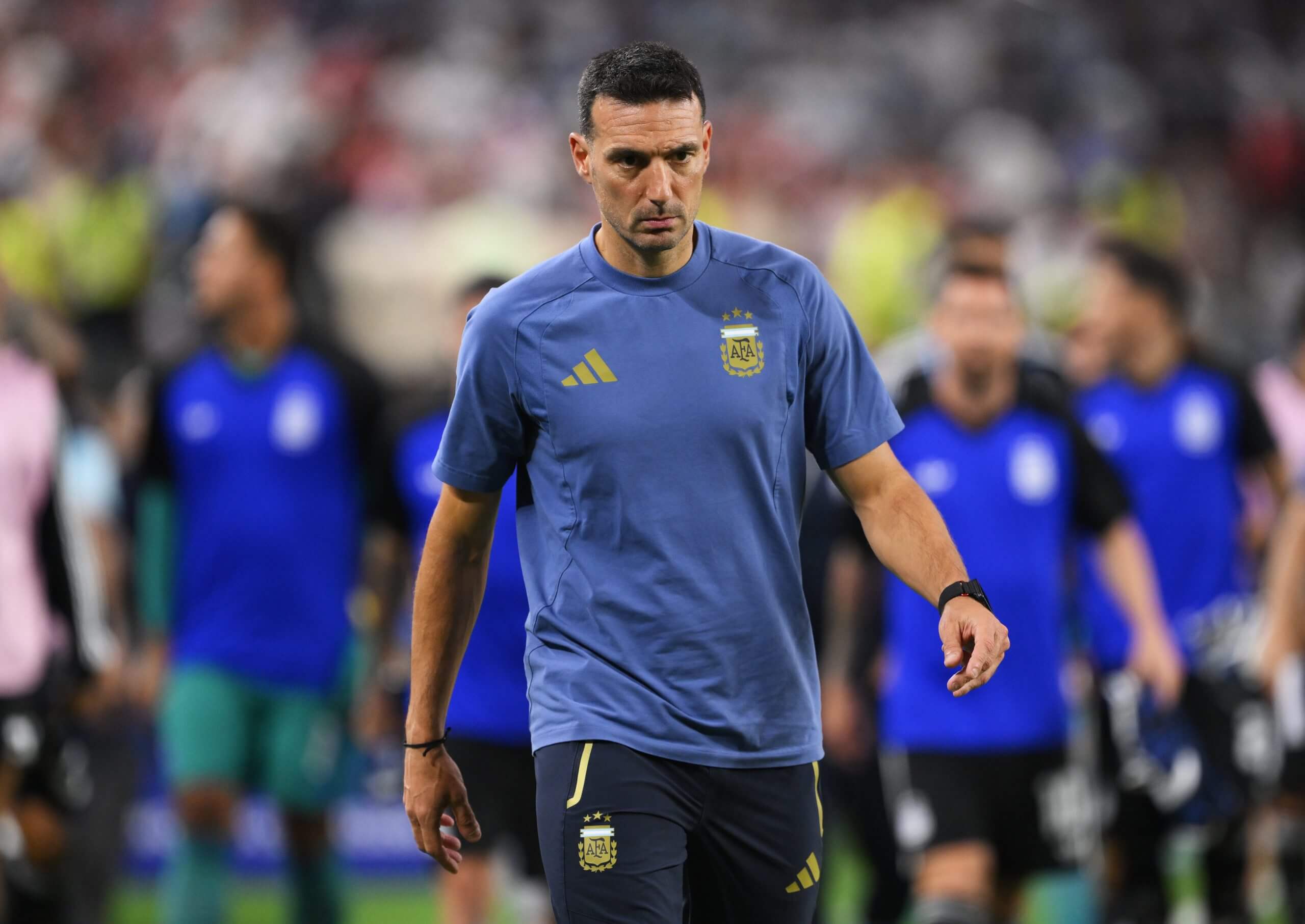
Lionel Scaloni was a novice coach when he got the Argentina job but has developed a reputation as an excellent man-manager (David Ramos/Getty Images)
Beccacece and Bielsa exited the tournament last week, trimming Argentina’s coaching contingent. Yet four Argentine managers remain in the field, meaning that, even if Lionel Messi and company do not retain the World Cup under Scaloni, there’s still a very good chance that an Argentine manager gets his hands on the trophy at the final on July 19.
Pochettino represents the global face of Argentine coaching.
A native of the north-eastern province of Santa Fe shaped by Bielsa’s coaching at leading local club Newell’s Old Boys, he built his managerial reputation in Europe with Espanyol, Southampton, Tottenham Hotspur, Paris Saint-Germain and Chelsea before taking over the United States men’s national team in 2024. Despite a turbulent start, in which on-pitch results were mixed, the stylish and some would say arrogant Argentine has won the hearts of millions of Americans by delivering results when it really mattered — at a World Cup the U.S. is co-hosting with Canada and Mexico.
But Pochettino’s success with the USMNT has never been solely about tactics. Players and staff have long described him as a manager who obsesses over culture, psychology, and the emotional environment around a team as much as he does over formations and pressing triggers.
Even his quirks reflect that philosophy. He has a thing with lemons. Pochettino is famously superstitious — just look at the same all-navy outfit he has worn throughout the group stage and now into the round of 16. But while those rituals have become part of his mythology, he has always insisted they are not about magic. They are about energy, routine and creating the right environment for success. For Pochettino, creating the right atmosphere is as important as designing the right game plan.
That holistic approach has resonated with the U.S. squad. He has emphasized connection over hierarchy, encouraged players to take ownership of the team’s identity and fostered an environment where younger members of the group feel empowered rather than intimidated. On the training ground, his intensity is legendary. Away from it, he is known for remembering small personal details, checking in with players individually and building trust before demanding complete commitment.
There is also a relentless curiosity in Pochettino, who played 20 times for Argentina as a defender, including at the 2002 World Cup. Whether it is his fascination with sports science, his belief in body language, or his famous habit of walking training pitches barefoot to “feel the energy”. To outsiders, those habits can seem eccentric. To his players, they reinforce a simple message: every detail matters.
“I see him as someone who’s very fresh. Very composed. Very empathetic toward the country and toward his team,” Ruben Capria told The Athletic. Capria is a former midfielder who played for clubs in his native Argentina, Mexico, Ecuador, Chile and Uruguay. He and Pochettino crossed paths on the field several times during their playing days back home.
“In fact, I think the U.S. has been one of the best-performing teams under him. I’ve really enjoyed this World Cup, and I think he’s done very well. He looks calm, fulfilled. You can tell he’s enjoying himself instead of suffering through the role of being a coach, and that’s no small thing.”
Grossi argues that Pochettino’s success is rooted in the coaching culture of one of Argentina’s great soccer cities.
“He was educated as a footballer within Argentina’s coaching tradition, in the city that has perhaps become the country’s greatest cradle of football development: Rosario.
“Rosario has produced generations of influential coaches. It was home to figures such as Jorge Solari in the 1970s and 1980s, followed by Marcelo Bielsa and later Tata Martino. It’s also worth noting that several of the Argentine coaches at this World Cup — including Gustavo Alfaro with Ecuador and Paraguay’s coach — also come from Santa Fe province and the areas surrounding Rosario.
“For a city of just 1.5 million people, Rosario has produced an extraordinary number of internationally-recognized coaches. That, I believe, is another reflection of the football culture that developed there.
“Pochettino’s journey also reflects that culture. He combined his Argentine education with years of study and experience in Europe, both through managing European clubs and through exposure to UEFA coaching methods. The result is a complete coach: a South American manager whose footballing education was refined by European professional and cultural influences.
“In many ways, Pochettino represents the same blend Messi (who is also from Rosario) does as a player: South American talent polished in Europe. His case is particularly unique because his life has been divided almost equally between the two continents — roughly 25 years in South America (now 54, he left Newell’s to join Espanyol in Spain at age 22) and 25 years in Europe. That balance has shaped him into a coach who draws from both traditions.”
USMNT prepares for Belgium without Balogun
While Pochettino made his reputation coaching abroad, Alfaro is almost the perfect counterpoint.
After a short career as a player, he earned his stripes over decades navigating Argentina’s cut-throat domestic league before winning the Copa Sudamericana (roughly its equivalent to UEFA’s second-tier Europa League) with Arsenal de Sarandí and later managing Boca Juniors. International football has become his second act. After guiding Ecuador to the 2022 World Cup, he has repeated the feat with Paraguay, ending a 16-year absence from the tournament for that country.
Lorenzo took a quieter route. A starter in Argentina’s run to the 1990 World Cup final, he spent years as Pékerman’s trusted assistant before emerging as one of South America’s most respected international coaches. Since taking charge of Colombia in 2022, Lorenzo has restored the team to continental prominence, leading them to the 2024 Copa América final and now into the World Cup’s knockout phase.
Then there is Beccacece, the outlier. Unlike the others, he never played professionally. Instead, he rose through coaching from his early twenties as Sampaoli’s assistant before forging his own career in Argentina, Spain and, most recently, Ecuador. Although Ecuador’s tournament ended in the round of 32, leading to his resignation, Beccacece’s work accelerated the country’s generational transition and reinforced Argentina’s remarkable influence on coaching across the Americas.
At one end of the spectrum is Bielsa, the game’s obsessive thinker and perhaps the most influential coach Argentina has ever produced. Known simply as El Loco (The Crazy One), Bielsa’s trophy cabinet tells only part of the story. His greatest legacy is the generations of coaches shaped by his ideas. From his early success with Newell’s to transformative spells with the Chilean national team, Leeds United and Uruguay, until last week, Bielsa has become less a manager than a movement. Many of today’s elite coaches, including Pochettino and Pep Guardiola, consider him their greatest influence.
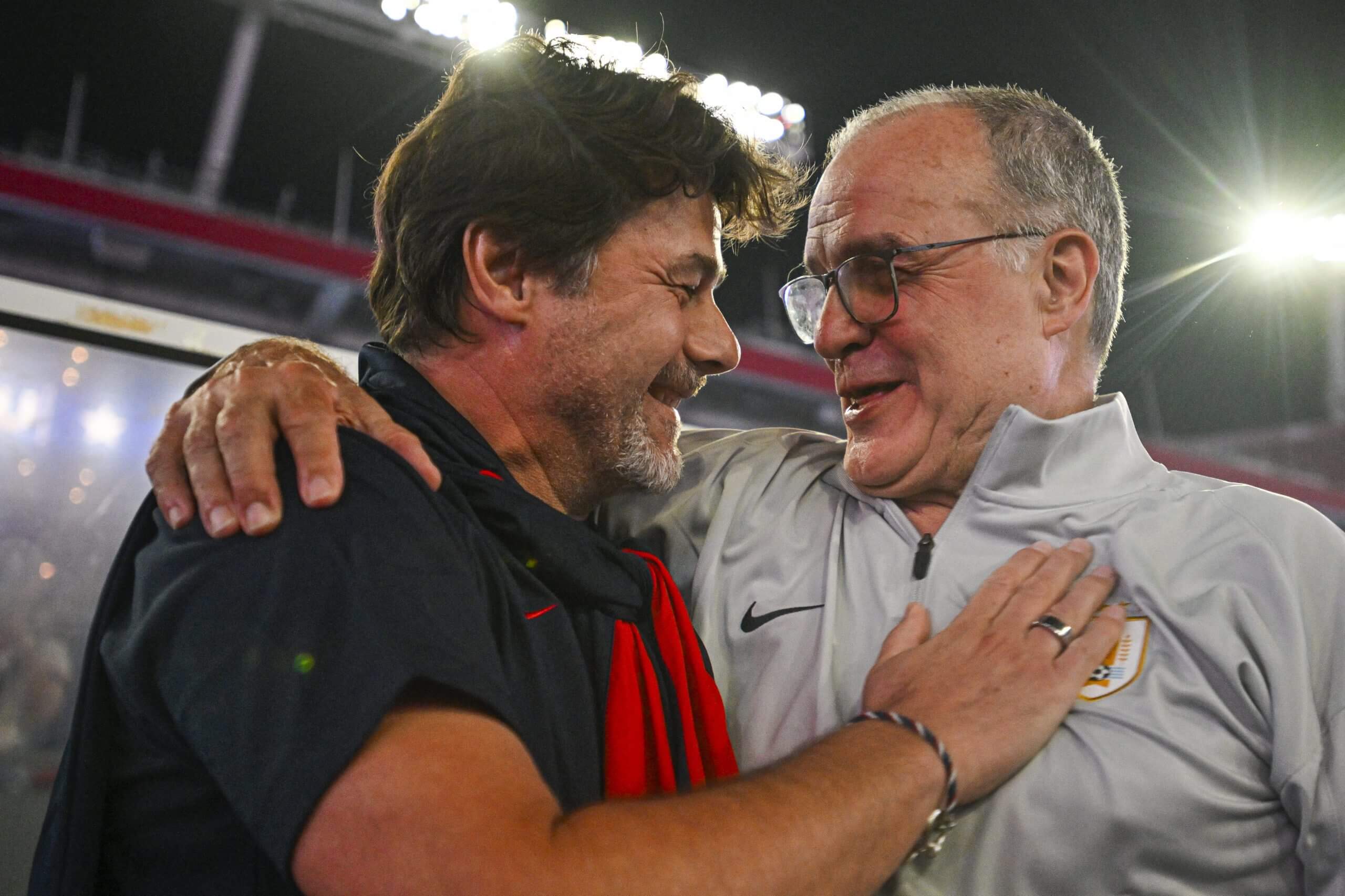
Mauricio Pochettino was greatly influenced by Marcelo Bielsa (Miguel J Rodriguez Carrillo/AFP via Getty Images)
The question is: why? Why have so many countries, particularly some of Argentina’s fiercest South American rivals, repeatedly handed the keys to their national teams to Argentine coaches?
The answer begins with three names.
“Argentina has been blessed with the ball,” said Capria. “If we’re talking about the history of football, and the kings of the sport, three are from Argentina: (Alfredo) Di Stefano, (Diego) Maradona, Messi. Of course, we have our flaws, but naturally, we’ve been blessed when it comes to football. Football is deeply embedded in our society. It’s a huge passion.”
For more than seven decades, Argentina has been one of football’s great talent factories. No country has done more to shape its mythology. Despite a population of fewer than 50 million, the place has produced some of the greatest players the game has ever seen.
But their success cannot be explained by passion alone.
The pathway to becoming an Argentine coach with international credentials is also highly structured. Through the football association’s technical personnel registry, licensed coaches can have their qualifications approved to obtain a CONMEBOL coaching license — a credential recognized throughout South America. Coaches seeking the credential must already be nationally certified, document their academic training and coaching experience, and pay licensing fees ranging from $500 to $1,500, depending on the level of certification.
The system reflects Argentina’s emphasis on formal coaching education, creating a standardized pipeline that has helped produce one of the world’s deepest pools of managerial talent.
Add to that a football pyramid of more than 520 clubs, where aspiring coaches can learn, fail, adapt and build their resumes long before reaching the highest levels.
The assumption that Argentine coaches are champion-makers surpasses nationalistic debates across South America. Considering that football has both stopped and started wars on that continent, it remains remarkable that Argentina’s fiercest rivals continue to entrust their national teams to Argentine coaches.
The World Cup and War
Adam Leventhal and Reuben Pinder
“Because in the end, the people making those decisions are impartial,” Capria said. “They set aside emotions and shirt colors. Sometimes people are too emotional, but those responsible for choosing coaches analyze things objectively. They choose the person they believe is best suited for the particular stage their national team is in.
“But coaches, no matter how good they are, suffer from the ups and downs of results. The outside pressure, the media…one loss and you’re no good anymore.”
Coupled with their perceived tactical acumen, Argentine coaches are also known and respected for their ability to adapt to the different cultural idiosyncrasies of South American football. Domestic leagues throughout the region are littered with Argentine managers. The same can be said for players of Argentine descent. They often leave their country’s first division to join some of the continent’s top clubs.
Brazilian club sides have dominated South America in recent years, but Argentina’s 2022 World Cup title has strengthened its hold as the continent’s best national team. But even in Brazil, where the language can be an initial obstacle, some Argentine coaches have had success.
Menotti, who guided Argentina to its first World Cup title in 1978 and shaped a generation of coaches through his uncompromising vision of the game, understood what was at stake better than anyone.
“The national team is a very serious place to be,” he said in 2019. “Every ball that’s kicked by a player awakens a cultural manifestation. We’re going to support that cultural growth because it’s something that clubs cannot do. Only the Argentina national team can.”
Perhaps that is why Argentine coaches keep traveling so well. They know the game is never just about the ball.
Additional reporting: Felipe Cardenas